Image Credit: Christina Lengyel / The Center Square
The Center Square [By Merrilee Gasser ] –
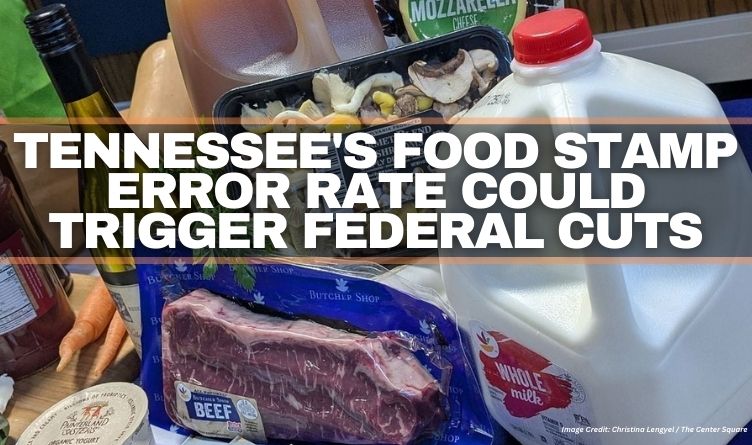
Tennessee might need to start paying millions more to cover food stamp benefits if it doesn’t reduce its rate of errors in administrating them, according to a new report.
Tennessee’s error rate in the federal Supplemental Nutritional Assistance Program was 9.5% in the 2024 fiscal year, according to The Sycamore Institute, which provided a brief on the state’s program.

The Trump administration’s new law requires states with payment error rates above 6% to cover 5% to 15% of the benefits starting in October 2027.
Under the One Big Beautiful Bill Act, Tennessee’s current payment error rate would require the state to cover 10% of SNAP benefit costs – between $81 and $243 million, the report found.
Nearly 700,000 residents receive the benefits each month, down from 1.2 million recipients in 2015, the report said. The monthly average is $415 for each household, per the report.
Payment errors occur due to various reasons, including household expenses incorrectly calculated and outdated income information. The National Governors Association has asked Congress to delay the cost-sharing until fiscal year 2030, citing the expenses that will fall to states.
Previously, the federal government covered the full cost of SNAP benefits while states covered a portion of administrative costs for the program. But those costs are also rising under the new law, requiring states to cover 75% of the administrative expenses instead of 50%.
It means that Tennessee will need an estimated $77 million in additional recurring state funds to cover the cost of running the program, estimated at $256 million for the 2028 fiscal year, the report said.
The law also puts new requirements on recipients, expanding the number of people who will need to meet work requirements in order to be eligible for benefits.
“It expanded the age range of recipients who must work at least 80 hours per month to keep their benefits, and also removed work exemptions for veterans, people experiencing homelessness and people ages 24 or more who aged out of foster care, meaning these individuals may need to meet work requirements,” Robin Yeh, the paper’s author and the Sycamore Institute’s policy director, told The Center Square.

Tennessee recently added work requirement rules to its program and restricted SNAP purchases of items such as soda and candy.
To offset federal cuts, the state’s Department of Human Resources has asked state lawmakers for $77.7 million in new recurring funds and $19.4 million in one-time funding.


3 Responses
Simply double or triple tax on junk food/drink.
How about we just eliminate them altogether? Those items are not food.
So what the feds are telling us is that the state welfare offices are NOT doing their jobs, and not following up with their cases. As a result, unqualified people are receiving benefits. This is going to cost the state, ie, the residents of Tennessee more money because the welfare system isn’t doing their job. How about we either get more case workers, or implemented some sort of electronic program that a more rigorous means testing to eliminate those that do not qualify?
There was a point that the case workers kept tight reins on those getting assistance of any kind. I received benefits decades ago as a struggling full time student who had multiple part time jobs. I had to recertify every 3 months to remain eligible. If I failed to submit the required information, my benefits were halted until the case worker got the information and I had an appointment with my case worker. Then they would either deny the benefits or reinstate them, but there was a penalty for missing the deadline. Usually that months benefits. We need to reinstate policies like this.
In addition to paring down the list of things that food stamps eligible. I personally am tired of funding not only the food stamps program that allows people can eat garbage food, that in turn creates health issues, so I can pay for their health care. They willingly use their “healthcare” because they have zero skin in the game, while I pay dearly for mine not only in coverage, but if I use it as well.
And the only big winners out of all of this is the junk food and health care industries. Oh, and in the end, the funeral homes.
Enough all ready.
We should be trying to eliminate as many able bodied people off the rolls. I have no issue with assisting the elderly, the struggling but willing to work/learn, the orphans, widows, and even those disabled. But those who can work, but won’t, should be removed from any and all assistance.