Pharmacy chain says regulation of pharmacy benefits managers would lead to store closures.
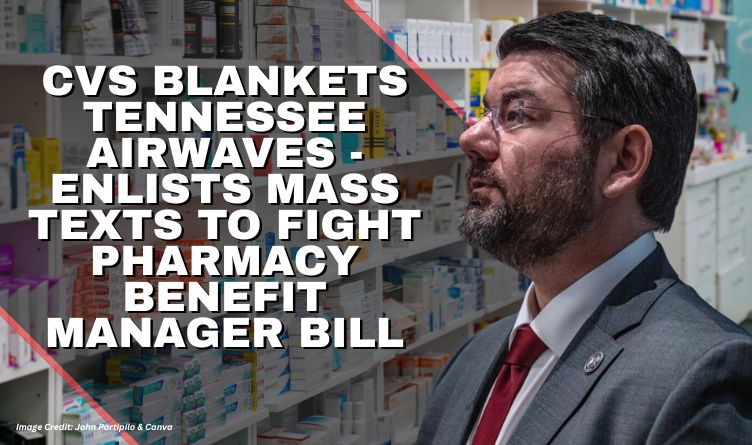
Image: Sen. Bobby Harshbarger, prime sponsor of SB2040 Image Credit: John Partipilo & Canva
***Note from The Tennessee Conservative – this article posted here for informational purposes only.
By: Adam Friedman [Tennessee Lookout -CC BY-NC-ND 4.0] –
Health care pharmacy chain CVS has spent $1.3 million on political TV advertisements across Tennessee to push back against a bill aimed at targeting its ownership of a pharmacy benefit manager, Federal Communications Commission public inspection files show.
Tennessee lawmakers want to ban a pharmacy from also owning a pharmacy benefit manager, or PBM, which negotiates drug reimbursement rates between insurance companies and pharmacies, essentially serving as a middleman.

CVS has warned that the bill, HB1959/SB2040, would threaten “pharmacy access for patients” by forcing it to close all 134 Tennessee pharmacies and eliminate 2,000 jobs. CVS has taken particular issue with the legislation because it is the only PBM (CVS Caremark) that also owns physical stores in Tennessee.
The advertising campaign includes purchases in all six of Tennessee’s major TV markets, and was combined with text alerts from the company encouraging people to contact local representatives.
“This legislation is bad for Tennessee, for the more than 1.5 million patients we serve and for the more than 2,000 colleagues who could lose their jobs,” said Amy Thibault, a spokesperson for CVS, in an email. “Already tens of thousands of Tennesseans contacted their elected officials. We expect that number to grow, and we hope legislators will listen to their concerns.”
Tennessee has around 3,000 pharmacies, according to the National Association of Boards of Pharmacy. The largest chain is Walgreens with over 250 stores in 117 town and cities in the state.
The FCC files only show advertising purchases through mid-March, while the bill remains very much alive in the state legislature. The legislation is currently at its final step in House and Senate committees before it can head to the floor for a final vote.
The legislation has become a political fight between PBMs and the independently owned pharmacies backed by the Tennessee Pharmacy Association, which has donated around $225,000 to lawmakers and their political action committees since 2020.
The bill’s Senate sponsor is Kingsport Republican Bobby Harshbarger, a pharmacist for a small independent company.
“I think that’s fearmongering, or even as far as misinformation,” Harshbarger told the Lookout in February. “This bill says you have to divest. Divestment does not equal closure. The fact that if they were to, in a worst-case scenario, decide to close, that would be a corporate business decision, not because of this bill.”
Three other sponsors of the bill are pharmacists by trade.

How we got here
Over the years, the healthcare industry has consolidated to the point where the same company often owns a health insurer, a PBM, and a pharmacy. Express Scripts is owned by Cigna, Optum by UnitedHealth and CVS owns Aetna. But Express Scripts and Optum don’t own physical stores in Tennessee, preferring to sell online.
An analysis by KFF, a health policy research organization, found that CVS, Cigna, and UnitedHealth accounted for nearly 79% of prescription drug claims. In 2024, the Federal Trade Commission under President Joe Biden sued the three companies for artificially inflating drug prices.
The bill follows an audit by the Tennessee Department of Commerce and Insurance, which found that all three companies reimbursed their own pharmacies at higher rates than non-affiliated pharmacies.
In CVS’s case, the department found that CVS reimbursed its stores up to 16,500% more for certain drugs than non-affiliated locations. Audits of Express Scripts and Optum showed similar problems.
The Tennessee legislation is similar to one passed by Arkansas in 2025, which is currently on-hold as part of an ongoing lawsuit. Arkansas was the first state to pass such a bill, and CVS also threatened to close its 23 pharmacies there, but instead sued to stop the law from going into effect.
*Sam Stockard contributed to this report


One Response
Wonder how much CVS has paid legislators?