
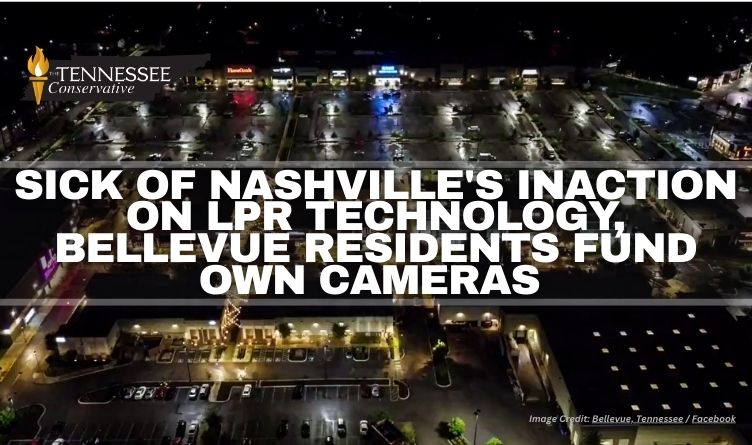
Image: One Bellevue Place From Above Image Credit: Bellevue, Tennessee / Facebook
The Tennessee Conservative [By Paula Gomes] –
The Bellevue neighborhood is funding its own cameras to crack down on crime as Metro delays putting License Plate Readers (LPRs) into operation within Nashville and Davidson County.
Charlie Tygard says his neighbors chose not to wait for Metro to get their act together, instead voting to pay for three LPR cameras at the annual cost of $6,500.
Tygard cited robberies that needed technological support in order to be solved as the impetus for the decision.
New Mt. Juliet Police Chief Tyler Chandler credits the city’s LPR program for helping his department keep residents safer and says that crime numbers have dropped continuously since the technology was implemented.

Before LPRs were installed, Chandler said that not only was property crime increasing, but also shoplifting and vehicle burglaries. Mt. Juliet’s shopping center, Providence Marketplace, is targeted especially during the holiday season.
Mt. Juliet adopted their LPR program, Guardian Shield, in 2020. Covering 42 locations at intersections of main roads, Interstate 40 and county lines, it has been successful in recovering hundreds of stolen cars.
Earlier this year, Tennessee Voices for Victims founder Verna Wyatt strongly encouraged Nashville leadership to consider installing LPRs in Davidson County.
Wyatt was quick to point to the success of LPRs in neighboring counties, specifically praising the City of Mt. Juliet’s success rate in catching known criminals from Nashville, while also acknowledging Metro’s approval of a private camera network in March.
The FUSUS proposal was shot down last year by just one vote but finally passed this year after assurances that the network would not be used to aid ICE agents. Months after the passage of the amended proposal, a contract has yet to be approved by the Metro Council.
Last October, Chandler told The Tennessee Conservative that the majority of the suspects that the Mt. Juliet Police Department (MJPD) encounters through the use of LPRs come from outside the city, overwhelmingly from Nashville.
In stating his opinion, Chandler said that Nashvillians would obviously benefit from LPRs but residents in Mt. Juliet and the broader area would also be helped by Metro adopting a similar system.

With most of Nashville’s bordering cities already operating their own programs, adding Nashville to the mix would give law enforcement access to an even broader pool of data with which to track down dangerous criminals who often travel between neighboring cities. Chandler pointed out that this would lead to quicker identification and arrests across the entire region and reduce overall crime, making Nashville, Mt. Juliet and other nearby cities safer.
Due to no current LPR program in Nashville, Mt. Juliet and other cities shoulder a heavier burden as they end up apprehending suspects from Nashville more often over local suspects. Chandler says that Nashville setting up its own LPR system would reduce the load on Mt. Juliet law enforcement as suspects could potentially be apprehended before crossing over into Wilson County.
In July, Mt. Juliet’s LPRs helped MJPD catch a longtime criminal who turned out to be an illegal alien who had been deported multiple times.
More recently, on Saturday, a stolen car coming from Nashville was involved in a head-on collision that left the two occupants in serious condition and injured eight others, including several children.
According to the Mt. Juliet Police Department (MJPD), Metro Nashville Police alerted MJPD about a stolen vehicle by sharing a be-on-the-lookout advisory with their dispatch.
The vehicle, last seen traveling near Mt. Juliet city limits, was spotted by an officer passing at a “very high rate of speed” at 1:40 in the afternoon on Central Pike. The officer gave chase but lost sight of the car, only to discover a short time later that the vehicle had crashed near Pleasant Grove Road.
On Saturday, neither MJPD dispatch or responding officers were aware that a Metro Nashville officer had unsuccessfully attempted a traffic stop on the stolen vehicle. The MNPD officer did not pursue the driver of the vehicle after it fled at high speed.
LPRs being installed in Nashville and Davidson County would lead to more effective collaboration between cities, not only in faster and more coordinated responses in real time as crimes occur, but also in sharing data for investigating serious crimes.

About the Author: Paula Gomes is a Tennessee resident and reporter for The Tennessee Conservative. You can reach Paula at paula@tennesseeconservativenews.com.

One Response
Democrats should never be responsible for ANYTHING because…..it will be either run into the ground……or it will be corrupted…………be dependent by all the stolen money…. or they won’t know anything about the issue…..or complete stupidity about anything………