Image Credit: John Partipilo/Tennessee Lookout
***Note from The Tennessee Conservative – this article posted here for informational purposes only.
By: Adam Friedman [Tennessee Lookout -CC BY-NC-ND 4.0] –
When Tennessee lawmakers legalized sports gambling in 2019, they hoped it would create a new revenue source.
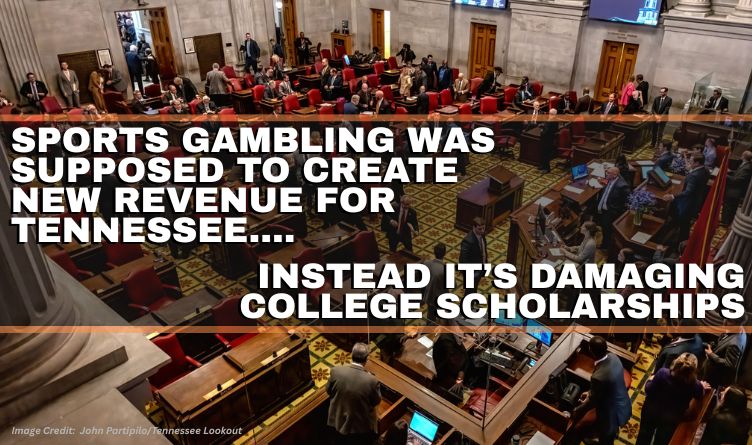
But nearly seven years later, while Tennessee’s sports gambling tax revenue exceeds $100 million, the state’s Lottery-funded scholarship program faces an $80 million budget deficit. Now, higher education officials are warning that if the funding hole isn’t addressed, the state will have to dramatically reduce costs, like the number of scholarships it offers.

“I can say pretty confidently that at least part of [the lottery revenue] reduction in the last several years has been thanks to legalized sports wagering,” Don Bruce, a professor with the University of Tennessee’s Boyd Center for Business and Economic Research, told a state Senate finance committee.
Tennessee voters, through a constitutional amendment, created a state lottery corporation in 2002 that specifically designated the revenue from the sale of scratch-offs and lottery tickets to fund college scholarships. For much of its history, lottery revenue increased, allowing higher education officials to keep expanding the program.
Then in 2019, Tennessee legalized online-only sports betting, launching it a year later. Budgeting officials were uncertain about how much money this would generate, so the state designated those gambling funds to the lottery’s college scholarship program as backup funds in case lottery revenue ever came up short.
That changed in 2025. Lawmakers decided to move the vast majority of sports gambling revenue into a special fund to pay for new K-12 school construction. The construction fund was created as part of a deal among Republican lawmakers to secure the votes needed to pass a statewide private school voucher program.
At the time, some lawmakers who opposed the voucher plan warned the shifting of these funds could threaten scholarships. This prediction proved right over the last year. The lottery scholarship fund was hit from both sides. Lottery ticket revenue fell by 20% in 2025, and the backup sports gambling funds were taken away.
If the sports wagering money had been left in the college scholarship fund, it likely would have been enough to cover the looming budget hole. In 2025, the lottery funds created almost 160,000 college scholarships, a record that, under the current budget situation, officials warned is not sustainable.
“They’re looking at potentially drastic cuts,” said Mandy Spears, the executive director of the state budget think tank Sycamore Institute. “It’s not clear at the moment how they’ll fill the budget gap.”

Other threats to the Tennessee sports wagering market
Bruce said another trend that could potentially damage gambling revenues are prediction markets like Kalshi, Polymarket and Crypto.com. These federally regulated online platforms allow users to buy and sell contracts tied to the outcomes of real-world events, essentially placing bets on whether certain events will occur. Unlike Tennessee’s sportsbooks, which operate under state gambling licenses, they operate under a federal Commodity Futures Trading Commission license but can offer similar types of sports bets. This means they also don’t pay any state taxes.
The Tennessee Sports Wagering Council sent cease-and-desist letters to the three companies in January, seeking to stop them from offering sports betting prediction markets in the state without a license. A federal judge granted Kalshi a preliminary injunction that same month after it sued over the letter, blocking Tennessee regulators from enforcing state gambling laws on the companies while the case continues.
The Tennessee court case is part of a broader nationwide fight between states and prediction markets. In Nevada, Kalshi initially sued state regulators and lost. Kalshi appealed, but in February 2026, a federal appeals court rejected the company’s motion, allowing Nevada to enforce its state laws against prediction markets.


One Response
Gambling=TROUBLE!