Image Credit: Canva
***Note from The Tennessee Conservative – this article posted here for informational purposes only.
This story was originally published by Chalkbeat. Sign up for their newsletters at ckbe.at/newsletters.
By Melissa Brown [Chalkbeat Tennessee] –
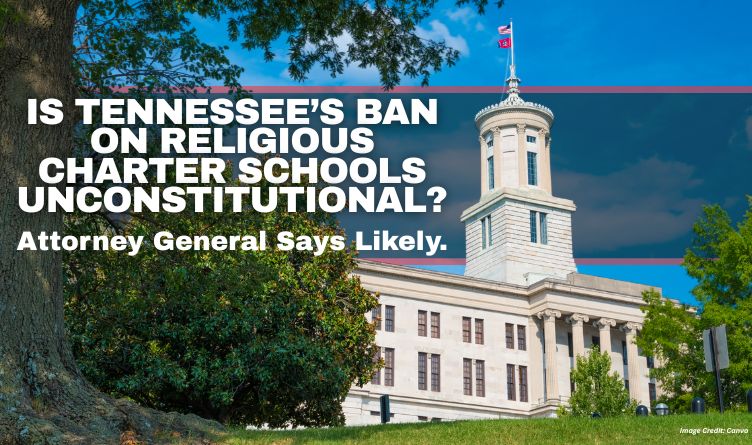
A legal fight is brewing over religious charter schools in Tennessee after the attorney general said the state’s law blocking them is “likely” unconstitutional and a Christian nonprofit in Knox County sued the local board of education over its charter school requirements.
The state law banning religious charters has not yet been legally challenged, nor has any lawmaker proposed legislation to amend the current law.
But the Knox County lawsuit, which uses Tennessee’s new voucher program as part of its argument, could bring a fresh challenge to the religious charter issue that deadlocked the U.S. Supreme Court earlier this year.
Charter schools, or publicly funded but independently managed schools, have received broad bipartisan support across the country for decades as an alternative to private schools. Nonreligious charter schools were legalized in Tennessee in 2002.
Religious charter school backers have argued that state bans are unconstitutional and amount to religious discrimination, citing U.S. Supreme Court precedents that found states could not block private schools from receiving public funds because of their religious affiliation.

Whether charter schools should be viewed as private or public entities, and therefore subject to the same constitutional boundaries, is also at issue.
Preston Green, a professor of education at the University of Connecticut who has written extensively about charter schools, said the fight over religious charters has major implications for public education.
“There are people who see religious charter schools as the next frontier of getting more public funding toward religious education,” Green said.
Nonprofit Wilberforce Academy of Knoxville sued the Knox County Board of Education in federal court on Nov. 30, alleging “explicit” religious discrimination over local and state rules banning religious charter schools.
Wilberforce does not appear to have had an educational presence in Tennessee before November 2025. According to state business records, the nonprofit registered with the Secretary of State’s office on Nov. 21. Its address is a UPS store in Knoxville, per court filings.
On Nov. 25, Wilberforce submitted a letter of intent to the Knox County Board of Education to indicate interest in opening an “explicitly Christian school” in 2027. The board would not accept the letter, according to court documents, because Wilberforce would not affirm it is a “nonsectarian, non-religious school,” a state requirement.
The group sued the board five days later.
The flurry of activity from the nonprofit coincided with a new legal opinion from Tennessee Attorney General Jonathan Skrmetti published the same day Wilberforce sent its letter of intent to the school board. The opinion examines whether the state’s ban on nonreligious charters is constitutional.
“Those restrictions exclude otherwise qualified religious entities from participating in a public benefit, and no compelling interest is apparent,” Skrmetti argued.
Tennessee attorney general opinions are not legally binding and are considered legal advice to his clients, the state lawmakers who request them. But they are an insight into the office of Tennessee’s top lawyer, who has installed a strategic litigation unit and taken on increasingly politicized legal fights since 2022.
Skrmetti’s opinion was published in response to a legal question from Rep. Michele Carringer, a Republican lawmaker from Knoxville.
“This request is simply for legal clarity and I currently have no plans to carry legislation on this issue,” Carringer, who declined a full interview, said in a statement. “I remain committed to strengthening our local schools, preserving religious liberty and protecting parental choice.”
The Wilberforce lawsuit does not currently involve the state.

In 2023, Skrmetti hired Washington D.C. attorney Cameron Norris to defend Tennessee in a lawsuit over the state law banning gender transition treatments for minors. Republican lawmakers hoped to use the new law as a test case to challenge access to the treatments nationwide, and they were successful after the U.S. Supreme Court sided with the state this summer.
Norris, who works at the conservative law firm Consovoy McCarthy in Virginia, is now the lead attorney for Wilberforce. He has not responded to a Chalkbeat request for comment.
In the Wilberforce lawsuit, Norris points to Tennessee’s new voucher program, which allows public education funds to flow to private religious schools, to support the case for religious charters.
“This enshrined hostility to religious charter schools stands in marked contrast to Tennessee’s recent support of religious schools through its Education Freedom Scholarship Program,” Norris argued in the Wilberforce complaint.
Attorneys for the Knox board declined to comment on pending litigation, and they haven’t responded to the lawsuit in court. A Knoxville educator listed as Wilberforce’s principal in court documents also hasn’t responded to requests for comment.

3 Responses
Think this through.
# 1- The US was founded on separation of church and State.
# 2 – If religious schools can get public money, then Muslim schools qualify.
But Islamic schools are though?
Tennessee law, enacted in 2002 AFTER charter schools were authorized, explicitly requires public charter schools to be “nonsectarian” and “nonreligious” (Tenn. Code Ann. § 49-13-111(a)(2)) and prohibits sponsors that promote the agenda of any religious denomination. This should effectively ban religious entities from operating charter schools, which are publicly funded but independently managed.
BUT……
Recent Supreme Court cases have shifted the landscape in favor of religious participation in public funding programs: Trinity Lutheran Church v. Comer (2017) — States cannot deny public benefits (e.g., grants) to religious entities solely based on religious status.
Espinoza v. Montana (2020) — States cannot exclude religious schools from scholarship/tax-credit programs just because they are religious.
Carson v. Makin (2022) — States cannot bar religious schools from tuition assistance programs based on religious “use” (i.e., providing religious instruction).
Proponents (including the AG and plaintiffs) argue Tennessee’s ban discriminates against religion in violation of these rulings, as charter schools are treated as private operators with curricular flexibility, and the state already funds religious private schools via its new voucher program (Education Freedom Scholarships).Opponents (e.g., Freedom From Religion Foundation, some education advocates) contend that charter schools are public schools (state-funded, accountable to public standards), so funding religious ones would violate the Establishment Clause (no government establishment of religion). They point to a 2025 U.S. Supreme Court 4-4 deadlock in an Oklahoma case, which left in place a state ruling blocking a Catholic charter school—but that sets no national precedent.