
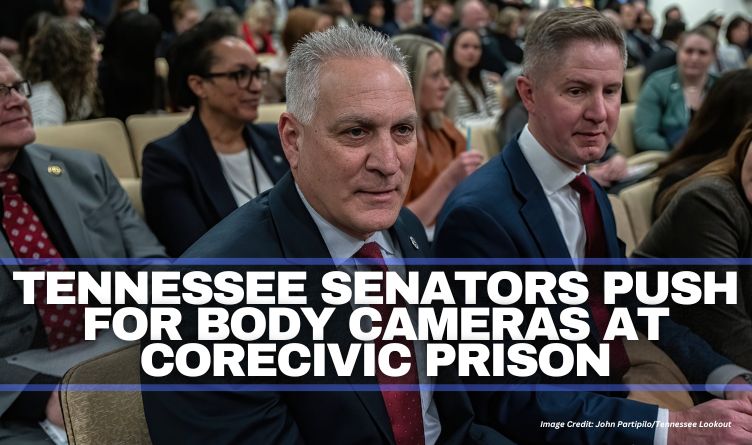
Correction commissioner touts central intelligence center over officer cams.
Image Credit: John Partipilo/Tennessee Lookout
***Note from The Tennessee Conservative – this article posted here for informational purposes only.
By Sam Stockard [Tennessee Lookout -CC BY-NC-ND 4.0] –
A Tennessee Senate panel wants officers at a privately-run prison rocked by a 2025 riot to wear body cameras despite opposition from the state’s correction commissioner.
The State and Local Government Corrections Subcommittee recommended a pilot program Tuesday for the state’s private-prison contractor, CoreCivic, to equip detention officers at Trousdale Turner Correctional Center with body cameras in an effort to protect officers and inmates and provide clearer evidence for criminal investigations.
State Sen. Ed Jackson of Jackson pointed out that prisons can be “extremely dangerous” because of a shortage of prison officers.
“Body cameras would keep everybody honest,” Jackson said.
CoreCivic President and CEO Patrick Swindle estimated the cost of putting cameras on Trousdale Turner officers at $350,000.

Senators surmised that CoreCivic was willing to pay for the hardware, but a spokesperson said afterward the company hadn’t agreed to fund the equipment, only that it would work with the state on the policies it adopts.
Correction Commissioner Frank Strada, though, balked at the notion of putting body cameras on every prison officer in the state, saying it would cost $6 million for the equipment and $2 million to handle public records requests, including the expense of hiring attorneys and technology specialists to go through video frame by frame and blur people’s faces for privacy reasons. He did not have a cost estimate for a pilot project at Trousdale Turner.
Instead, Strada told lawmakers the Department of Correction is putting together a central intelligence center in Nashville with nearly 30 employees using artificial intelligence to monitor prisoners. The department’s proposed budget for fiscal 2026-27 includes $8.6 million for technology upgrades.
The department also plans to spend $1.7 million to fly drones over facilities to stop contraband and phones from being smuggled into prisons.
Strada raised privacy questions about video surveillance, mainly the constitutionality of having officers and inmates on video in cells, restrooms and other areas.
Lawmakers and a state attorney, though, said inmates lose some of their privacy rights when sent to prison.
Correction officials and CoreCivic leaders also challenged the concept of keeping body cameras turned on at all times, saying the amount of video is overwhelming for those who would monitor it or search for incidents.
Swindle told lawmakers the company uses body cams at an Ohio prison but the state changed policy to allow officers to activate them only when they sense the need rather than keeping them on at all times.
Strada and a Correction Department lawyer also advised lawmakers the cost of hiring attorneys and technology experts would be extensive if cameras are rolling throughout an officer’s shift.
Lawmakers based their decision, in part, on the testimony of Wilson County District Attorney Jason Lawson, whose office handles Trousdale County cases, including those at the prison.

Lawson told the committee body cameras would help with prosecution of prison cases by providing better evidence. He showed pictures of inmates attacking an officer at Trousdale and explained that cameras in the prison’s pods are located at each end of a hall and when video is enlarged it doesn’t give a clear look at people’s faces to identify them in court.
“This is one of those situations where a picture is worth a thousand words,” Lawson said.
Swindle told lawmakers that CoreCivic invested in safety and security measures and increased officers’ pay, which reduced vacancies and cut the turnover rate. In addition, the state moved gang members out of Trousdale Turner to state-run prisons.
A Trousdale Turner officer was stabbed and three inmates were treated for injuries in June 2025 when prisoners left their cells and gained access to an inner yard, destroyed property, set small fires and refused to take orders from staff.
The U.S. Department of Justice initiated a civil rights investigation at Trousdale Turner in 2024, citing a record of assaults, murders and understaffing at the facility since it opened in 2016. It is unclear whether the investigation is continuing.
The Department of Correction is seeking a $13 million contract increase for CoreCivic next year that would push the company’s total contracts to $243 million for running four prisons. The department also wants $3.5 million to go toward an increase in CoreCivic’s officer pay.


4 Responses
How does drones stop contraband? Looks like CoreCivic needs an overhaul of dishonesty and corruption.
Put these criminals to working hard labor on the old ball-and-chain from years ago, while being guarded. We’re way to easy on criminals. They have more rights and government handouts than average people who worked all their lives, and can barely make ends meet now.
Body cameras are a good idea.
US prisons are a bad joke and an unbearable burden.