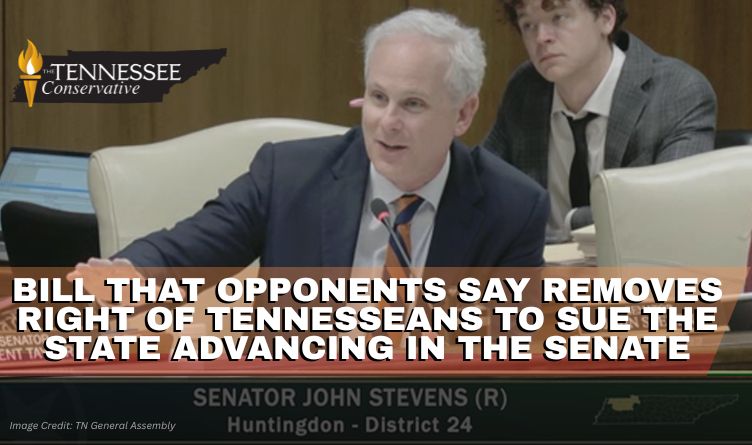
Image Credit: TN General Assembly
The Tennessee Conservative [By Paula Gomes] –
A bill that has received considerable conservative pushback over concerns that the legislation strips an individual’s right to challenge constitutionally questionable state laws passed the Senate Judiciary Committee on Tuesday in a 6 to 2 vote, sending it on to the Senate Calendar Committee.
Republican Senators Todd Gardenhire, Bobby Harshbarger, Paul Rose, John Stevens, Brent Taylor and Dawn White voted in favor of the legislation. Democrat Senators Sara Kyle and London Lamar voted against it, while Republican Senator Kerry Roberts passed on the vote.

According to the bill’s summary, “Present law provides a cause of action for any affected person who seeks declaratory or injunctive relief in any action brought regarding the legality or constitutionality of a governmental action.” SB1958 limits such cause of action to “actions of political subdivisions of this state and specifies that such cause of action does not apply to challenges to the validity or constitutionality of state law.”
In speaking to the committee, Solicitor General of Tennessee Matt Rice said, “Your rights have to be implicated, there must be a specific tie to the law and an action by the government, not just an opinion. You can’t just bring suit because you don’t like a law that’s been passed by the General Assembly.”
The companion House bill (HB1971) sponsored by Representative Andrew Farmer (R-Sevierville-District 17 is scheduled to be heard in the House Judiciary Committee today, March 25th.
Find contact information for members of the committee below.
House Judiciary Committee – HB1971 scheduled to be heard today (3.25.26)
HB1971, in summary, removes the right of a cause of action for any affected person who seeks declaratory and injunctive relief in any action brought regarding the legality or constitutionality of a state governmental action.
Rep.andrew.farmer@capitol.tn.gov; rep.elaine.davis@capitol.tn.gov; rep.rebecca.alexander@capitol.tn.gov; rep.fred.atchley@capitol.tn.gov; rep.gino.bulso@capitol.tn.gov; rep.clay.doggett@capitol.tn.gov; rep.rick.eldridge@capitol.tn.gov; rep.johnny.garrett@capitol.tn.gov; Rep.ga.hardaway@capitol.tn.gov; rep.torrey.harris@capitol.tn.gov; rep.gloria.johnson@capitol.tn.gov; rep.kelly.keisling@capitol.tn.gov; rep.william.lamberth@capitol.tn.gov; rep.mary.littleton@capitol.tn.gov; rep.jason.powell@capitol.tn.gov; rep.lowell.russell@capitol.tn.gov; rep.gabby.salinas@capitol.tn.gov; rep.rick.scarbrough@capitol.tn.gov; rep.tom.stinnett@capitol.tn.gov; rep.chris.todd@capitol.tn.gov; rep.joe.towns@capitol.tn.gov; rep.ron.travis@capitol.tn.gov

About the Author: Paula Gomes is a Tennessee resident and reporter for The Tennessee Conservative. You can reach Paula at paula@tennesseeconservativenews.com.

3 Responses
Thanx, emailed committee, “PLEASE vote NO!!
Why anyone thinks we need this is baffling.
Tennessee bills SB1958 (Senate, sponsored by Sen. John Stevens) and HB1971 (House, sponsored by Rep. Andrew Farmer) in the 114th General Assembly (2025-2026 session) would significantly limit—but not entirely eliminate—the ability of Tennesseans to sue the state for declaratory or injunctive relief regarding the legality or constitutionality of state government actions.
The headline “removes right of Tennesseans to sue the state” is a common way opponents describe it, and it’s directionally accurate for pre-harm constitutional challenges to state laws. However, it’s more nuanced: it narrows one specific statutory pathway rather than banning all lawsuits against the state. People with actual injuries from enforced laws could still pursue claims through other legal routes.
What do the Bills Change (Amends T.C.A. § 1-3-121 and related sections in Title 49)The bills repeal the broad version of § 1-3-121 and replace it with a much narrower version. Key specific alterations: Eliminates the cause of action against the State itself. The new language explicitly states that the provision does not apply to challenges to the validity or constitutionality of state law or state governmental actions (state statutes, state agencies, Governor, state officials, etc.).
You can no longer use this statute to seek declaratory or injunctive relief against the state just because you are an “affected person.”
Limits the cause of action to local governments only. The right is preserved only for actions by political subdivisions of the state (cities, counties, school districts, utility districts, municipalities, etc.).
You can still sue local governments under the revised § 1-3-121 using the “any affected person” standard for declaratory/injunctive relief.
Explicitly reinforces sovereign immunity for the state. The new text clarifies that nothing in the provision allows damages against the state or waives the state’s sovereign immunity.
(Note: Sovereign immunity was already a barrier before 2018; the 2018 law created a specific waiver for these claims.)
Higher education discrimination claims. Previously, someone claiming discrimination in a state college/university could use this broad § 1-3-121 cause of action.
Now, that route is closed for state institutions; instead, they must use the Tennessee Human Rights Act, which can allow damages (not just injunction/declaration).
No change to other ways to sue. The bills do not eliminate all lawsuits against the state. You can still sue if: You have actual, concrete injury (traditional standing rules).
You bring the claim under other statutes, the Tennessee Constitution directly, federal law (e.g., 42 U.S.C. § 1983), or the general Declaratory Judgment Act — provided you meet normal justiciability requirements (ripeness, standing, case-or-controversy).
Why do we need this law? Has the State been over sued? Is the State wasting time defending frivolous lawsuits? I need much more information on the why before I can determine if this is necessary or not as, on the surface, it seems to be taking away citizens right.