Image Credit: John Edwards / Facebook & Canva
The Tennessee Conservative [By Olivia Lupia] –
As artificial intelligence (AI) and data centers continue to be a center stage issue in the state, several regulations were proposed by lawmakers during the 2026 legislative session and local government entities have been attempting to set their own boundaries as the facilities continue to rise in prevalence across Tennessee. Amidst continued public opposition and concerns about utility usage, water consumption, and overall environmental impacts, another local elected official is joining the call for preemptive regulation, proposing a minimum two-year moratorium on any new data center or cryptocurrency mining facilities.
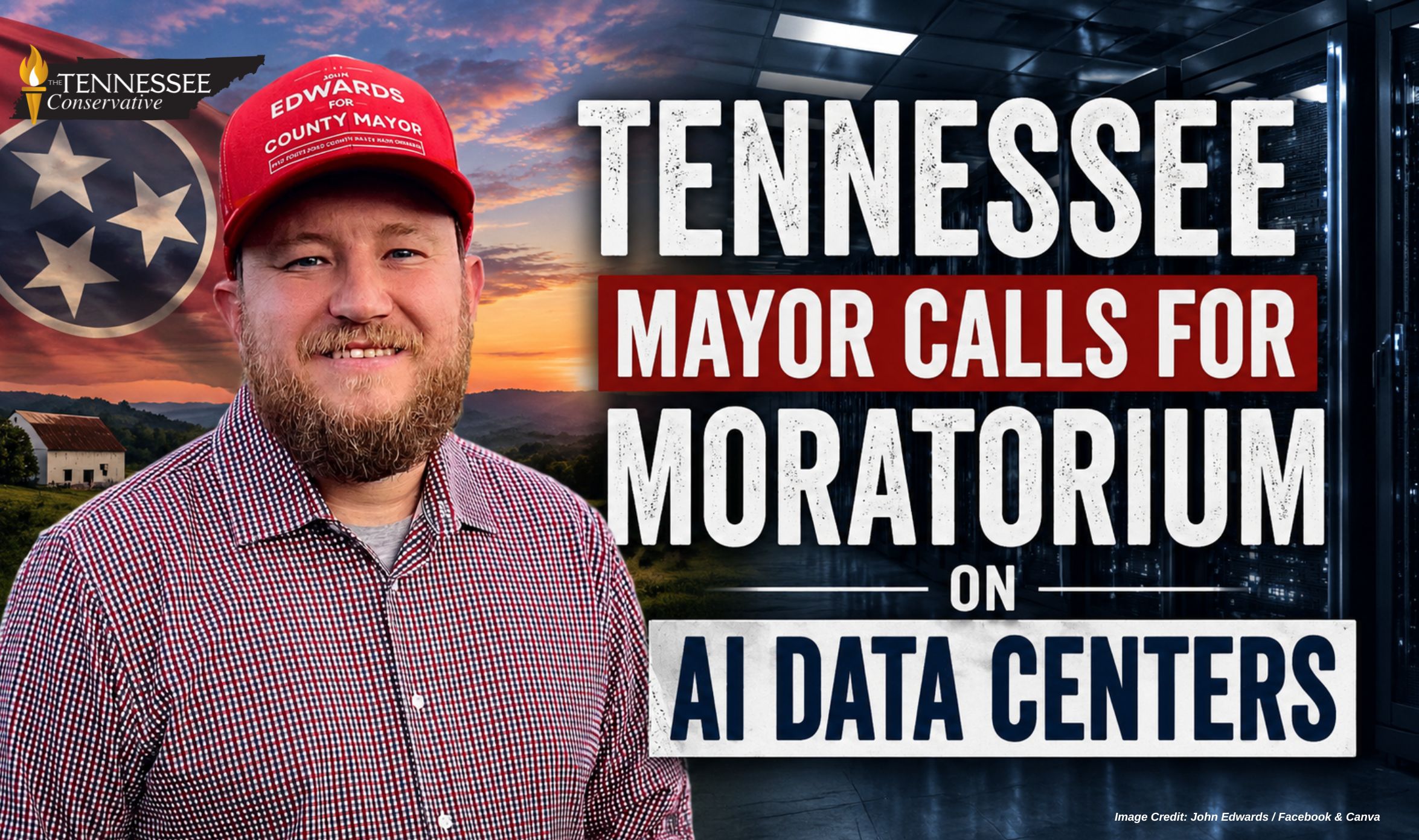
In a Facebook post, Republican Mayor of Cedar Hill John Edwards calls attention to the explosion of data center construction, stating that numerous “Big Tech” firms are slated to begin construction on approximately 2,913 data centers nationwide valued at nearly $2.4 trillion between 2026 and 2030.
He notes that public opposition has been just as explosive, yet numerous states, including Tennessee continue to court major tech companies, specifically citing companies that have business partnerships with Oracle which have been developing data centers in Memphis.
“Tennessee now has approximately 60 data centers statewide and the Nashville region alone reportedly has around 27 operational or under construction facilities as of late 2025. Heck, our neighbors to the north are currently working through the approval process for a major project in Franklin, Kentucky. Clarksville has a Google data center and Gallatin is home to Meta’s nearly 900-acre campus,” he writes. “It’s not a matter of if one comes to Robertson County. It’s a matter of when.”
He then expounds on some concerns he holds, including massive strain on the electrical grid, land consumption, and “impacts on natural resources and air quality”. He notes that one proposed facility in East Nashville would reportedly require roughly 18 megawatts of energy capacity by itself, using enough electricity to power approximately 18,000-22,000 homes.
Lawmakers did pass legislation this year attempting to somewhat address this specific concern in HB1847 which requires data centers that use fifty or more megawatts in their first three years of operation to pay for their own infrastructure or improvements.
Aiming to prevent power companies from unfairly raising the price of electricity through subsidies to data centers for those infrastructure costs, the new law prohibits the associated costs with building a new data center or upgrading electrical infrastructure from being absorbed or subsidized by a municipal or electric utility except in limited circumstances. Should upgrades also benefit ratepayers, utilities may then share then cost with a data center.
HB1847 was the only one of seven proposed bills aiming to create guardrails for data centers in the state that made it across the finish line during this year’s legislative session.
Edwards acknowledges that not all data centers are “massive 1,000-acre campuses. Some modern modular facilities can be constructed on just a few acres of land and that smaller footprint often draws far less public opposition.” But he still believes even these smaller centers need more consideration and proactive planning.
“I could honestly write a book on the environmental, infrastructure and quality-of-life concerns tied to these facilities, but we’ve got to land this plane. I would be willing to make a sizable bet that Robertson County has already had eyes on it,” he says. “The future is here and it’s time we act before we’re reacting after the fact.”
To implement this forward-thinking planning, Edwards says “the first step is establishing moratoriums so communities have time to evaluate legal options, zoning protections, infrastructure impacts and long-term regulations before projects begin arriving. I would recommend a minimum two-year moratorium on data centers and cryptocurrency mining facilities.”
At the June City Council meeting, he will be introducing a resolution aimed at “establishing a moratorium within the City of Cedar Hill to help protect our residents, infrastructure, natural resources and community character. I am hopeful other municipalities and Robertson County will consider similar action. The time for action is now, not after the fact.”

In a counter argument, Kirk Offel, founder and CEO of Overwatch, a company involved in building, staffing, and sustaining data centers, said that while many of the community concerns are legitimate, they are often based on older versions of the technology and thinks citizens should instead focus on creating standards and regulations rather than trying to completely block projects.
“The concerns about energy are valid. The concerns of water and the concerns of jobs are all valid, but they’re all outdated,” Offel said. “Get your policymakers to figure out how to write rules and regulate.”
He argues that modern data centers are increasingly being designed to require little to no water with closed-loop cooling systems and that developers are beginning to build their own power infrastructure instead of relying on existing electrical grids. Offel also compared the growth of data centers to the development of other “transformational” infrastructure projects, like highways, claiming that communities that reject them could end up missing out on future investment and job creation.
“Every city right now should be scrambling to find a way to put data centers in their city,” he said.
This debate is being echoed across the country and at the national level as community members and lawmakers on both sides of the aisle work to best navigate a pioneering technology field which has revealed both interesting potential and serious, potentially fatal, flaws.


About the Author: Olivia Lupia is a political refugee from Colorado who now calls Tennessee home. A proud follower of Christ, she views all political happenings through a Biblical lens and aims to utilize her knowledge and experience to educate and equip others. Olivia is an outspoken conservative who has run for local office, managed campaigns, and been highly involved with state & local GOPs, state legislatures, and other grassroots organizations and movements. Olivia can be reached at olivia@tennesseeconservativenews.com.

2 Responses
A great and helpful article. Thank you.
Every City and County planner and politician should read this.
Thanx, he’s thinking for residents, beyond the promises of immediate gain for investors.