Image Credit: Canva
***Note from The Tennessee Conservative – this article posted here for informational purposes only.
The Center Square [By Kim Jarrett] –
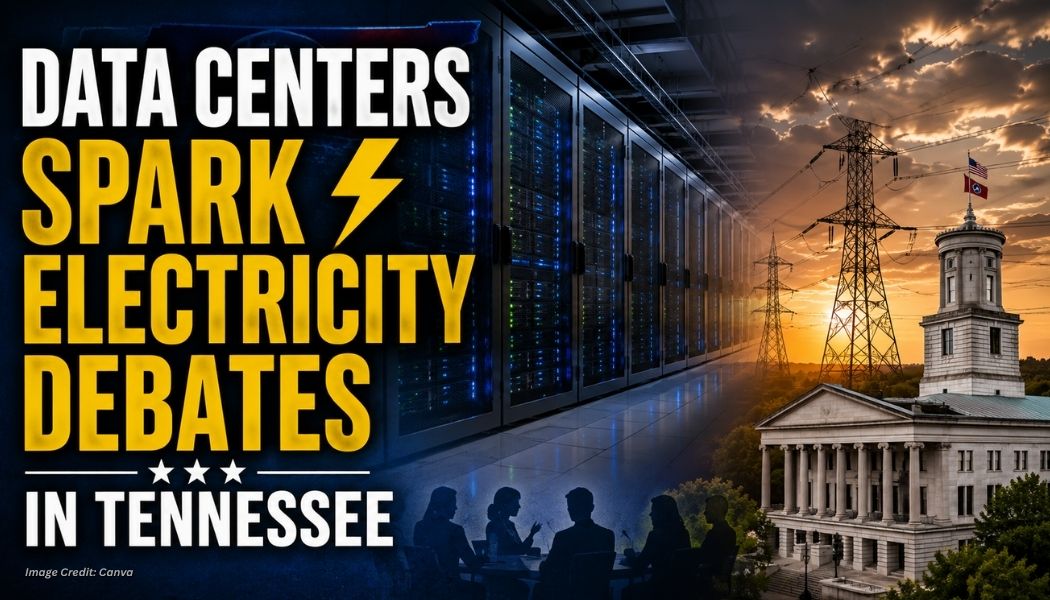
The question of data centers and their effects on electricity prices is sparking debates in Tennessee’s small and large towns and among the state’s largest utility.
Moratoriums or bans on data center construction are being passed by local governments across the state, from tiny St. Joseph with a population of less than 1,000 to Tennessee’s largest city, Nashville.

The Tennessee Valley Authority is asking the 153 power companies it serves to begin discussions on new rate and pricing options to ensure data centers pay for the cost of their service, according to TVA spokesman Scott Brooks.
“Our goal is to support economic development projects and industry growth, including data centers, while ensuring system reliability and low rates for other customers,” Brooks said in an email to The Center Square.
Tennessee is a “critical decision point” when it comes to data centers, according to a report by Think Tennessee, a nonpartisan think tank. Electricity consumption in the Tennessee Valley reached 8.3 million megawatt-hours, enough to power 661,000 homes, according to the organization.
“The policy decisions that are made today on pricing, grid planning, that’s going to determine whether it’s going to shift costs onto everyday households,” Chris Candelaria, research director for Think Tennessee, told The Center Square in an interview.
Gov. Bill Lee signed House Bill 1847, which requires data centers that use more than 50 megawatts of power to pay their own electricity costs.
“We view this as a good step, as an initial step,” Candelaria said. “There’s still some fuzziness around this policy in particular because, written in the law, if there is an infrastructure upgrade involved, the data center has to pay, but at the same time, too, if there’s a broader infrastructure upgrade, then local governments might still be contributing. We’ve got to do more research and better understand the parameters of these types of policies.”
The effect on the power grid was one of the big questions when the mega data center Colossus was built in Memphis. The company temporarily used natural gas turbines to power the facility while it was being connected to the local power grid, according to the company’s website. Twelve turbines remain that would only be used as a backup. The company will disconnect from the power grid during emergencies or when it is strained, according to the company.
The purpose of Think Tennessee’s report is not to say that data centers are good or bad, Candelaria said. Researchers found patterns but not proven cause-and-effect relationships, he said.
“As an example, in areas that host data centers, yes, residential, electric bills rose faster than the statewide average,” Candelaria said. “And what we also found, what was interesting, is that commercial bills in those same areas went down slightly.”
A study from the Lawrence Berkeley National Laboratory shows that in areas where electricity demand is highest from industrial customers, rates are stable or dropping by more than 1 cent per kilowatt-hour, according to Pete Sepp, president of the National Taxpayers Union.
“That’s actually a fair decrease even for a typical residential customer,” Sepp said. “That might be a five, even 10% savings on an electricity bill.”
The data center industry is committed to being a good neighbor in the communities where they operate, said Dan Diorio, vice president of State Policy for the Data Center Coalition, in an email to The Center Square.
“Collectively, the data center industry used significantly less water than other essential industries in 2025, including the agriculture, power, food and beverage, and semiconductor sectors,” Diorio said. “Data centers are also committed to paying their full cost of service for the electricity they use.”


One Response
The cons of data centers FAR outweigh the pros.