
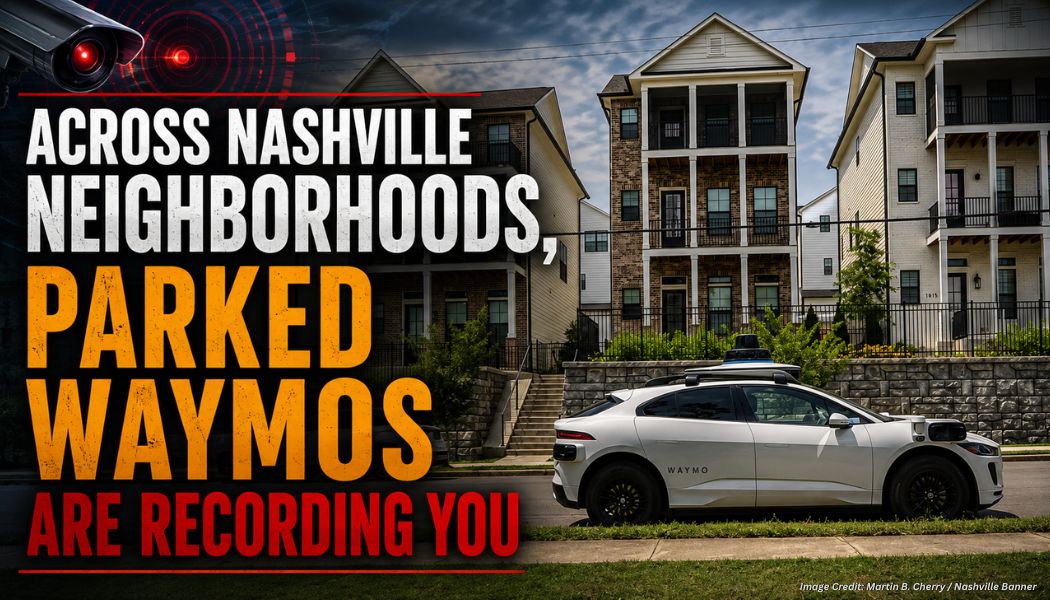
The company says footage and audio are only maintained for a ‘reasonably appropriate amount of time’.
Image: A Waymo idles on Hillside Avenue next to Reservoir Park in Edgehill. Image Credit: Martin B. Cherry / Nashville Banner
***Note from The Tennessee Conservative – this article posted here for informational purposes only.
This story was originally published by the Nashville Banner. Sign up for their newsletter.
by Sarah Grace Taylor [The Nashville Banner, Creative Commons] –
Parked Waymo vehicles are recording Nashville neighborhoods, churches, businesses and parks every day without any public guidelines on how long footage is stored, and minimal details on how it is used.
Since the company fully launched in Nashville in June, more than 50 white, driverless Jaguars with out-of-state plates and large, spinning sensors shaped like top hats on their roofs have been carting people around Nashville, saturating downtown hotspots like the riverfront, Lower Broadway and Music Row.
The vehicles use a combination of radar and LiDAR sensors, external audio and video from both the in-car camera system and the 29 external cameras to operate and train the vehicles when they’re underway.
But even when they are vacant, if the vehicles are running — which is identifiable by the sensors spinning and whirring — they are recording audio and 360-degree video to “continuously perceive the world around the vehicle.”
Ethan Teicher, a spokesperson for Waymo, told the Banner last week that the constant recording is necessary for the parked vehicles to respond to, say, emergency vehicles or other hazards when parked, but the vehicles “are engineered with privacy-by-design.”
“The sensors remain active while the vehicle is parked to maintain awareness of its surroundings and move from that location when required,” Teicher continued.
Asked how long the data recorded is stored, the company said it’s too costly to store large amounts of random footage or audio that doesn’t directly help train the vehicles or pertain to a specific incident, involving the Waymo or otherwise.
When asked, the company did not provide any specific policy on when and how idly collected data is used, but rather said retention is determined on a case-by-case basis.
“Waymo retains data for a reasonably appropriate amount of time to improve our automated driving system,” Teicher wrote.
Waymo would not specify whether it has different policies for recording residential or other potentially sensitive areas, but said the company “only collects and uses the minimum information reasonably appropriate to” improve automated driving.
But between rides, the vehicles are frequently stationed in low-traffic street parking, which the company says helps reduce the impact on traffic as they await trips, recording areas across Nashville.
Where they park
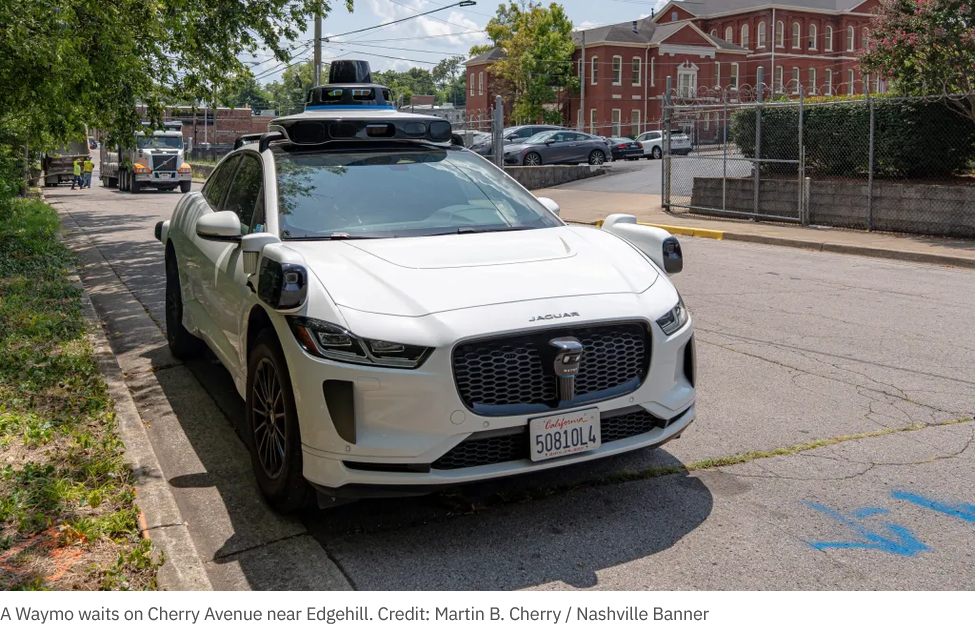
The company wouldn’t say how many designated or frequented parking areas exist in the city, but Nashvillians have noticed several hot spots where the vehicles repeatedly sit idly. In these spots, the vehicles park several times per week, sometimes for prolonged periods, and sometimes more than one vehicle at a time.
In the last week, the Banner visited 12 street parking spots where Waymos reportedly parked frequently and found vehicles parked in 10 of those on the first visit.
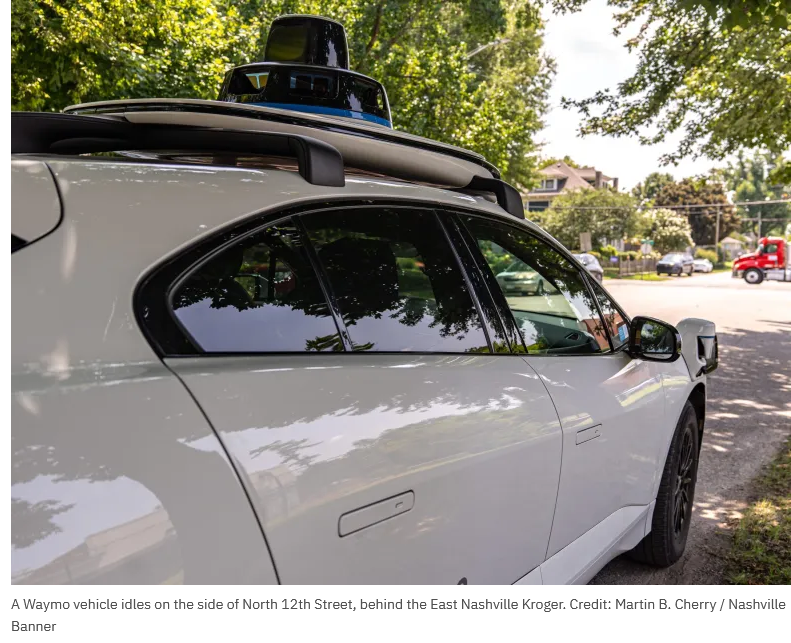
The vehicles were parked and sensors were visibly running without any occupants in each spot, including residential areas in North Nashville, East Nashville and Wedgewood, near businesses on Spence Lane and in South Nashville.
The spots included some more discreet locations, like behind the Church of Scientology off of Eighth Avenue, and others with lots of people in sight, including high-foot-traffic residential streets overlooking Reservoir Park and behind the Eastland Kroger.
At Lenore Street and 7th Street, two Waymos were parked about 100 yards apart, both running and presumably recording. On Scovel Street, Waymos have been parking in front of several homes and two churches since June, sometimes for hours at a time.
Some in Nashville didn’t know the vehicles were recording and expressed concerns about Waymo contributing to the growing number of private companies recording people in public, including a woman named Rachel, who did not agree to share her last name, but lives in an apartment in East Nashville near one of the frequent parking spots.
“Oh hell no, I don’t like that at all. That thing is parked outside of my house all the time,” Rachel said. “It’s just another of these private companies spying on us.”
Rachel added that she didn’t like the company having carte blanche to record everything around its vehicles, even without consent, like when a rider has to agree to terms and conditions.
“It feels like the last couple of years has been one company after another monitoring people and we have no real idea what they’re doing with that video,” Rachel continued.
“And it’s not like they announced that they’re recording us, they’re probably not gonna tell us if they start sharing with another company down the line,” she added.
Not all neighbors mind their presence, like Jon Martinez, who lives with his fiancé and child in North Nashville, directly across from one of the spots where Waymos park multiple times per week. Martinez described himself as a “big fan” of the company, noting that he and his family prefer taking the autonomous vehicles over riding with a stranger.
“The most dangerous thing on the roads is definitely the people,” Martinez said, defending the company. “Especially in Nashville.”
Noting that he has multiple Ring cameras and lives in a neighborhood with notable foot traffic and safety concerns, Martinez said he doesn’t mind Waymos contributing to the surveillance ecosystem.
“Realistically speaking, this street in particular has historically been more of an unsafe street,” said Martinez, who has lived in his home for four years. “Do I love being recorded? No. … Do I think an extra layer of recording is good? Probably.”
Who has access to the footage?
Private companies doing surveillance and sharing the data they collect has become increasingly prevalent in recent years and has been front of mind in Nashville with plans for license plate readers on state highways and implementation at the airport. At the center of privacy concerns around LPRs is the surveillance company Flock, which aggregates data from its cameras and provides it to users, including law enforcement.
Last week, 404 Media reported that Flock was trying to broker a deal to access in-car footage from rideshare apps Uber and Lyft to add to its sweeping surveillance network. In a nutshell, Flock proposed accessing Nexar dash cameras in 350,000 delivery and rideshare vehicles, but the deal never materialized.
Still, the idea raises questions about how the burgeoning robotaxi company will share data with its partners, which include Lyft, Uber and Nexar.
When asked if Waymo shared its footage with Uber, Lyft, Flock or Nexar, the company acknowledged a “research agreement” between Waymo and Nexar, but insisted that they “do not partner with any organization for the purpose you mentioned.”
What Waymo shares with law enforcement has been sporadic.
Waymo has repeatedly provided stored footage to law enforcement across the country, but says that the general practice is to only share minimal information to lawful requests, though in a July incident, a self-driving Waymo reported two teenagers for drinking and using toy guns, delivering the riders to San Mateo Police.
In another instance footage requested by San Francisco police in connection to a robbery was not provided, despite a warrant, because the company was no longer storing the footage by the time police requested it, lending credence to the company’s claim that mundane footage is not being stored for extended periods of time.
“When we receive requests for information from law enforcement, we carefully review each request to ensure it satisfies applicable laws and is legally valid. We will closely scrutinize each request, narrow its scope or push back as needed,” Teicher said, also offering that the company does “not use facial recognition or other biometric identification technologies to identify individuals, and we only retain data necessary for the continued improvement of the Waymo Driver.”
A spokesperson for the Metro Nashville Police Department said they were unaware of any instances in which the department had requested material from Waymo. The Tennessee Highway Patrol did not respond to the same question.
As Waymo gets underway in Nashville, Elon Musk’s Tesla appears to be plotting a local launch of its own untested autonomous vehicle service, after a fleet of 15 gold Tesla Cybercabs were spotted in Franklin last week. Tesla has been repeatedly found in violation of its own privacy policy by recording and storing sensitive and less-than-anonymous footage through its consumer-owned vehicles.


One Response
Woulda prob ratted out us non-maskers during the Covid farce.