
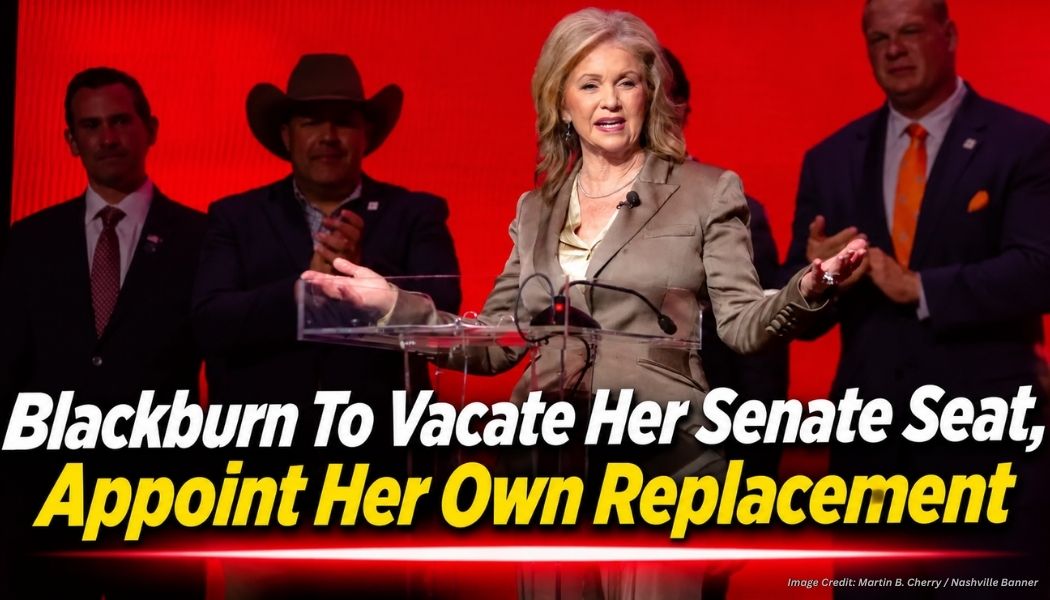
Marsha Blackburn Elected Tennessee’s First Female Governor.
Image: Marsha Blackburn speaks to supporters Tuesday night at The Pinnacle in Nashville after winning the election for governor of Tennessee. Image Credit: Martin B. Cherry / Nashville Banner.
***Note from The Tennessee Conservative – this article posted here for informational purposes only.
This story was originally published by the Nashville Banner. Sign up for their newsletter.
Article by Sarah Grace Taylor and Steven Hale, The Nashville Banner republished under Creative Commons License –
Sen. Marsha Blackburn was elected Tennessee’s next governor on Tuesday, making her the state’s first female governor and adding another chapter to her decades-long political career.
Though Blackburn pulled through with just over 45 percent of the vote counted by 11 p.m., unexpectedly close to Democrat Jerri Green’s 42.95 percent, representing a less-than-decisive victory on a night with a nationwide shift to the left, which translated to several wins and near-wins for Democrats in Tennessee.
Blackburn, the state’s senior senator, who has served in the state legislature, U.S. Congress, and most recently the U.S. Senate since 2018, will vacate her federal seat to become governor in January, after a turbulent campaign.
As governor, Blackburn will join the state’s Republican supermajority legislature in maintaining and implementing conservative policies.

On Tuesday night, before the race was called or Green conceded, Blackburn claimed victory in a speech to supporters at The Pinnacle in Nashville. Although attendees had been told they’d also hear from Republican congressional candidates, only Blackburn addressed the crowd. Congressional candidates Johnny Garrett and Matt Van Epps — both winners — stood behind her along with other supporters, including Knox County Mayor Glenn Jacobs.
Blackburn did not mention Green but did address a statement to the people who voted for her.
“Elections are tough,” she said. “I fully appreciate that not every Tennessean voted for me, but I can tell you this — I will be a governor for each and every Tennessean. And I wish the best for Tennesseans. It is time for all Tennesseans to come together for the good of our state.”
Moments later, though, Blackburn struck a somewhat different note, to cheers from the crowd.
“Tennessee has become a Christian conservative standard bearer, an economic powerhouse, and it is the place that people want to be,” she said. “So our job is going [to be] keep what we’ve got and make the best better, … and I will tell you this: As your governor, you can count on me to fight with every fiber of my being against these socialist, communist, Islamic policies.”

Despite waning support for Trump this year, Blackburn stuck to her guns as a national conservative firebrand, campaigning with Trump and promoting her vision of Tennessee as an ultra-conservative respite from culture war issues like transgender participation in sports and an allegedly looming threat of socialism coming to the state.
Her staunch partisanship, lack of public events, and refusal to debate made both the Republican primary and general election closer than expected when Blackburn entered the race, armed with immense name recognition, support and funding from Republicans nationally.
Candidates to the left and right of Blackburn fared unexpectedly well between the primary and general, giving Republican Congressman John Rose in the primary and Democrat Green in the general a perceived chance at victory, though both came up short.
David Hatley, who ran as an independent after not qualifying to run as a Republican, snagged 9.3 percent of voters, many of whom would otherwise have been in Blackburn’s base. Blackburn and her allies recognized the threat and spent the final six weeks of the campaign launching a deluge of attack ads against Hatley.
Even with the Hatley bump, Green’s longshot campaign to be the first statewide elected Democrat in 20 years fell short.
At an election party in Chattanooga, Green conceded the race, but celebrated the strength of Democrats in a red state.
“Tonight, I didn’t win for you,” Green said, interrupted by cheers of “yes you did.”
“But I want you to know that I’m not going anywhere, that you’re not going anywhere, that we aren’t going anywhere,” Green continued. “We’re not backing down, and we’re not done fighting.”
Lauren Pinkston, another independent, whose views are to the left of Hatley, garnered just 1.25 percent of the vote. While Green and other Democrats urged Pinkston to drop out for fear she would split the vote of people defecting from Blackburn or the Republican Party, Pinkston’s votes ultimately would not have made a difference for Green.
Blackburn, who will still have four years left on her second Senate term when she is sworn in as governor, can appoint her own Senate replacement to serve out the remainder of her term.
While she has refused to discuss who she is considering for the appointment, Blackburn told the Banner before the primary that she intends to stay in the Senate until she’s sworn in as governor, rather than resigning and allowing outgoing Gov. Bill Lee to make the appointment.
Rumored frontrunners for Blackburn’s seat include: Jacobs, who has traveled with and served as Blackburn’s treasurer all year; Republican Congressman Tim Burchett, who has stumped for Blackburn and publicly admitted to wanting the Senate seat; and, most recently, U.S. Secretary of War Pete Hegseth, who lives at least part-time in Tennessee and is facing political pressures and impeachment in D.C.