
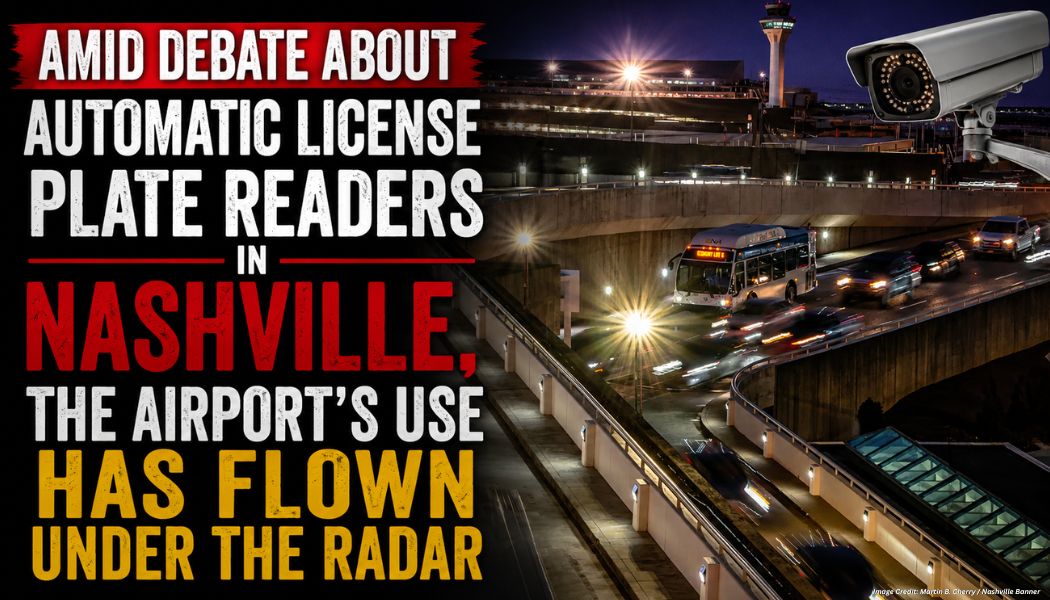
Public records show data collected by airport LPRs is part of a sprawling web of surveillance accessed by law enforcement across the country.
Image Credit: Martin B. Cherry / Nashville Banner
***Note from The Tennessee Conservative – this article posted here for informational purposes only.
This story was originally published by the Nashville Banner. Sign up for their newsletter.
by Steven Hale [The Nashville Banner, Creative Commons] –
While a groundswell of community opposition blocked plans to deploy automatic license plate readers across Nashville, the city’s airport is an outpost in the growing surveillance network those devices have created.
There have been at least 10 of the AI-powered cameras in use at Nashville International Airport since 2024, according to a contract between the Metro Nashville Airport Authority and the surveillance technology company Flock Safety obtained by the Banner through public records requests.
The MNAA has its own police department, which operates independently of the Metro Nashville Police Department.
The LPRs capture the license plates and other details of thousands of cars that pass through every day. That data is accessible to officers at the airport’s Department of Public Safety as well as thousands of law enforcement agencies around the country who are part of Flock’s network.
But despite the roiling debate over LPRs in Nashville in recent years, the airport’s use has flown under the radar.
“The deep layer of it that I think a lot of people across the country are discovering is that really these are fights about democracy,” Ed Vogel, a researcher and advocate who is part of the nationwide DeFlock movement, told the Banner. “What is happening in a lot of communities, the patterns that we’re seeing are technologies like ALPRs are being procured, contracts are being signed with very little public disclosure.”
Vogel describes his work as “trying to make the problem legible.” He is one of many people around the country who have devoted themselves to meticulously reviewing public records to map LPR deployment and track how they are used.

In post-9/11 America, most people who go to an airport likely take for granted that they will encounter some degree of invasive surveillance or security. What they may not be aware of is how widely available Flock’s LPR network makes their license plates and vehicle details and how much that data can reveal about them.
Audit logs for the Nashville airport’s LPR’s obtained by the Banner through a public records request show that data captured has been combed over as part of hundreds of thousands of searches by law enforcement agencies across the country so far this year. Among them are more than 75,000 searches by police departments and sheriff’s offices in Tennessee and nearly 2,500 searches by airport police.
Flock’s policy states that LPR data is stored in the cloud for 30 days before deletion. But the airport’s policy instructs officers to transfer all data captured during each shift to the internal servers, where it is stored for a minimum of three years.
The logs record the reason given by the user for each search, often listing the alleged crime being investigated. In many cases, those reasons are what one might expect: a “fugitive” with an arrest warrant, a homicide investigation, a kidnapping case or a stolen vehicle. But others raise questions about whether a mass surveillance network is being used to track people accused of minor crimes or none at all. Several searches performed by Nashville airport police in June were only labeled “other.” One logged on June 11 was labeled “alcohol offenses / non-DUI”; one in February was simply explained as a “welfare check.”
Searches by other law enforcement agencies in the state also included some with notably vague explanations. In June, officers in Hendersonville, White County and Memphis logged queries for cases of “disturbing public peace/riot” and “disorderly conduct.” The University of Tennessee Police Department logged a search June 13 for “alcohol offenses.”
In Nashville, part of the resistance to LPRs and other police surveillance technology was based on fear that it could be used by or for federal immigration authorities to pursue the Trump administration’s policy of hunting down allegedly undocumented immigrants across the country. The audit logs reviewed by the Banner indeed show a number of searches logged as immigration cases, including one in Sevierville in June.
Although Flock says it does not directly share data with Immigration and Customs Enforcement, 404 Media has reported on local law enforcement agencies acting as a sidedoor to the network.
The MNPD does not have direct access to Flock’s LPR network since it does not have a contract with the company. But the department has announced on a number of occasions that LPRs from private owners or neighboring counties have been used to assist its investigations. MNPD spokesperson Kris Mumford told the Banner the department has rarely asked airport police to search the LPR network on its behalf, citing a homicide case a few years ago. But the audit logs do appear to show examples of other departments accessing the network for MNPD. A May 20 search by the Murfreesboro Police Department, for example, was logged as a case of a wanted person with an arrest warrant and included the name of a Nashville police sergeant.
The searches recorded in the audit logs also provide a picture of the immense surveillance capability at the fingertips of anyone conducting them. They are mostly not targeted surveys of footage obtained by local cameras, but rather a scouring of Flock’s immense network of LPRs. The most common type of query in the logs reviewed by the Banner was what’s called a “lookup,” which allows the user to see a license plate’s recent location history based on readings from the nationwide network of cameras. Flock also offers what it calls a FreeForm search which, according to the company, allows “searches based on everyday language, such as ‘white sports car with a racing stripe’ or ‘red pickup truck with a dog in the bed.’”
The airport authority’s contract with Flock also highlights an “Unlimited Custom Hot Lists” feature, which allows the user to “add a suspect’s license plate to a custom list and get alerted when it passes by a Flock camera.”
“These tools really give a pattern of life and they can really make it obvious for their users what someone’s daily habits are, what their patterns are, what they’re doing,” Vogel told the Banner.
It takes little imagination to come up with ways such a tool can be abused — in fact, it takes no imagination at all. The Washington Post earlier this week reported that at least 46 police officers have been charged or accused of using their access to Flock’s LPR network to do things like stalk an ex-wife or girlfriend or spy on women they wanted to meet.
The airport authority document outlining the policy for its LPRs states that they are to be used “for the furtherance of criminal investigations” and that “no officer may use, or authorize the use of, the equipment or database records for any other reason.” The policy also prohibits officers from using the LPR system until they have been “properly trained.”
“For authorized Department of Public Safety (DPS) members, this training covers login procedures, two-factor authentication setup, and an introduction to the Flock Safety user interface,” Charlotte Weatherington, the airport authority’s director of corporate communication, wrote in response to emailed questions from the Banner. “Upon logging in, new users are introduced to system capabilities, search parameters, and the importance of query specificity. DPS members gain access to the Flock ALPR system through supervisor approval. After approval, a system administrator creates the user login.”
Asked what measures are in place to ensure that airport officers don’t abuse their access to the network, Weatherington referenced the airport’s written policy and added that users are required to enter an offense type and case number before conducting a search of the network.
“These strict data rules block the improper searches,” she wrote.
But the airport’s internal policies can’t control how others might use the data its LPRs provide. Vogel said he is not optimistic that a network designed to collect and share surveillance data on such a massive scale can be made safe.
“It’s difficult, I would argue impossible,” he said, “to actually implement meaningful guardrails to prevent the use of these tools in ways that are harmful.”
* Banner reporter Stephen Elliott contributed to this reporting.


One Response
Yup, lucifer’s Big Brother’s spy cameras.