
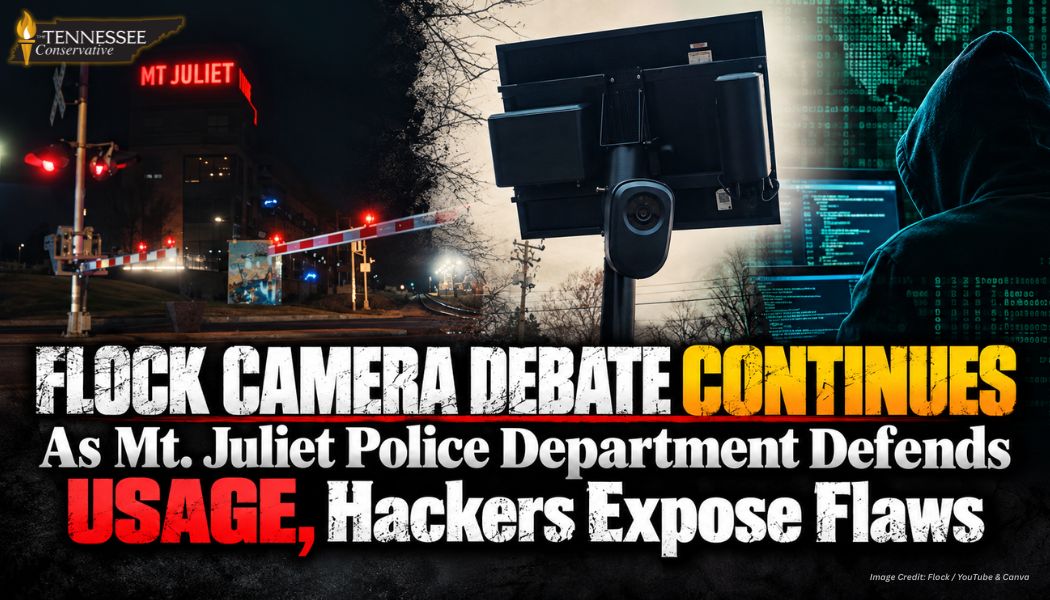
Image Credit: Flock / YouTube & Canva.
Article by Olivia Lupia, Tennessee Conservative News –
While more Tennessee towns are rethinking their usage of LPR technologies in response to mounting citizen concerns, Mt. Juliet law enforcement is standing firm, maintaining the Flock system has helped the department in “countless situations.”
Meanwhile, a group of hackers managed to remove a camera and reverse engineer its data, showing the system collects far more information than users and citizens may be comfortable revealing.

Coopertown, about 40 miles north of Mt. Juliet, recently ended its two-year contract with Flock early and stopped ALPR usage after significant public pushback.
Mayor Jeff Smith said, “While we agree that this a useful tool, we also agree that our citizens need to be heard.”
But that stance does not seem to be mirrored by the nearby Mt. Juliet Police Department (MJPD), with Police Chief Tyler Chandler saying the public has “so many misconceptions about this system and what it collects and what it does not collect.”

The Mt. Juliet department has at least 80 Flock Cameras on the eGuardian Shield program, which Chandler says has helped law enforcement across all kinds of cases, from car thefts to missing people.
In August, the eGuardian program alerted MJPD officers to vehicle plates connected with felony theft investigations in several states, leading to the arrest of a California man who allegedly crossed multiple state lines to steal large quantities of drugstore makeup.
Chief Chandler says the department is countering online rhetoric with transparency, noting the department posts online nearly every time officers apprehend a criminal using the LPR program and pointing to the informational page explaining the department’s safeguards and policies concerning the technology.
MJPD has used ALPRs for a few years now, but switched to Flock last year, with the company even creating promotional videos highlighting their partnership with the city and featuring several officers praising the technology.
The department also launched Flock911 in February of this year, “a groundbreaking new technology” that acts as a real-time emergency communications tool allowing officers to hear live 911 calls as they are en route to a scene.
“Flock911 integrates with officers’ smartphones and in-car computers, allowing them to receive instant alerts, live audio of incoming emergency calls, and the caller’s location. While dispatchers continue their important role, officers can now assess a caller’s situation, call for help, urgency, and emotional state in real time, leading to quicker, more informed decisions on the ground,” the press release reads.
But while Chief Chandler continues to offer assurances that the technology is being used responsibly and with proper safeguards, like audits, data storage for less time than the 90 days allowed by the state, and no use of facial recognition technology, skepticism and opposition continue to rise.
And a recent report suggests that while the law enforcement department itself may not be using certain invasive features, the cameras and Flock system themselves are indeed capable of performing these functions and may do so with or without the client’s consent.

According to The Hill, a group of “hacktivists” tore down a Flock camera last week, accessing its encryption key and discovering thousands of videos they said were designed to detect cars and people. The group also found that the cameras’ software can generate dozens of images from a single passing vehicle to develop its “signature.”
In a 21-day period, the camera photographed about 50,200 vehicles and generated about 1.6 million images, noting the camera generally captured around 28 images from just one vehicle, though some can produce more than 100. Those images are then added to the Flock database which logs license plate numbers and other vehicle identifiers like make, model, color, and bumper stickers.
One instance showed the camera was able to detect and American flag patch on the saddle bag of a motorcycle, which was then run through the roughly 20-built in apps that detect motion and upload the data.
The hackers’ investigation concluded that besides license plates, the software explicitly detects people, bicycles, and vehicles. They also suggested that while Flock insists the plate readers do not track people, other reports to the contrary may be correct.
So, while Tennessee law enforcement agencies may believe they are in control of what information they collect and how it is used, it appears civilian concern could be justly warranted as more inconsistencies and questionable functions of Flock cameras and other LPR technologies are exposed.
Sources:
WKRN.
WKRN.
WKRN.


About the Author: Olivia Lupia is a political refugee from Colorado who now calls Tennessee home. A proud follower of Christ, she views all political happenings through a Biblical lens and aims to utilize her knowledge and experience to educate and equip others. Olivia is an outspoken conservative who has run for local office, managed campaigns, and been highly involved with state & local GOPs, state legislatures, and other grassroots organizations and movements. Olivia can be reached at olivia@tennesseeconservativenews.com.

3 Responses
The more I hear and see about these LPRs, the more I’m worried. As the article states, the police may think they control the data, it’s clear that may not be the case. We don’t live in London or Beijing, enough with the Surveillance, particularly if they can access your smart phone. I’m just your average Joe with nothing to hide, but that’s not the point. And don’t get me wrong, I’m a strong supporter of Police, but they have no right to access my phone data unless it’s proven that I’ve committed a crime. These systems are an incredible invasion of our privacy. Get rid of them! Get rid of them all!
I went to a Flock meeting here in Anderson County a while back and the Commissioners agreed that if the people want them gone, then that’s how they would vote. Then a few days ago, some voted to do just that, while others voted to send it to the Budget Committee. Correct me if I’m wrong, but that seems to me that they aren’t taking us very seriously. I’ll wait and see, and if enough of them vote to keep these cameras, I’ll work my ass off to get them out of office in the next round of elections.
I suspect FLOCK has bought many LEOs and Commissioners.
I suspect FLOCK has bought many LEOs and Commissioners.