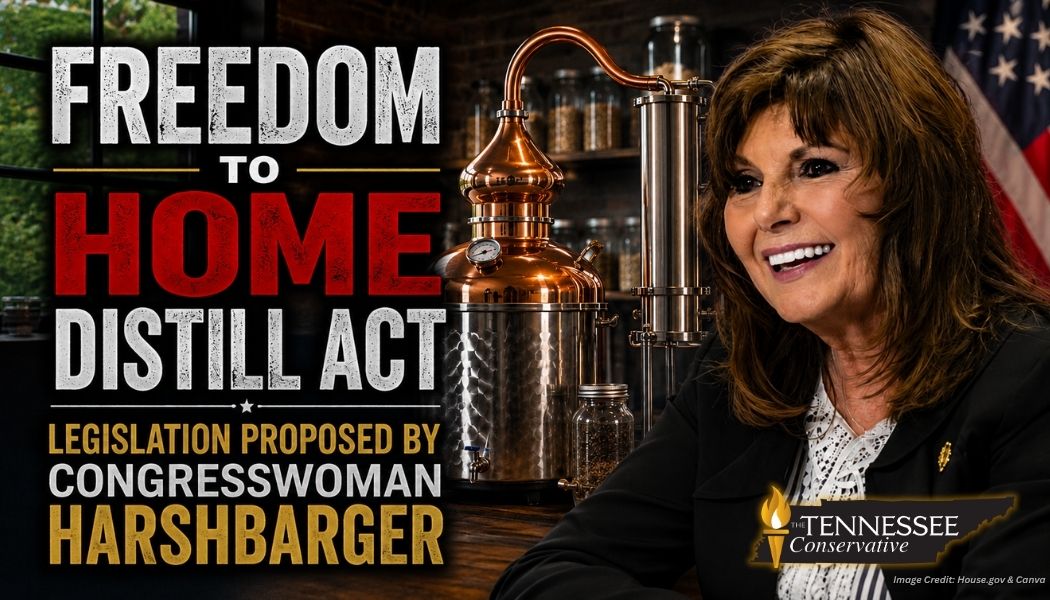
Image Credit: House.gov & Canva.
Article by David Seal, Tennessee Conservative News –
First District U.S. Representative Diana Harshbarger (R-Tennessee) has filed legislation to end the federal prohibition on home distillation for small batches of spirits. The proposal is called the Freedom to Home Distill Act.
Second District U.S. Representative Tim Burchett (R-Tennessee) is a co-sponsor of the House Resolution.
Burchett commented as follows on the resolution.
“Nationwide prohibition ended nearly a century ago, yet the federal government continues to regulate domestic distilling operations. There is no reason to keep antiquated and inefficient laws on the books, nor is there any reason that this should not be state-level issue. I support the “Freedom to Home Distill Act” and any legislation that reduces red-tape and strengthens individual liberties,” – said Congressman Tim Burchett.
Provisions of the House Resolution are as follows:
- Creates a tax exemption for spirits produced at a qualifying home distillery, defined as a private residence, or a connected shed, yard or enclosure, used solely for personal or family consumption.
- Sets production limits mirroring current homebrewing limits: up to 10 proof gallons per year for single-adult households and up to 20 proof gallons per year for households with two or more adults age 21 or older.
- Prohibits any sale or transfer for sale of home-distilled spirits.
- Exempts qualifying home stills from federal registration and notice requirements, provided the equipment has a pressure release and vacuum relief valve and a capacity no greater than 50 gallons.
- Removes criminal penalties under the tax code for distilling within a qualifying home distillery establishment.
- Preserves state authority. The bill applies only to federal law, and states retain full power to regulate or prohibit home distillation as they choose.
The Congresswoman issued the following statement in her recent media release concerning the legislative proposal.
“It makes no sense that Americans can legally make beer and wine at home for personal consumption, but not a small batch of spirits. Distilling has deep roots in Tennessee and across Appalachia, tied to self-reliance and craftsmanship that go back generations. It’s long past time we modernize this outdated federal law. My bill restores an important piece of that tradition and puts personal responsibility back where it belongs: with the American people.” – said Congresswoman Diana Harshbarger.
Harshbarger’s proposed legislation is not about moonshining. Instead, it is about the freedom to distill small amounts in the privacy of your home. The following paragraphs explore some of the colorful details and impact that distilling has had on the region and its traditions.
Whiskey has had a vast impact on the Appalachian region. Harshbarger’s district was ground zero for whiskey making from the days of the American Revolution to the 1960’s, a region of the nation that was known for its fierce independence, distrust of government, and contributions to the American Revolution.
Whiskey was a currency in the period in which the region was settled by farmers and woodsmen, a byproduct of farming made by inhabitants that did not appreciate the Whiskey Tax that was levied in 1794. In part, the settlers were escaping a tax they considered unfair. Whiskey making was part of their culture and economy.
At the time of the revolution, East Tennessee was inhabited by European settlers from England, Scotland, and Ireland that just wanted government to leave them alone. They expressed this during the Battle of Kings Mountain after Major Patrick Ferguson issued a statement to settlers to lay down their weapons and submit to the crown, threatening their homes and farms with fire and sword if they failed to comply.

Major Ferguson and many of the loyalists that he commanded were ambushed and slaughtered at Kings Mountain by Patriots that mustered at Sycamore Shoals in what is now modern-day Elizabethton, Tennessee. This was the turning point of the American Revolution in the Southern Theater of Operation.
Stock car racing, the predecessor to modern motorsports, has its roots in illicit distilling. “Whiskey runners” started the practice of racing modified cars on dirt tracks for bragging rights, a tradition of speed that was featured in the 1958 film Thunder Road staring a young Robert Mitchum.
During the period of failed prohibition, sequential blasts of dynamite could be heard echoing throughout the foothills of the Smoky Mountains from time to time, a crude but effective warning system to those who depended on whiskey making for their livelihood that federal revenue agents were in the area.
To learn more about The Freedom to Home Distill Act, a one-page summary is linked here.
The full text of The Freedom to Home Distill Act is linked here.
Author’s Note: While Harshbarger’s legislative proposal does not promote, or permit, moonshining, whiskey running, and unlawful production of spirits. It will permit, if enacted, responsible home distillers the freedom to produce small batches for personal consumption, a long-overdue measure that is consistent with the traditions of our nation. For disclosure, my distant ancestors were moonshiners and blockaders, some of which served in the American Revolution.


About the Author: David Seal is a retired Jefferson County educator, recognized artist, local businessman, 917 Society Volunteer, and past Chairman of the Jefferson County Republican Party. He has also served Jefferson County as a County Commissioner and is a citizen lobbyist for the people on issues such as eminent domain, property rights, education, and broadband accessibility on the state level. David is also a 2024 winner of The Tennessee Conservative Flame Award & has received an accolade from the Institute For Justice for successfully lobbing the TN legislature to protect property rights. David can be reached at david@tennesseeconservativenews.com.

One Response
Good.