
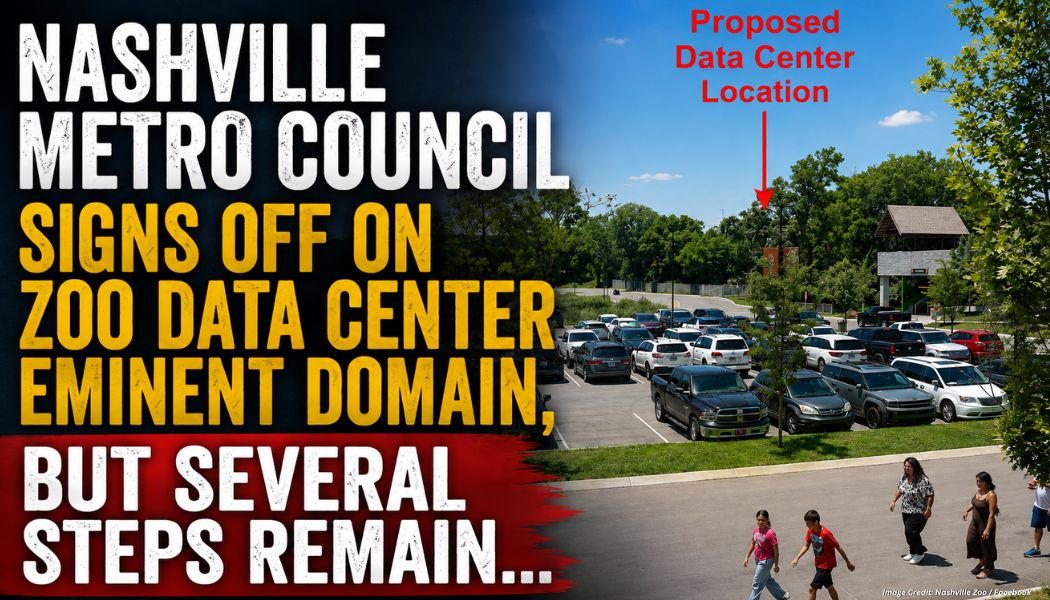
Image Credit: Nashville Zoo / Facebook
***Note from The Tennessee Conservative – this article posted here for informational purposes only.
This story was originally published by the Nashville Banner. Sign up for their newsletter.
by Stephen Elliott [The Nashville Banner, Creative Commons] –
Nashville’s Metro Council voted 27-5 on Tuesday to authorize city attorneys to initiate eminent domain proceedings seeking to take ownership of the property adjacent to the Nashville Zoo where a developer is planning to build a data center.
The legislation, which passed its third and final vote, allows the city to begin negotiations with the property owner and potentially use eminent domain.

There’s a long road ahead still. Pending zoning appeals related to the property are still on the docket and can’t be heard until the moratorium expires in December. A successful appeal then could scupper the DC Blox plan. Even if Metro decides to proceed with eminent domain, a protracted legal fight with developer DC Blox could delay a purchase.
Mayor Freddie O’Connell launched the eminent domain process as the Metro Council was considering both new data center zoning rules and a temporary moratorium on their construction, both of which passed last month.
Councilmember Rollin Horton, the lead sponsor, did not mention the zoo or the proposed data center. Instead, he said the move is due to the city’s “severe shortage of office space.”
Some skeptics raised questions about the mayor’s proposal, including its cost. Councilmember Quin Evans Segall added an amendment to the legislation requiring that any appraisal of the property prepared for Metro be sent to the council. The amendment also requires that Metro wait at least three weeks from the submission of the appraisal before filing any condemnation action, which could give Metro Council the chance to rescind the authorization.
The mayor’s office and legal representatives contend that Metro must buy the property next to the zoo due to longstanding office needs in the South Nashville area, especially in the face of the pending closure of a city office building in the area. Councilmember Russ Bradford supported the purchase, citing the city’s spending on office rents.
Officials said that funding for the purchase, if it comes to pass, has already been allocated to different departments as part of a capital spending plan. If Metro can prove to a court that the purchase is necessary, the city would have to pay fair market value, a subjective figure that could be hotly contested. The property sold last month to data center developer DC Blox for $23 million, but the county assessed the value at $37 million last year.
Councilmember Courtney Johnston, who represents the Nashville Zoo area and has been opposed to the data center project there, expressed reservations about the legislation during Monday’s meeting of the Budget and Finance Committee. She called the move to initiate eminent domain proceedings “dangerous” and said she is concerned about the cost to the city and the legal fight that could ensue. She ultimately voted in favor of the legislation.
The debate created some strange political bedfellows. Councilmember Ginny Welsch, one of the body’s most progressive members, called the proposal “a gross misuse of the power of condemnation.” Welsch, Jeff Eslick, Joy Kimbrough, Brandon Taylor and Joy Styles voted no.
Metro departments are continuing to review data center impacts and possible additional regulations in response to a mayoral executive order. Kendra Abkowitz of the mayor’s office told the Metro Council’s Planning and Zoning Committee on Monday that departmental recommendations will be delivered within two weeks. Councilmember Rollin Horton, chair of the committee, said several councilmembers have considered further legislation to refine the recently instituted zoning rules.

Vanderbilt neighborhood
The council held a public hearing for zoning legislation that would allow Vanderbilt University to create its planned “innovation neighborhood.”
The mixed-use district would be built mostly on parking lots owned by Vanderbilt. It would include office space for tech initiatives, research and development labs, open space, housing and retail.
Eben Cathey, a Vanderbilt representative, said the school “wants to turn 40 acres of what is mostly surface parking lots into a hub for innovation” with space for entrepreneurs and startups to be “in close proximity” to Vanderbilt’s faculty and research labs. Cathey said an amendment put on the bill Tuesday includes a “long list of concessions.”
Some neighbors have expressed concerns about density, traffic and the further encroachment of Vanderbilt into adjoining residential areas.
“This would create a second downtown,” said Ginger Hausser, a former councilmember for the district and part of the group opposing the development.
She urged councilmembers to reduce the allowed heights for the project. Many of the speakers who opposed the bill said they supported some form of Vanderbilt development in the area but that it should be scaled back and reconfigured.
The legislation passed its second of three readings. Third and final reading of this bill and two related pieces of legislation was deferred until the first meeting of September.

Music City Center refinancing
Legislation that would allow refinancing Music City Center debt and transferring $300 million in excess tourism tax revenues for East Bank infrastructure was deferred after members of the council’s East Bank committee asked a series of questions about the financing proposal.
City finance officials have said the refinancing is necessary in order to release Metro’s “backstop” on the Music City Center debt. That action, they said, is necessary to free up debt capacity in order to stand up an affordable housing bond program.
Additionally, they said the $300 million would help pay for infrastructure projects on the East Bank that would otherwise need to be funded in the city’s capital spending plan, which is crowded with requests for schools, parks and other projects.
But members of the committee, including Sean Parker and chair Quin Evans Segall, questioned whether the move, initiated by the state legislature this spring, would be good for Metro in the long term. One option they are investigating is allowing certain downtown sales tax redirects that fund the Music City Center to expire and instead allow those revenues to flow into the city’s general fund.
Metro Finance Director Jenneen Reed and Metro Legal Deputy Director Tom Cross discussed the proposal at length during Monday’s Budget and Finance Committee meeting. Reed presented an estimate that the sales tax dollars Metro could recapture by eliminating the convention center revenue streams would be less than the annual benefit provided by the legislation.
The rest
- Thirteen councilmembers have signed on to a bill, on its first of three readings, that would mostly ban right turns on red lights within Nashville’s urban services district (most of the inner core and adjacent neighborhoods). The legislation passed this preliminary vote without debate, as is typical of bills on first reading. It will next be considered by the Traffic and Parking Commission before returning for further council deliberation.
- Another public hearing on the agenda concerned a rezoning required for the construction of a Veterans Affairs medical clinic on land owned by American Baptist College. The public hearing was deferred.
- Metro Council approved legislation adding to both the size and length of a lease agreement with the Electric Power Board for the Music City Solar community solar array at the old Due West Landfill.
- Councilmember Erin Evans is leading a group of sponsors backing a bill that would help guide the use of funds coming to Metro from legal settlements involving the opioid industry. The measure was deferred until September as Evans said she is continuing to tweak the legislation.
- The council voted to confirm recently retired legal director Wally Dietz to the Metro Nashville Airport Authority board. The appointment is to the exiled mayor-appointed board, not the majority-state-appointed board currently in control of Nashville International Airport. Metro is pursuing court intervention to return control to the Metro board.
- Some councilmembers are hoping to establish guardrails around the use of drones. The Metro Nashville Police Department is currently conducting a pilot program of a “drone as first responder” program out of the Madison precinct. The legislation passed the first of three readings without debate.
- At its July 21 meeting, the Metro Council opted for one of two competing bills related to operations and oversight of the fledgling Nashville Entertainment Commission. That bill passed its third and final reading on Tuesday.