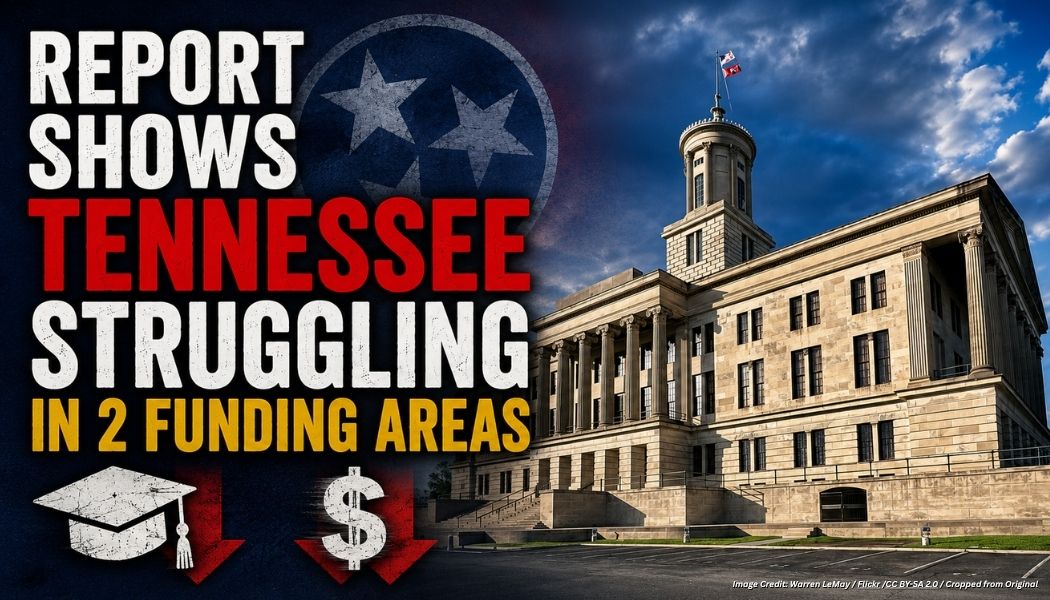
Image Credit: Warren LeMay / Flickr /CC BY-SA 2.0 / Cropped from Original
***Note from The Tennessee Conservative – this article posted here for informational purposes only.
The Center Square [By Kim Jarrett] –
Tennessee has structural deficits in funding for transportation and lottery-funded scholarships, according to the Tennessee State Budget Primer released by the Sycamore Institute.
The 4th annual report from the nonpartisan research organization is listing “hot topics” from the fiscal year 2027 budget for the first time. The State Budget Primer is an educational resource, and the Sycamore Institute does not make policy recommendations, said Mandy Spears, the organization’s executive vice president, in an interview with The Center Square.
The state budget approved by lawmakers and signed by Gov. Bill Lee is $57.9 billion. The fiscal year runs from July 1 to June 30, 2027.

The section outlines why transportation and lottery-funded scholarships are facing revenue shortfalls.
The state’s struggles with transportation funding have been discussed in committee meetings for the past two years.
“Like every state and even the federal government, gas tax revenues, what we’ve traditionally used to fund construction and maintenance of our roads, just don’t keep up with inflation anymore,” Spears said. “Gas taxes, fuel taxes, they used to be good kind of user fees, essentially, because how much gas you used was a nice little proxy for how much time you were spending on the road. But because of changes in fuel efficiency and electric vehicles, and then literally just the inflationary costs of building roads, those things are way out of sync now.”
The June revenue report shows that Tennessee is experiencing an uptick in all other revenues except fuel taxes. Fuel taxes were down $5.2 million, or 4.57%, when compared to June of last year, according to the Tennessee Department of Finance and Administration.
A report presented to the Tennessee Advisory Commission on Intergovernmental Relations in February shows a $3.6 billion increase in transportation projects in five years, beginning in July 2024 and ending in June 2029.
Gov. Bill Lee included a one-time $425 million investment in transportation projects in his fiscal year 2027 budget, following a $1 billion investment in fiscal year 2026.
While transportation received an infusion in recent budgets, a stopgap funding measure for the lottery was shifted. Lottery revenues fund the state’s Tennessee Hope scholarships and others.
The issues with the lottery are on the revenue and expense side, according to Spears.
“The amount of the Hope Scholarship had not actually changed in decades,” Spears said. “Meanwhile, college costs were going up.”
Tennessee’s higher education officials also expanded dual enrollment credits for high school students who want to take college courses. The credits are funded from the lottery.
On the revenue side, lottery proceeds are not growing as they did before the pandemic.
“Originally, there was some thought that it was because sports gambling became legal in a lot of states, including Tennessee,” Spears said. “It’s easier to do sports gambling. You can do it from your phone whereas with lottery, you have to go to a retailer and pay cash.”
One of the main lures of the lottery is a large jackpot, but there have been fewer of those recently.
“We were supplementing those scholarships with sports betting proceeds until essentially last year, when the legislature decided to divert those funds for a new school capital grant program as part of the Education Freedom Scholarship. So the lottery fund is no longer being supplemented by these sports betting proceeds. And so what we’re looking at in the latest projections is that these scholarship costs are going to be more than the lottery is going to bring in.”
Inflation also affects the Tennessee budget, which is heavily dependent on sales tax because the state does not have an income tax.
“As people spend more money on things, because prices are going up, the revenue system does capture those increases,” Spears said. “But once you actually adjust those numbers for inflation, you see that in real terms, the value of those dollars actually declines from one year to the next.
Inflation also affects state workers who want higher wages.
“So you often see state employee salaries going up during times of high inflation,” Spears said. “So it’s kind of multidimensional in the way that it affects the state budget as a consumer of things but also trying to collect revenue to pay for those things and support Tennesseans.”


One Response
Because of the luciferian leftist indoctrination most colleges are providing, scholarships should be limited to Conservative institutions.
If we want roads, looks like gas tax needs increased. I hope EVs are paying their share.