
Manufacturing has long been one of Tennessee’s strongest industries. Automation, production and profits are on the rise, but job growth is leveling out.
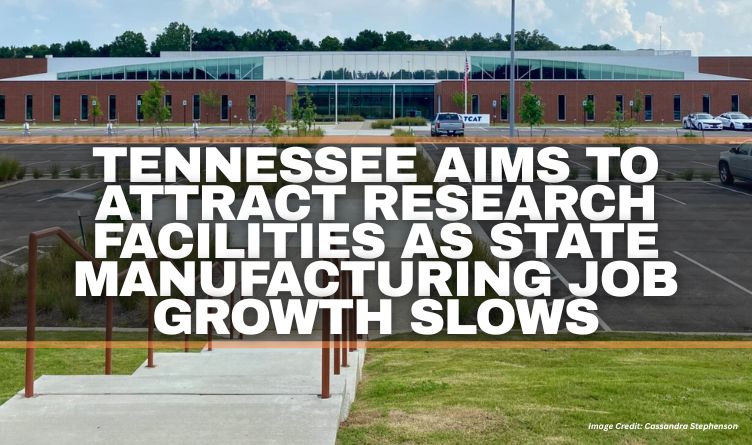
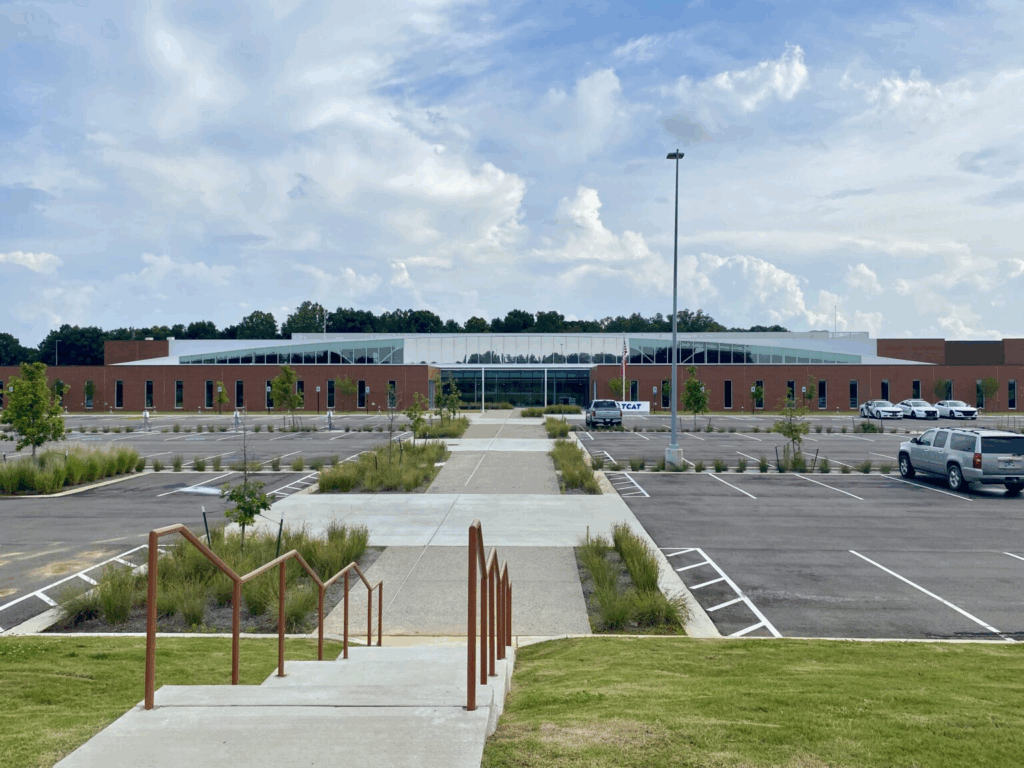
Image: The Tennessee College of Applied Technology at Stanton is just down the road from Ford’s BlueOval City campus. Image Credit: Cassandra Stephenson
***Note from The Tennessee Conservative – This article reposted here for informational purposes only.
By Cassandra Stephenson [Tennessee Lookout -CC BY-NC-ND 4.0] –
Tennessee’s economic development leaders are nudging their focus toward attracting research and development business as job growth slows in manufacturing, one of the state’s largest industries.
Manufacturing sector employment in the United States has fallen sharply in the last 40 years, dropping from about 21% of total U.S. employment in 1980 to about 8% by the end of 2024, according to the U.S. Bureau of Labor Statistics. While job shrinkage in Tennessee has been less drastic, the trend is similar.
“This industry is growing in terms of production, but it’s shrinking in terms of employment,” Celeste Carruthers, professor of labor economics at the University of Tennessee Haslam College of Business, told The Tennessee Lookout. Those patterns can be chalked up to advancements in technology, automation and robotics, in addition to offshoring manufacturing labor, she said.
Manufacturing had the highest gross domestic product of any industry in Tennessee in 2024, bringing in more than $68 billion. The industry employed 364,400 Tennesseans that year, federal data shows — a modest increase from the state’s pre-pandemic high of 355,600 manufacturing employees in 2019.
An annual state economic outlook report presented to Gov. Bill Lee by the University of Tennessee’s Boyd Center for Business and Economic Research projected that Tennessee manufacturing jobs will “remain flat or see modest increases” in the long term, while nationwide manufacturing jobs continue to shrink.
The rising number of “advanced manufacturing” businesses choosing to locate in Tennessee translates to more capital investments, but not as many jobs, Deputy Governor and Tennessee Department of Economic and Community Development Commissioner Stuart McWhorter said at a policy forum hosted by nonprofit think tank ThinkTennessee in October.
“Advanced manufacturing is a lot of things to a lot of people, but for us, it means companies that are investing in their equipment, in their automation, (and) making things using fewer people,” McWhorter said.
Since 2019, Tennessee recorded a 61% increase in those types of projects and facilities.
“We’ve just seen this sort of decline in the number of jobs at new job projects that we’ve announced, and this (capital expenditure) number that’s just continuing to grow at a pretty exponential rate,” McWhorter said.
McWhorter is now asking companies who express interest in Tennessee to consider the state as a hub for their research and development operations as well. He cites the state’s universities, Oak Ridge National Laboratory, Chattanooga’s quantum technology center, Arnold Air Force Base and logistics innovation in Memphis as examples of Tennessee’s research and development assets.
Gov. Bill Lee spotlighted innovation as an investment priority in his seventh State of the State Address in January, proposing more funding for trade schools and nuclear energy.
“If you look at 10 states that we typically compare ourselves to, we’re at the bottom, or near the bottom, in terms of R&D spend in our state, and we can do better than that,” McWhorter said. “We’ve just got to make sure that we lean in on that and make sure the industry understands it.”

State emphasizes technical college investments, research and development potential
Tennessee has poured hundreds of millions of grant dollars into attracting and expanding manufacturing businesses over the last decade.
From 2017 to 2024, Tennessee spent nearly $276 million to provide state job creation tax credits to businesses, more than half of which supported the creation of 33,409 manufacturing jobs, according to a report on Tennessee’s economy released in September by ThinkTennessee.
Automotive manufacturing has become one of the state’s highest priority industries for economic development, and its footprint in Tennessee grew from 264 establishments in 2019 to 305 establishments in 2022, according to ThinkTennessee’s report.
State leaders have particularly celebrated manufacturing investments as employment opportunities in rural communities. The announcement of more than 5,800 promised jobs at Ford and SK On’s new BlueOval City electric vehicle manufacturing plant in 2021 was heralded as a game-changer for rural communities in West Tennessee, though Ford has since delayed vehicle production at the plant until 2028.
Matt Kisber served as a Democrat state representative and was commissioner of the Tennessee Department of Economic and Community Development under former Gov. Phil Bredesen before moving to his current private sector position as co-founder and CEO of solar energy company Silicon Ranch Corporation.
He and Bredesen took a trip to Wolfsburg, Germany to visit Volkswagen’s global headquarters when the company announced their Chattanooga plant.
“We’re going through this hall, they call it the Ghost Hall, and you don’t see a single person,” Kisber recalled. “It is where the undercarriage and the body of the vehicle are married, and it’s bolted and welded, and it’s all done by robotics.”
Kisber said company leaders told them that technical degrees are required to work in the Ghost Hall.
Advanced manufacturing jobs that are coming to Tennessee will require that higher skill level — the ability to problem solve, communicate with teams and work with the robotics that are actually doing the work of production, he said.
Tennessee leaders have emphasized efforts to prepare Tennesseans for these opportunities for the last several years, including expanding technical college options.
The Tennessee College of Applied Technology opened an extension campus down the road from the BlueOval City campus in Stanton in 2024, for example.
McWhorter said the state is continuously working to identify and narrow skill gaps in the state’s workforce. The state launched TNWorks, a “central hub” to connect employers to workforce development services and provide data, this year.
Tennessee Department of Labor and Workforce Development Commissioner Deniece Thomas said innovative manufacturing processes will still require a “human in the loop” to oversee automated systems.
Advanced manufacturing skills are useful outside of the manufacturing industry, she added.
“It’ll be disruptive, but some of those disruptions will be healthy,” Thomas said.