Image Credit: Canva.
Article by Olivia Lupia, Tennessee Conservative News –
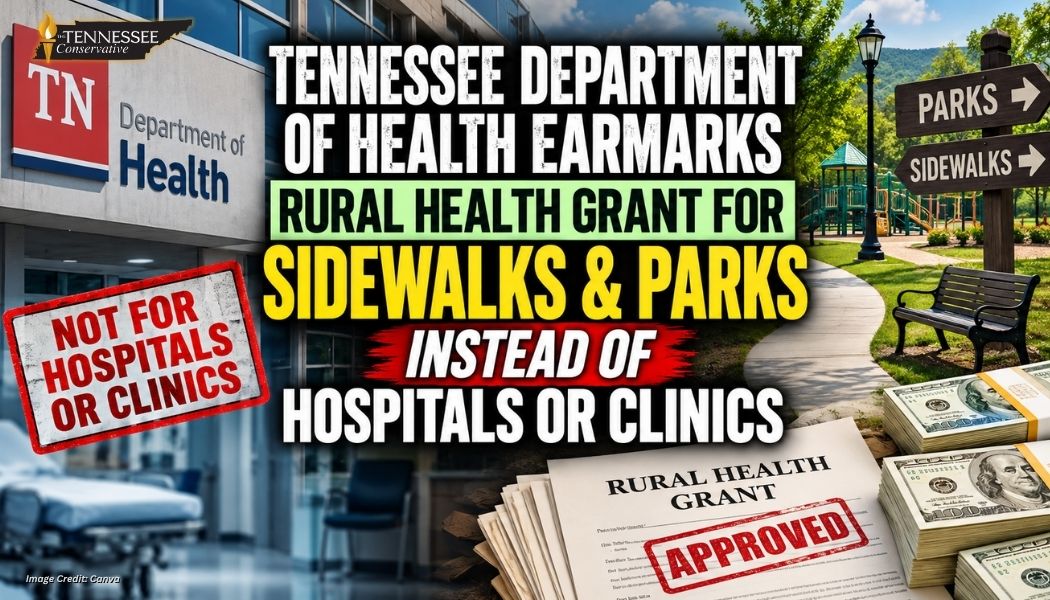
After receiving nearly $207 million through a federal grant program funded through the “One Big Beautiful Bill” (OBBB) in 2025, the Tennessee Department of Health (TDH) has decided to not to focus the first round of disbursements on hospitals, ambulances or medical clinics, but projects like sidewalks, community gardens, and playgrounds.

The Rural Health Transformation Program is a new initiative approved through the OBBB, aimed at improving healthcare access in rural communities.
But instead of focusing the new funds on helping secure hospital or clinic access and availability in rural areas, the state has announced the initial recipients of the funds will be organizations and cities for 53 projects focused on building walking trails and sidewalks, introducing community gardens, fitness programs, and creating social gathering spaces and “inclusive” playgrounds across 44 counties.
These projects appear to align with the priorities of the TDH’s Healthy Active Rural Tennessee (HART) program which is designed to improve health outcomes “through ‘built environment’ projects in rural and suburban Tennessee communities” and “support projects that encourage physical activity, healthier lifestyles, community resilience, and access to health-promoting spaces.”
A TDH press release from May of this year further detailed the aims the department has for the first round of the federal funding, with the agency expressing a focus on a Perinatal and Pediatric Behavioral Health Teleconsultation and Education Project which will “support the use of technology to expand access to behavioral health education and consultation services” to improve health outcomes for women and children in rural communities.
Besides HART projects, grant opportunities were opened for organizations or cities in areas including Healthcare Resiliency Program for Maternal Child Health, Chronic Disease Prevention, Memory Care Assessment Network, Health Tech Innovation, Make Rural Tennessee Healthy Again (MaRTHA), and County Health Council CARE Grants.
HART project funding comes as many rural communities continuously struggle with limited healthcare access, including 22 counties not having a local hospital and 17 counties lacking emergency department services, according to the Beacon Center of Tennessee.
And Alexis Fante with March of Dimes told media in December of 2025, “There’s 27% of Tennessee women that don’t have a birthing hospital within 30 minutes of where they live.”
But state officials seem to think a focus on prevention and healthy living initiatives is a better place to start. “An ounce of prevention is worth a pound of cure,” it wrote in its grant application. This approach could be fueled in part due to restrictions in the program which stipulate funds cannot be used for brick-and-mortar medical center construction, clinician salaries, loan repayment, hospital operating deficits, historical debt, or raising reimbursement rates.
While Tennessee is using the first round of Rural Health Transformation funding to focus on encouraging lifestyle changes, additional funding opportunities will supposedly be used to address broader healthcare needs like recruiting healthcare workers, supporting struggling hospitals, modernizing technology in rural healthcare facilities, addressing chronic disease, and expanding mobile mental healthcare services.

The exact amount of funding for the HART projects has not been released by TDH, and it is currently unknown when the next round of Rural Health Transformation grants will be awarded. As the federal program is funded through 2030 Tennessee could see additional funds, though the federal government has not indicated how much.
State lawmakers previously expressed skepticism at some of the conditions attached to accepting the federal funding, including a requirement to eliminate the state’s Certificate of Need law. Without that provision, the state is susceptible to a claw back of over $8 million in the first year of funding and $10 million in future years.
But the legislature did pass a bill addressing the issue so the claw back should not affect the funds Tennessee has received. Some lawmakers were also hesitant to commit funds for projects when the federal funding availability may fluctuate depending on how other states perform and how well Tennessee is able to meet its own goals.
Sources:
TennesseeConservativeNews.com.
TennesseeConservativeNews.com.


About the Author: Olivia Lupia is a political refugee from Colorado who now calls Tennessee home. A proud follower of Christ, she views all political happenings through a Biblical lens and aims to utilize her knowledge and experience to educate and equip others. Olivia is an outspoken conservative who has run for local office, managed campaigns, and been highly involved with state & local GOPs, state legislatures, and other grassroots organizations and movements. Olivia can be reached at olivia@tennesseeconservativenews.com.
One Response
Guess they’ll pay to get folks to use them next?