The two cases — the size of Metro Nashville Council and control over the city’s airport — will test state lawmakers’ ability to impose laws on cities
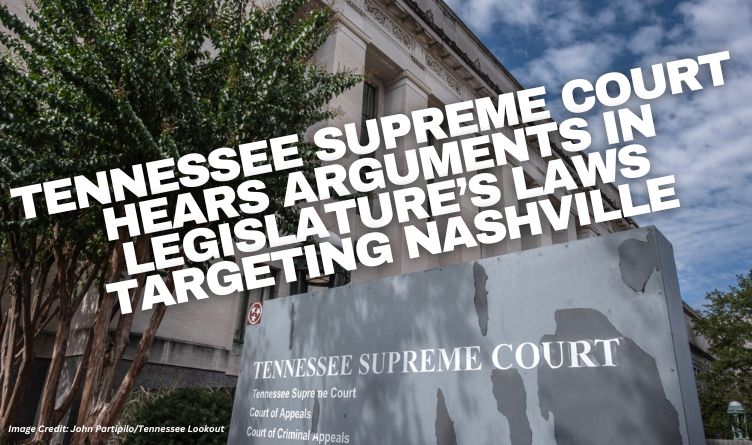
Image Credit: John Partipilo/Tennessee Lookout
***Note from The Tennessee Conservative – this article posted here for informational purposes only.
By: Adam Friedman and Cassandra Stephenson [Tennessee Lookout -CC BY-NC-ND 4.0] –
Tennessee’s Supreme Court heard oral arguments Thursday in two cases with implications for state lawmakers’ ability to wield influence over local governments that run contrary to their interests.
Justices heard arguments on whether state legislators have the constitutional authority to require the Metro Nashville Council to reduce its size from 40 to 20, and whether the state can take majority appointment control over the Metro Nashville Airport Authority.

The airport case also serves as a litmus test of other state legislation targeting the city’s boards controlling Nashville’s sports stadiums, convention center, and fairgrounds.
Nearly three years ago, the Republican-controlled Tennessee Legislature passed a slate of laws targeting Metro Nashville. The legislation followed an escalation in political power moves by both legislative bodies.
Republican state lawmakers redistricted Nashville’s U.S. congressional seats in 2022 and successfully eliminated a seat that represented the city, carving the reliably Democratic Congressional District 5 up into three portions. The Metro Council and then-Nashville Mayor John Cooper blocked the city’s bid to host the 2024 Republican National Convention.
Nashville’s mayor and the council are nonpartisan offices, but Cooper’s brother, Jim Cooper, was the Democratic representative for Nashville before the redistricting.
In all cases, Metro Nashville’s lawyers have argued that Tennessee’s Home Rule prevents lawmakers from enacting laws that impact the city without local approval. The difference between the two cases is whether the laws apply to Nashville alone or to a sufficient number of cities, thereby rendering home rule moot.
In the Metro Council case, a panel of the Tennessee Court of Appeals ruled 2-1 that the council law applied to all forms of metro government and was constitutional because it didn’t target Nashville specifically. The law requires all legislative bodies of metro governments to have 20 or fewer members. There are three metro governments in Tennessee, but only Nashville’s has more than 20 members.
Justice Sarah Campbell, a Gov. Bill Lee appointee, pointed out on Thursday that the Metro Council size law addressed “multiple scenarios” for how the law can go into effect and that it was “significant” in showing that the law might not only apply to Nashville.

Another appeals court panel ruled 3-0 that, in the airport case, the law was written to target Nashville and wasn’t constitutionally valid.
The Supreme Court justices were more skeptical on Thursday of the state’s argument that the Nashville airport was a statewide concern and that’s why lawmakers sought majority appointment control.
Chief Justice Holly Kirby, an appointee of former Gov. Bill Haslam, indicated that the state’s focus on Nashville International Airport undercut its argument that it should have board control because the airport is a statewide concern.
“Other airports have similar effects, but the legislature chose only to address the one in Nashville,” she said.


One Response
Lucifer’s accursed dimmercrap cities, cancers on the face of God’s green earth, are total failures at governance, NEED to be ran by the States.