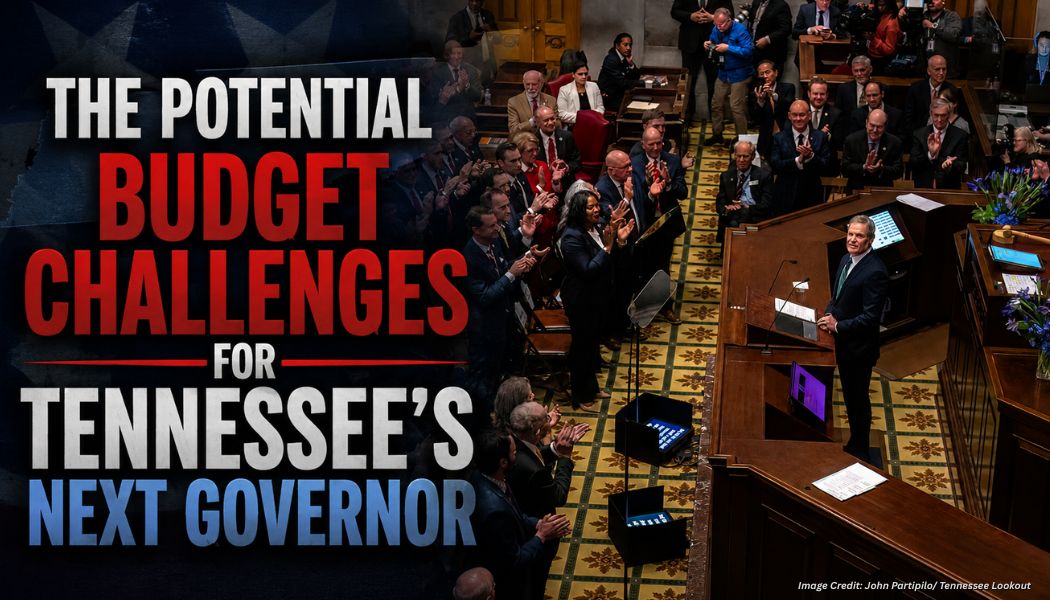
Image Credit: John Partipilo/ Tennessee Lookout
***Note from The Tennessee Conservative – this article posted here for informational purposes only.
By Adam Friedman [Tennessee Lookout -CC BY-NC-ND 4.0] –
For the past eight years, Tennessee has seen an ever-increasing state budget, with surpluses often in the billions of dollars.
The growing pot of money has allowed Gov. Bill Lee and state lawmakers to use the extra cash for large-scale infrastructure projects, to cut taxes and expand the state’s private school voucher program.
But with a cooling economy and changes to the amount of federal cash that makes its way to the state, Tennessee faces a more challenging budgetary environment going forward, according to a report by The Sycamore Institute, a nonpartisan think tank.

Mandy Spears, Sycamore’s executive vice president, said the state is still in a strong financial position, partly because of conservative budgeting, but the next governor faces several important budgetary decisions.
”There are a lot of unresolved issues for the next administration,” Spears said.
Top of the list in the report was road funding, a long-standing problem, as the state’s 2017 gas tax increase hasn’t kept pace with rising construction costs and the state’s growing infrastructure needs.
Lee’s administration has typically funded construction projects using past surpluses, dedicating almost $4.7 billion in additional funding over the past three years. But the administration and lawmakers have not created a new dedicated funding source to fill the gap between tax collections and costs.
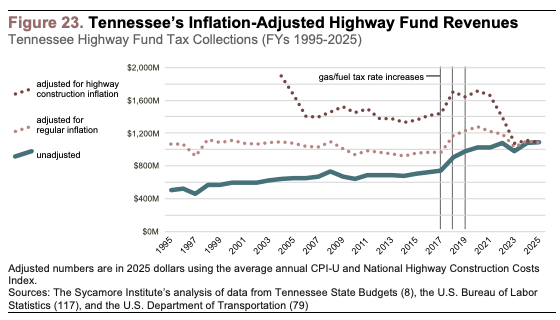
Tennessee’s next governor, elected this fall to replace the term-limited Lee, will likely have a $1.2 billion surplus that could be used for roads depending on other increased costs in the budget.
President Donald Trump’s One Big Beautiful Bill, which passed in June 2025, reduced the amount of money the federal government gives to states. Tennessee’s budget for this year is $57.9 billion dollars, and about 51% comes from state taxes, according to Sycamore.
But next year, Spears said the state could be required to cover more expenses, particularly in the Supplemental Nutrition Assistance Program, SNAP, and Tennessee’s Medicaid program, TennCare, because of a lower federal match.
Tennessee already increased its funding to cover a large portion of the $77 million in additional state funding required for SNAP this year and going forward. But the lawmakers could be on the hook for another $171 million in federal penalties if Tennessee continues its past SNAP payment error rate, which measures how accurately officials determine household eligibility and benefit amounts.
For TennCare, because Tennessee’s per capita income is rising, the federal government has been reimbursing the state for less of the program. Lower federal cost coverage means the state must cover the difference or find a way to reduce the number of people on TennCare.
“Even the tiniest of changes in TennCare could cost hundreds of millions of dollars,” Spears said, adding that TennCare is by far the state’s largest expense at $19.2 billion, of which 60% is covered by the federal government.
Other challenges the state faces, according to Sycamore’s report, include higher costs for state projects than expected as a result of inflation.
This played out earlier this year when lawmakers and Metro Nashville officials agreed to move $300 million from the downtown tourist zone to help cover a shortfall in initially projected construction costs for East Bank infrastructure. A road extension connected Oracle’s new campus to East Nashville, estimated at $40 million in 2021, is now projected to cost $60 million, according to the Nashville Business Journal.
The report also notes the Tennessee Education Lottery’s budget deficit, as the number of scholarships has outpaced revenue. The lottery is bringing in less money than previous years, at least partially driven by the introduction of sports betting. Lawmakers also decided in 2025 to shift sports betting funds to cover new school construction as part of a deal to pass private-school vouchers.
The deficit is projected to continue for the foreseeable future and could reach several hundred million dollars by 2030.


One Response
SNAP’s buying of junk “food” and drinks NEEDS stopped.
Looks like gas tax is going up.