Image Credit: Canva.
Article by Olivia Lupia, Tennessee Conservative News –
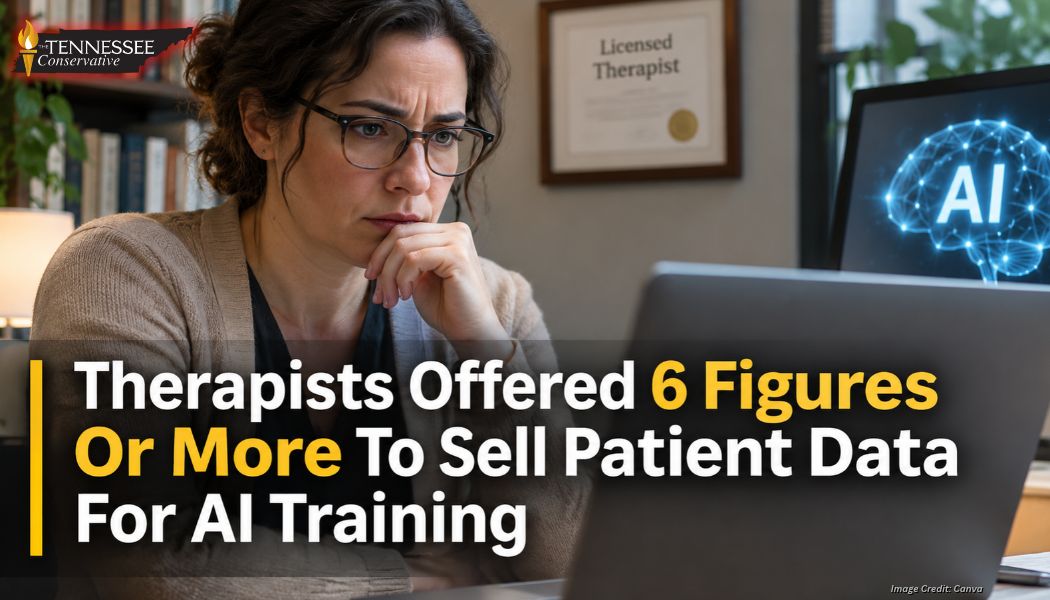
Therapists have reportedly been receiving “life changing” offers from artificial intelligence (AI) for the sale of their patient record data, raising major concerns about legal and privacy risks and shining a troubling light on the continuing growth of the AI training market.
The Nashville Business Journal reports that several therapists and mental health practices have been offered between $150,000 and $1 million to license patient records, progress notes, and scheduling data, possibly exposing them to severe financial, ethical, and legal risks should they accept.
AI companies appear to be targeting small-to-medium sized practices by sending cold emails pitching big bucks to obtain data that will be “de-identified” and scrubbed by the AI company.

One therapist in Utah, Bri Leavitt, recently recounted her experience on TikTok, saying she received an email from a company asking whether she’d consider licensing her practice’s data and offering her $170,000-$930,000 for “fully de-identified” data including client notes, session recordings, and billing records.
“I thought that what we do as therapists is supposed to be confidential. Is supposed to be somewhat sacred,” Leavitt said. “And now these AI companies are wanting to poach what we do.”
Others then began sharing across social media platforms near-identical pitches they received as the overall market for AI training data continues to grow. One consulting and research firm estimates the current global market at $4.4 billion with projections to hit $23.18 billion by 2034.
AI labs are reportedly facing a scarcity of publicly available original, human-generated text on which to train their models, with some even ending up in copyright lawsuits. This has driven companies to strike licensing deals with platforms and news providers for content and targeting private medical and mental health archives.
While the offers the therapists described may not be wholly verifiable as legitimate, there is conclusive evidence that companies are licensing their real-world data to AI developers. One example is a company named Protege which has reportedly aggregated access to more than 3 billion clinical notes, reiterating that these AI companies view such information as an asset worth paying for.
It is currently legal for these practices to sell de-identified health data, though this raises more questions about the definition of “de-identified”, how much of a patient’s personal information is actually redacted, and how that data is being used by the AI developers after the sale.
There are two methods to de-identify health data under the HIPPA Privacy Rule. The “Expert Determination” allows a qualified expert to certify that the risk of identifying someone is “very small”.
Or the “Safe Harbor” method removes 18 types of identifiers from the data including names, certain geographic details, most dates, phone numbers, email addresses, biometric identifiers, full-face photos, and any other “unique identifying characteristic or code”.
Once the information is de-identified to these standards, HIPPA no longer considers it protected health information, and the rules about selling that protected information no longer apply. And according to some legal precedents, once the health data is officially labeled as de-identified, patients may have very little recourse, even if they never knew their data was being sold.
Additionally, the advances in AI technology over the past decade have made it easier for AI to engage in reidentification, especially as “anonymized” data has been proven not to be so secret. Other studies have found that AI was able to identify individuals with accuracy rates as high as 95-100% from wearable heart-rhythm and retinal data that was classified as “de-identified”.
There have even been cases of therapy transcripts being subpoenaed in court, sometimes without the patient’s knowledge or consent. One woman who had been using a therapy app found that transcripts from her sessions were produced in court during litigation involving her former employer which discussed her personal life, emotional state, relationships, and even finances.
But while the practice of selling the de-identified data may technically be legal, mental health practitioners, and other small businesses receiving offers, are being cautioned against blindly accepting such proposals.
“Any practice considering one of these offers should ask four things in writing: Exactly which data fields? License or sale? Exclusivity and downstream resale? And, who carries liability if patients are re-identified? Then, have a healthcare attorney read the contract before the check clears,” advised Manvendra Kumar, founder of an AI workflow automation platform for service businesses.

From an ethical standpoint, communications manager for the American Institute of CPAs Professional Ethics Division Kelly D. Mullins writes, “Client confidentiality obligations do not disappear because the data is redacted, labeled ‘anonymous’, or framed as a technology partnership. Before you say yes, you need to evaluate whether the disclosure is permitted, authorized, and consistent with your professional responsibilities… Removing names and other identifying details does not change the confidential nature of the underlying information or eliminate your obligations.”
And a group of therapist consultants advocate, “Remember that you’re the one holding the key. Protect your clients, read what you’re signing, and build a practice where you get to decide what happens to the stories people trust you with.”
Sources:


About the Author: Olivia Lupia is a political refugee from Colorado who now calls Tennessee home. A proud follower of Christ, she views all political happenings through a Biblical lens and aims to utilize her knowledge and experience to educate and equip others. Olivia is an outspoken conservative who has run for local office, managed campaigns, and been highly involved with state & local GOPs, state legislatures, and other grassroots organizations and movements. Olivia can be reached at olivia@tennesseeconservativenews.com.