
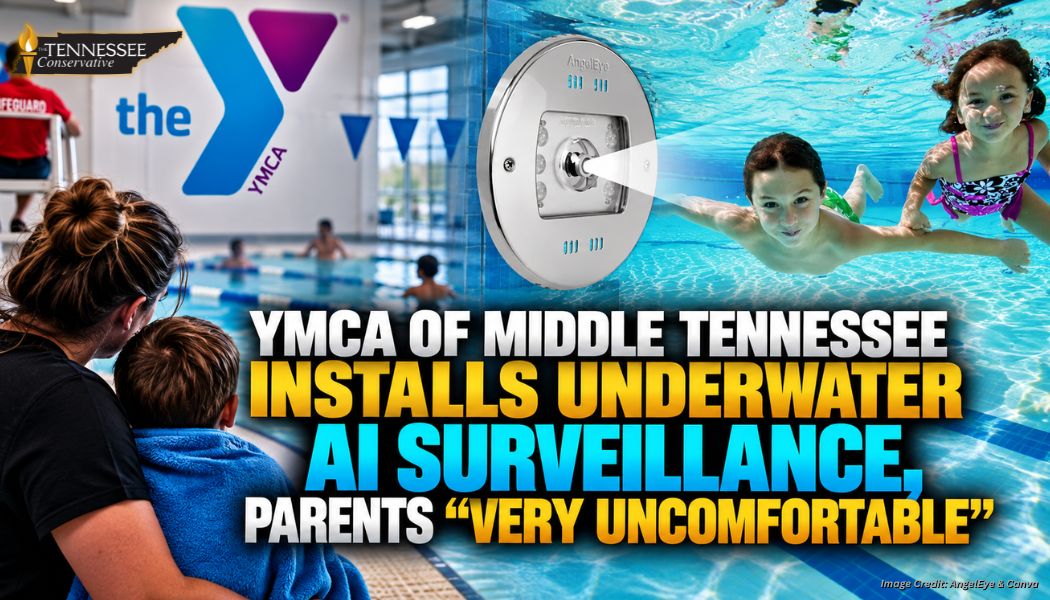
Image Credit: AngelEye & Canva.
Article by Olivia Lupia, Tennessee Conservative News –
Last Friday, Middle Tennessee YMCA members received an email announcing an artificial intelligence-powered camera system has been installed at the center’s indoor pools, sparking concerns amongst parents about their children being constantly recorded while they swim alongside other serious privacy and data safety worries.
According to the Y, the association launched “a successful pilot program” in 2025 of AngelEye, an underwater AI-powered camera system “to help identify possible swimmer distress and notify on-duty lifeguards in real time.” Upon the conclusion of the pilot program, the Y started installing the camera system in indoor pools in May 2026 and plans to have all 12 indoor pools equipped with AngelEye by the end of the year.

A spokesperson for the organization said the technology is not intended to replace lifeguards but instead add an extra layer of safety. If the cameras detect a body that’s gone underwater, it will notify lifeguards via their smartwatches.
Regarding privacy, the Y webpage says, “AngelEye operates on a closed, secure network designed to protect swimmer privacy and support emergency response efforts. Images captured by the system are used only for drowning detection, emergency response and, when applicable, lifeguard training, and are never sold or shared with third parties.”
But that assurance is not enough for many parents who are asserting that underwater surveillance crosses a line.
“My immediate concern went to the idea of there being cameras under the water,” said mother Catherine Aisbitt. “My son, who’s 8 years old, overheard us talking about it, and he said he wouldn’t want to swim if there were cameras underneath.”
She added, “One of the things the Y said in the email was that the data would not be sold on… but in my opinion, no technology is foolproof or safe from hacking. I think we’ve seen that through many systems. There’s always a way to hack, especially when it comes to A.I. technology.”
Other parents have begun an online petition demanding the Y stop use of the camera system, saying members were unaware of the cameras and worrying the footage could be sold or used to train AI models amongst numerous other listed concerns.
In response, the Y released a statement reiterating the AngelEye system operates on a secure network and that images will not be used for any other purposes besides drowning detection and lifeguard training.
“We want to reassure members that the safety and privacy of our members are always our top priority, including in our decision to deploy this potentially life-saving tool. AngelEye operates on a closed system that underwent rigorous security review. Any images captured by the system are used only for drowning detection, emergency response and, when applicable, lifeguard training. They are never sold or shared. Every second matters in a water emergency…Even a small amount of additional response time can make a meaningful difference during an emergency,” the statement read.
But some cybersecurity experts have concurred with the parents, stating that a closed system doesn’t make it impervious to the possibility of hacking or other misuse.
Dr. Jared M. Smith, a private-sector cybersecurity expert, said, “The recent coverage of abuse of Flock camera data by internal users of the ‘closed’ system applies here. Beyond those concerns of an internal user abusing the system, parents and YMCA members have every right to be concerned about the system even if the company claims that it is closed or secure.”
Smith pointed to common safeguards, such as limited user access or auditable access logs as ways to help prevent and identify misuse, but it is unclear whether the Y has such guardrails in place for AngelEye.
The camera system has been deployed in at least nine other U.S. markets, one being Los Angeles County. The Center for Digital Government (CDG) presented an award to the county for the software’s help in reducing the average response time from 9.5 seconds to 1.7 seconds to a swimmer in distress.
But faster detection has not necessarily correlated to less drownings, as Los Angeles County reported a 7% spike in accidental drownings in the five years after implementing the technology, though it was not specified whether the technology impacted those numbers.

While experts continue to debate the pros and cons of increased technology in drowning prevention, perhaps the parents have the perspective that matters the most.
“I’d hate it to impact numbers, but it just doesn’t feel safe,” said Aisbitt. “I can’t imagine going into the pool now with my little daughter knowing that there are cameras underneath the water. I mean, it’s very, very uncomfortable.”
Sources:
YMCA.
WKRN.
WKRN.


About the Author: Olivia Lupia is a political refugee from Colorado who now calls Tennessee home. A proud follower of Christ, she views all political happenings through a Biblical lens and aims to utilize her knowledge and experience to educate and equip others. Olivia is an outspoken conservative who has run for local office, managed campaigns, and been highly involved with state & local GOPs, state legislatures, and other grassroots organizations and movements. Olivia can be reached at olivia@tennesseeconservativenews.com.