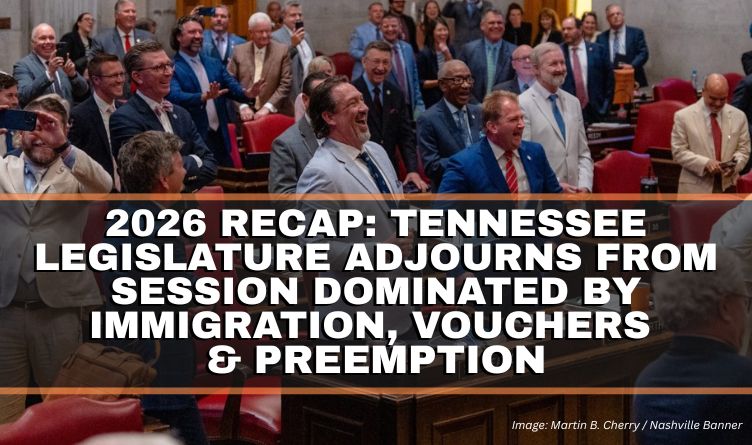
Here’s a recap of the biggest bills that passed and those that fell short during the two-year session.
Image: Martin B. Cherry / Nashville Banner
***Note from The Tennessee Conservative – this article posted here for informational purposes only.
This story was originally published by the Nashville Banner. Sign up for their newsletter.
by Sarah Grace Taylor, [The Nashville Banner, Creative Commons] –
Tennessee Lawmakers adjourned late Thursday after a marathon week of floor sessions, during which they heard around 150 bills to wrap up a biannual legislative session focused on penalizing illegal immigrants, spending big on private school vouchers and exerting state influence over local government.
The final days of the session repeatedly devolved into fighting between and amongst parties littered with expletives, bald jokes and other cheap shots, but dictated by questionably transparent procedural choices like muted mics, substantive eleventh hour amendments and about two dozen conference committees, only two of which were broadcast for the public as final changes were negotiated on disparate bills between the House and Senate.
Thursday’s House floor session dragged on for about 10 hours, off and on, as members were assigned to committees to iron out sticking points in near-complete bills. The final bill in the way of adjournment — a somewhat watered-down effort by the state to assert control over the Memphis and Nashville electric services — was, in many ways, a microcosm of the session.
The bill, which ultimately passed both chambers, adds four members to the board overseeing the Nashville Electric Service and two to its counterpart in Memphis. Members of the supermajority Republican party said the bill was necessary to give representation to customers serviced by the utilities who live outside of the primary metropolitan area.
Democrats, who almost exclusively represent Nashville and Memphis, called the move a partisan “invasion,” and threatened to see Republican leaders “in court” over the bill. Ultimately, Democrats were cut off from speaking on the bill, as is commonplace for the minority party, and it passed largely along party lines.
After it was all said and done, Republican leaders celebrated their wins for the year, citing a 15,000-voucher expansion to Gov. Bill Lee’s signature education freedom scholarship program and honoring leaders on their way out, including the term-limited Lee and retiring Lt. Gov. Randy McNally.
At a news conference after the session, Lee touted the work of legislators and said he is proud of his work in education and budgeting during his two terms as governor.
“I came to this position in 2019, very hopeful for what we could accomplish for the people and today — eight sessions and a few special sessions later,” Lee said. “I’m grateful today.”
Democrat leaders rebuffed the idea of a productive session, saying Republicans failed to address basic necessities like affordability while they focused instead on “power grabs.”
Rep. John Ray Clemmons (D-Nashville) said the Republican “victories” were not aligned with the needs of their constituents.
“We all ran for elected office to improve people’s quality of life, we ran to benefit our children, our communities, our neighborhoods, our cities and benefit every citizen across the state of Tennessee,” Clemmons said, adding that the state should focus on infrastructure, public schools and other basic services. “Just do the basic things that you think about when you dream about serving.”
Below is a summary of every bill the Banner covered in 2026. Read here for bill updates from the first year of the session.

Immigration
PLYLER PREVAILS: A central issue of the last two years was the Republican-backed effort to challenge Plyler v. Doe, the landmark Supreme Court ruling that affirmed that all children have the right to public schools, regardless of immigration status.
A bill HB 793/SB 836 by Rep. William Lamberth (R-Portland) and Sen. Bo Watson (R-Hixson) that would have allowed school districts to ban or charge tuition to students who are not legal residents dominated discussion for most of the first year of the session, as both sponsors openly invited a chance to defend the bill in court and hopefully overturn Plyler. Instead, Lamberth shelved the bill at the last minute over concerns about federal funding, bringing back and passing through the House a gutted version of the bill, which focused only on tracking. Watson, having passed the original bill through the Senate after a great deal of pushback, rejected Lamberth’s version of the bill, letting it wither in calendar limbo and never taking a vote to reconcile the two.
A short-lived amendment originally written by House Speaker Cameron Sexton would have snuck a similar reporting requirement for public schools into a school voucher bill, but was ultimately abandoned.
IMMIGRANT TRACKING: In the second year of the session, Republican leadership carried a suite of bills written by the Trump Administration and designed to crack down on immigrants in the state. Among those were HB 1710/SB 1915 and HB 1711/SB 2108, a pair of tracking bills that would impact undocumented residents who interact with local governments, schools, hospitals and other service providers.
HB 1711, which would have required law enforcement and schools to report on immigration status, potentially amounting to another Plyler challenge, stalled in committees and never got a floor vote in either chamber, but HB 1710, which requires service providers to track the status of anyone who seeks any public benefit and report those who cannot prove their status, passed this week. The approved bill also creates a Class A misdemeanor charge for any employee who fails to comply with reporting requirements.
CRIMINALIZATION: Another piece of the White House-backed agenda was HB 1704/SB 1779, a bill by Lamberth and Sen. Jack Johnson (R-Franklin) that created a criminal offense of being present in the state of Tennessee 90 days after receiving a final removal order from an immigration judge. The bill, which has been signed into law by Gov. Bill Lee, is unprecedented not only for criminalizing the civil violation of being unlawfully present, but also for establishing a state offense for the federal matter of immigration.
MANDATORY 287(g): Under HB 2219/SB 2223, all Tennessee sheriffs will have to sign agreements with the federal government to participate in some version of the 287(g) immigration enforcement program. Though the program is voluntary, the state would require local governments to participate, minimally requiring them to share the immigration status of inmates with ICE. Just two law enforcement agencies in the state were voluntarily participating in the federal 287(g) program when the session started, but that number skyrocketed to 70 after lawmakers passed an incentive program that provided $5 million in extra funding to those agencies that opted in. Now, all sheriffs would have to participate or risk losing state funding.
DRIVING: Lawmakers also passed a series of bills making it harder for immigrants to drive in Tennessee and easier to press criminal charges related to driving as part of the White House package.
HB 1708/SB 1889 requires drivers to pass the state driver’s license test in English after an 18-month grace period, despite pushback from businesses with international employees and even the Japanese Consulate. Drivers can initially pass the test in one of the five languages currently provided by the state, but will only receive a temporary license and will only be allowed to test in English going forward.
HB1817/SB 1748 targets commercial drivers by requiring law enforcement to issue “out-of-service” orders to those drivers who cannot speak English “sufficiently to converse with the general public.” The law will effectively give Tennessee a way to delegitimize out-of-state licenses for non-English speakers.
The most sweeping of these bills, HB 1706/SB 1587, established a Class A misdemeanor charge for the act of driving in Tennessee if you are unlawfully present in the country. In other words, anyone without citizenship or legal residency could face up to a year in jail and would be required to be reported to federal immigration authorities.
Education
VOUCHER EXPANSION: One year after the legislature created a statewide voucher program, it voted to expand it from 20,000 to 35,000 students for the 2026-27 school year, under HB 2532/SB 2247 carried by House Majority Leader William Lamberth (R-Portland) and Senate Majority Leader Jack Johnson (R-Franklin). School choice has been a central platform of Gov. Bill Lee’s administration, and Republican leadership pushed for voucher expansion in his final year in office. The legislature also approved last-minute changes that will alter the funding floor for public school districts that lose enrollment to vouchers and require schools to request students’ Social Security numbers.
The legislature also weakened testing and accountability requirements for the state’s older voucher program. Students in the Education Savings Account program will no longer be required to take the state’s standardized test, the Tennessee Comprehensive Assessment Program, under SB 1585/HB 1881 carried by Johnson and Rep. William Slater (R-Gallatin). In another attempt to make drastic last-minute changes, the House added amendments that would have lifted the cap on enrollment and effectively merged the two voucher programs, but those ultimately failed.
TEN COMMANDMENTS: The legislature passed several pieces of legislation that test the limits of the separation of church and state in public schools. One sponsored by Rep. Michael Hale (R-Smithville) and Sen. Mark Pody (R-Lebanon) will allow school districts to display the Ten Commandments in a prominent location in every school building. Republican legislators have argued that HB 0047/SB 0303 does not violate the First Amendment, since the Ten Commandments is a “historically significant” document.
RELIGIOUS CHARTERS: A bill carried by Rep. Scott Cepicky (R-Culleoka) and Sen. Joey Hensley (R-Hohenwald) will authorize private postsecondary institutions that are religiously affiliated to open public charter schools. HB 2000/SB 2318 has faced some pushback from charter school advocates, who worry that challenging charter schools’ status as public schools could jeopardize state funding.
CHARTER RENEWALS: Another bill regarding charter schools, HB 2177/SB 2351, requires the automatic renewal of contracts for high-performing schools. Charter schools are required to apply to their authorizer — either the school district or the state — for renewal every 10 years.
VIRTUAL SCHOOLS: The fate of a dozen virtual public schools is uncertain after the legislature passed a bill setting a three-year deadline for these underperforming schools to improve. Any virtual school that stays on the state priority list or at a TVAAS Level 1 score for three consecutive years will close. HB 2420/SB 2441 was the target of sustained advocacy among virtual school teachers and families, while legislators, including sponsors Rep. Mark White (R-Memphis) and Sen. Bill Powers (R-Clarksville), have argued that accountability for these for-profit public schools is long overdue.
ECONOMIC STATUS: Thousands of students living in poverty are currently excluded from the state’s definition of economically disadvantaged. That definition includes students enrolled in SNAP and TANF but misses many students who participate in Medicaid. A State Board of Education committee has now been tasked with reviewing that definition and making recommendations for revisions under HB 2485/SB 2385 carried by Rep. Kirk Haston (R-Lobelville) and Hensley. Expanding the category to include Medicaid could bring $20 million in state funding to Metro Nashville Public Schools.
INTERNET SAFETY:The legislature passed a bill enacting stricter internet usage policies at public school districts. Every district will be required to prohibit access to online content that is harmful to students, contains pornography or obscenity, promotes self-harm, or is violent or frightening for a student’s age or maturity level. Under HB 1886/SB 1912, carried by Cepicky and Hensley, the policy will apply to both students and employees. The legislature had considered and abandoned much stricter legislation that would have prohibited elementary schools from giving students digital devices, including laptops.
SPECIAL SURVEILLANCE:A bill that would have allowed schools to install surveillance cameras in special education classrooms was taken off notice in the House Education Committee. Bill sponsor Sen. Janice Bowling (R-Tullahoma) said SB 2485/HB 2410 would protect students and teachers. Many families and advocates support the use of cameras to provide evidence of mistreatment or abuse of students who are non-verbal. However, some worried that under the language of the bill, the footage could be used to discipline or punish students with disabilities.
REBUILDING: Students at Antioch High School still eat lunch in the cafeteria that was the site of a deadly shooting in Jan. 2025. A bill sponsored by Rep. Jason Powell (D-Nashville) would have created a school safety grant to help districts alter facilities or undergo renovations after a shooting. The Covenant School made significant changes to its campus after the 2023 shooting, and this bill aimed to make that option available to public schools. HB1288/SB 1215 failed in the Senate Education Committee without a discussion due to a lack of motion from Republican legislators.
Public safety
HIT-AND-RUN: Both chambers of the legislature unanimously approved a bill (HB1967/SB1602) increasing the penalty for leaving the scene of an accident that results in an injury or one the driver knew or should reasonably have known resulted in death. The legislation was named for James Bardsey Jr., a 19-year-old who was killed in a hit-and-run in Rutherford County in 2021.
DRONES AT PRISONS: A bill (HB1538 / SB1631) that increased the penalty for operating a drone over the property of a prison, and also authorized prison officers to shoot them down on sight, advanced through committees in both chambers but stalled before reaching the floor of either. Tennessee Department of Correction officials have told lawmakers that they need enhanced technology to combat airdrops of contraband, and the use of drones to get drugs and other items inside prisons was discussed in a federal lawsuit the Banner reported on in 2024.
SCHOOL THREATS: A bill (HB1273/SB0591) specifying that school officials are only legally required to report threats of mass violence they deem credible passed both chambers with unanimous support. The legislation, sponsored by Sen. Ferrell Haile (R-Gallatin) and Rep. Clay Doggett (R-Pulaski), is meant to avoid cases in which students, including some with disabilities, are expelled and criminally charged for making verbal threats they have no ability to carry out. Metro Nashville Public Schools saw nearly four times as many students arrested for threats during the 2024-2025 school year compared to previous years following recent changes in state law. Haile told the Senate Judiciary Committee that a 5th-grade student with disabilities in his district was convicted of a felony, put on probation and moved to homebound instruction after making a threatening comment “in a moment of frustration while transitioning between
Local government
AIRPORT TAKEOVER: Lawmakers passed HB 2507/SB 2473 to take over and reconstitute the local airport authorities of the state’s five metropolitan airports, including Nashville, Chattanooga and Memphis. Though the bill was sponsored by Speaker Sexton, Rep. Johnny Garrett (R-Goodlettsville) carried the bill through the House, saying it was necessary because of the amount of money the state invests in the airports. He also claimed that since people outside the immediate surrounding area use those airports, including residents in bordering states like Georgia and Arkansas, they should have representation on airport authorities. Democratic representatives slammed the bill as overreach from the state.
LOCAL ELECTIONS: Legislation that would force Metro Nashville to move its regular odd-year elections to even years, HB 1497/SB 1630, fell short in the Tennessee General Assembly. Supporters said the move would increase voter turnout for local elections, though odd-year Metro general elections often surpass even-year August elections in turnout. Opponents, including many in Nashville, say lumping the elections in with bigger-ticket races would drown out local issues. There were also questions about the legality of extending (or reducing) the terms of officials who have already been elected for set terms, though different amendments to the legislation approach the implementation differently. The bill passed in the House, but its Senate sponsor abandoned the effort in the final days of the session.
CLOSED PRIMARIES: An effort to close Tennessee’s primary elections, meaning voters would have to register as a member of a certain party to participate in its primary, rather than just selecting a party’s ballot on Election Day, failed to reach the floor, leaving primaries unchanged. While current law requires someone to be a “bona fide” member of a party to participate in a primary, HB 1159/SB 0831 would have been more restrictive, prohibiting day-of decisions. A similar attempt in HB 886/SB 777 also failed in committee.
EAST BANK: The Tennessee General Assembly passed SB 1672/HB 2085, a bill that will redirect surplus tax revenue currently dedicated to the Music City Center for uses on the East Bank and in downtown Nashville’s entertainment district. The funds will be used to expand the convention center and to fund hundreds of millions of dollars in infrastructure work on the East Bank. Further excess funds could be diverted to major event recruitment, public safety and grants to businesses and commercial property owners in the tourism district.
BLESSING BUS LANES: Metro Nashville needs state permission to build dedicated bus lanes on state-controlled routes, including most of the busiest transit corridors in the city. The state legislature, via SJR 0657, started that process, signing off on dedicated lanes for Nolensville Pike, Gallatin Pike and downtown Nashville. The rollout is in the planning stage and will be funded by Choose How You Move, the voter-approved sales tax surcharge now supporting transportation projects around the city. The House did add an amendment aimed at restricting bike lanes along the dedicated bus corridors.
LGBTIA bills
NO PRIDE MONTH: HB 1474/SB 2409, otherwise known as the “No Pride Flag or Month Act,” one of a series of anti-LGBTQIA+ bills introduced by Rep. Gino Bulso (R-Brentwood), failed to make it to the floor this year, killing his efforts to ban symbols of pride on all state properties. Opponents criticized the bill for violating free speech. Though Bulso’s bill flopped, Gov. Bill Lee recently declared June, which is nationally known as LGBTQIA+ pride month, “Nuclear Family” month, a less material but similar slight against the queer community.
OBERGEFELL: Another of Bulso’s bills, HB 1473/SB 1746, sought to limit who was bound by the U.S. Supreme Court Obergefell v. Hodges decision, basically saying that certain entities in Tennessee would not have to recognize same-sex marriage. Though the legal scope and authority of Bulso’s bill were unclear, the bill initially passed the House floor but was punted by the Senate.
TRANS TRACKING: A bill requiring health care providers to report gender-affirming care to the state passed both chambers this year after years of effort by sponsor Rep. Jeremy Faison (R-Cosby). HB 754/SB 676 requires doctors to report transitioning and detransitioning care to the state in aggregate, not by name. The information will then be shared in a public database, an unprecedented measure to track any form of healthcare. Proponents of the bill say it’s necessary to measure the scope of care being provided and ensure that those who change their minds are able to reverse gender affirming care. Opponents say that the law will unfairly violate the privacy of trans and gender nonconforming individuals, though cisgender patients often receive similar hormonal and cosmetic care.
TRANS INMATES: Another anti-trans bill will require inmates to be incarcerated in prisons based on their assigned sex at birth. The “Riley Gaines Women’s Safety and Protection Act,” HB 051/SB 0468, passed both chambers this week, mirroring a bill by the same name from Louisiana, which disallowed intersex and transgender inmates from being incarcerated with any gender other than that assigned at birth. While sponsors say the bill is designed to protect cisgender female inmates, opponents say the bill violates the Prison Rape Elimination Act, and ignores the fact that transgender and intersex inmates are more likely to experience gender-based violence.
TRANS TEACHERS: HB 0571/SB 0468 passed the House during the same floor session and prohibits schools from requiring students, teachers or other employees to refer to any teacher by honorifics not associated with their gender assigned at birth. In other words, a school cannot require anyone to recognize a transgender teacher as “Ms.” if they were born male, or “Mr.” if they were born female.
Other
HOME OWNERSHIP: Despite unusual bipartisan support carrying the bill through the Senate, an affordable housing bill by Sen. Charlane Oliver (D-Nashville) and Rep. Aftyn Behn (D- Nashville) failed due to a lack of a second in the House Cities and Counties Subcommittee when Rep. Bo Mitchell (D-Nashville) chose to ignore the bill. The act of friendly fire and public response from both sponsors showed division among Democrats after Behn beat Mitchell in a special Congressional primary last fall, which seemed to kill HB 0298/SB 0242, the “Homes not Hedge Funds Act.” After public backlash from his party, Mitchell later signed HB 2340/SB 2516 over to Behn to take another crack at similar legislation, but the bill stalled before reaching any floor votes.
KRATOM BAN: Lawmakers outright banned kratom, a plant-derived substance that is often sold in gas stations and has dubious research to back up its homeopathic claims. Though often packaged as a supplement, Republicans called the drug “gas station heroin” as they overwhelmingly voted in both chambers to approve HB 1649/SB 1656, a sweeping ban of all forms of kratom, after a Chattanooga man died of an adverse interaction between a kratom product and his prescription medications.
Putting the kibosh on kratom was one of many changes in available substances in Tennessee, but likely less noticeable than last year’s bans on cannabis sales, which will take full effect this summer.
IBOGAINE INTEREST: While other substances were stalled and outlawed, Republicans rushed a bill through committees in the last week of the session that allows Tennessee research institutions to wade into the study of ibogaine, a Trump-endorsed hallucinogenic drug. While HB 2075/SB 2149 does not invest any state money into the study, it allows Tennessee researchers to get in on a $50 million allotment from Trump to study the drug, which some theorize could be therapeutic for PTSD, traumatic brain injuries and addiction.
PREDICTION MARKETS: With prediction markets like Kalshi and Polymarket becoming ubiquitous and allowing people to wager on everything from sports to politics and the details of international conflicts, Tennessee lawmakers passed a bill that makes it a felony to engage in conduct intended to influence the outcome of an event while they have a wager on. The legislation (HB2079/SB1992) was sponsored by Rep. Mary Littleton (R-Dickson) and Sen. Ferrell Haile (R-Gallatin); it was approved with almost unanimous bipartisan support.
ROBOTS: Even as lawmakers passed a number of bills regulating artificial intelligence, physical delivery robots got the greenlight to go faster and move through crosswalks and bikelanes. HB 1684/SB 1625, a DoorDash-backed bill passed by both chambers in March, allows unmanned cargo robots, some weighing up to 350 pounds, to travel up to 20 miles per hour. While rules are loosened for the robots on the state level, cities still have the authority to determine whether and where the robots can travel within their jurisdictions.
*Nashville Banner Staff reporters Lillian Avedian, Stephen Elliott and Steven Hale contributed to this story.


One Response
Thanx!