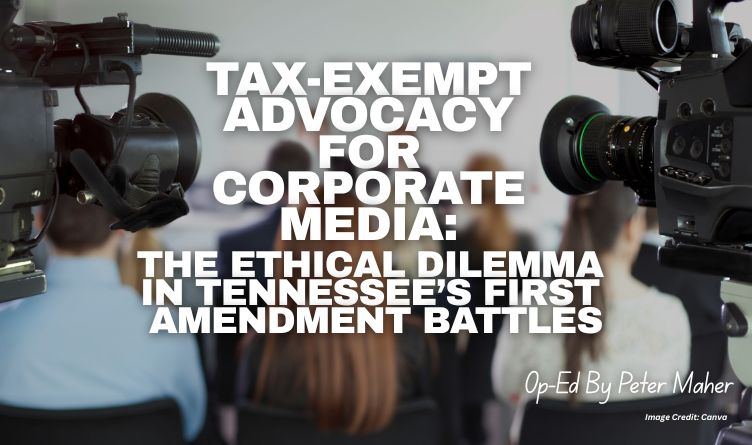
Image Credit: Canva
Submitted by Peter Maher –
The Reporters Committee for Freedom of the Press (RCFP), a nonprofit 501(c)(3) founded in 1970, proudly champions First Amendment rights in Tennessee. Funded largely by private donations and foundation grants, RCFP positions itself as a defender of Tennessee’s First Amendment and press freedoms. The nonprofit currently reports total assets of about $22.1 million as of the end of 2024. But in Tennessee, its litigation record raises an uncomfortable question: Who benefits most from this tax-exempt and public interest advocacy?
Who Gets Represented?

A quick review of recent RCFP Tennessee lawsuits shows a clear pattern:
• Tennessee News Organizations Sue Over Police Buffer Law
RCFP joined a coalition challenging a law that restricts how close journalists can approach police activity. The plaintiffs? Major corporate outlets like Gannett’s USA Today Network and Nexstar Media Group.
• Media Coalition Challenges Access Restrictions to Memphis Juvenile Delinquency Proceedings
Again, the coalition includes The Daily Memphian (a nonprofit) but is dominated by for-profit entities such as The Commercial Appeal (Gannett) and Memphis’ WREG (Nexstar).
• Media Coalition Continues Fight for Transparency in Memphis’ Tyre Nichols Case This lawsuit sought release of records tied to Nichols’ death. While undeniably newsworthy, the plaintiffs were the same corporate players—not independent journalists or rural news outlets.
• Media Coalition Challenges Tennessee Restrictions on Press Access to Executions
The plaintiffs included Associated Press, Gannett (USA Today Network), and Scripps Media—national corporations with their own deep pockets, attorneys, and broad reach.
Despite RCFP’s nonprofit status, research reveals few, if any, Tennessee cases where tax-exempt RCFP attorneys represented individual journalists or addressed First Amendment concerns unique to any of our small or rural communities. Independent journalists appear absent from each of RCFP’s most prominent dockets.
Here’s the irony: tax-exempt legal services intended to protect public interest are overwhelmingly deployed for corporate media giants—companies that profit from news but often limit public engagement. Consider this:
• Gannett’s USA Today Network (including The Commercial Appeal, The Tennessean, and Knoxville News Sentinel, and Chattanooga Times Free Press) disabled online reader comment sections in 2023.
• Other coalition media members, including Nexstar outlets, similarly restrict or forbid reader expression and dialogue.
So, while these organizations invoke the First Amendment to demand government transparency, they simultaneously curtail public dialogue and expression on their own platforms. This contradiction deserves scrutiny.

Compounding the issue, Tennessee’s largest public law schools—the University of Memphis and the University of Tennessee—appear to have eliminated curricula covering state-specific First Amendment laws, including the Tennessee Public Records Act and Open Meetings Act. At a time when rural communities struggle for access and accountability, the pipeline for local legal First Amendment expertise is all but gone.
When nonprofits like RCFP leverage tax-exempt status to litigate primarily for corporate interests, the public should ask:
• Is this truly serving Tennessee’s broader First Amendment mission?
• Who speaks for rural Tennesseans and protects our state’s independent journalists?
• Should tax policy incentivize advocacy that benefits billion-dollar media conglomerates while Tennessee’s grassroots voices remain unheard?
The First Amendment belongs to every Tennessean—not just those with the resources to benefit from elite and tax-exempt legal teams. If Tennessee’s legal and academic institutions retreat from this space, and public interest nonprofits prioritize corporate clients, the gap between constitutional ideals and lived reality for everyday Tennesseans will only widen.


One Response
It’d be REAL interesting to know the REAL incomes of the heads.
The Reporters Committee for Freedom of the Press (RCFP) is led by Bruce D. Brown, who serves as the executive director.
He has held this position since 2012 and is also referred to as the president of the organization.
The leadership team includes Katie Townsend, who is the deputy executive director and legal director
, and other key officers such as Gabe Rottman, vice president of policy, Jenn Topper, vice president of communications, and Danny Yu, vice president of finance and operations