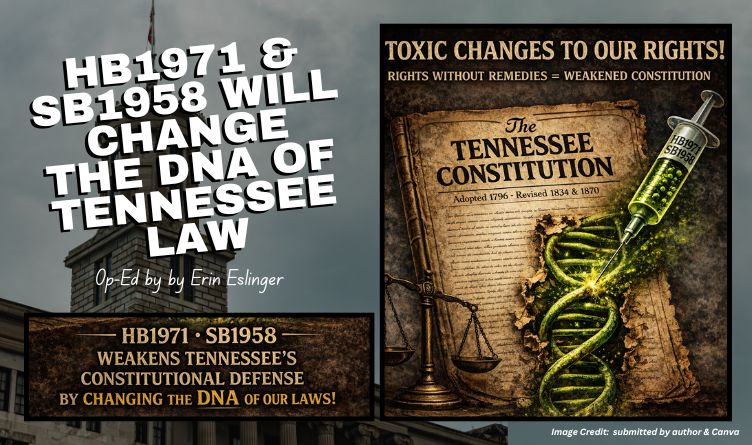
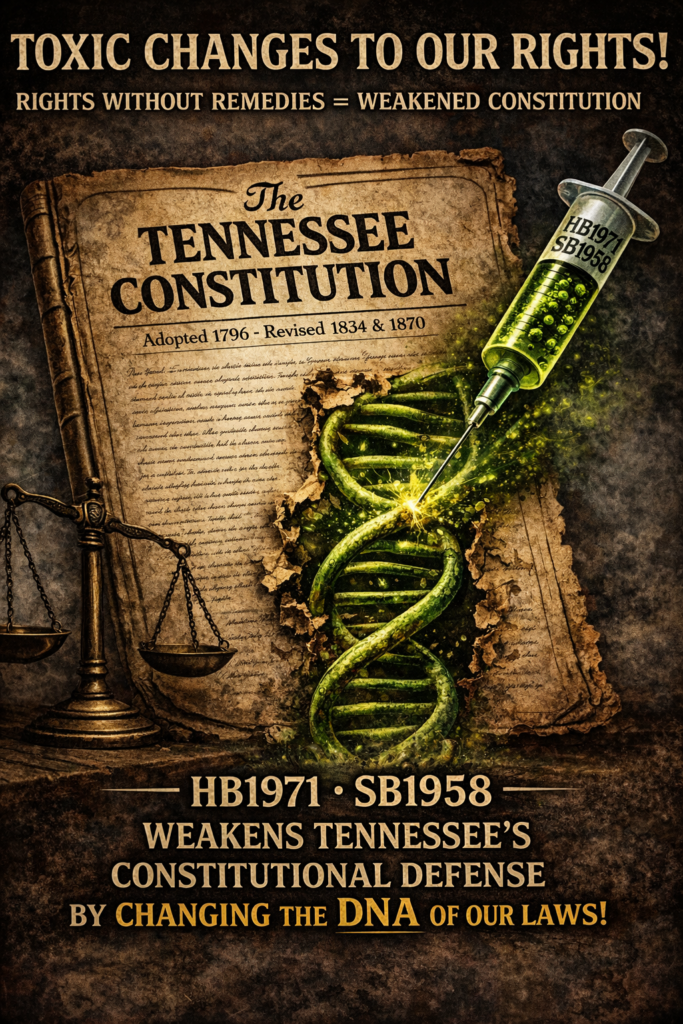
Image Credit: submitted by author & Canva
Note from The Tennessee Conservative: Editorial statements in this column are the sole opinion of the author; they do not necessarily reflect the opinions of the staff of this publication.
Submitted by Erin Eslinger –
HB1971 is scheduled for consideration by the House Judiciary committee Monday afternoon and then returning to the Senate judiciary committee that same day.
At first, I felt anger—then the feeling turned into something deeper: sadness.
I went back and reviewed the video of the bill being presented in the Senate.
There were several statements made by Senator Stevens on SB1958 that are true. For example, yes—courts are for those who are injured, but that raises a critical question: what about redressability? That is the mechanism by which a court rectifies the harm
This is where I believe the bill is being dangerously overlooked.

HB1971 limits relief to declaratory or injunctive remedies, while eliminating the ability to recover damages. That distinction matters more than it’s being discussed.
Declaratory relief means a court can say a government action is unlawful.
Injunctive relief means a court can stop the government from continuing that action.
Damage, in simple terms, means compensation for harm already done.
I have not heard a single clear explanation on the record addressing this loss of damages, and that is deeply concerning. The conversation seems focused on protecting the legislative branch—yet it does so at the expense of the judiciary’s ability to fully deliver justice.
As written, this bill risks empowering government entities to act without meaningful consequence. It alters the very DNA of Tennessee law. If the remedies available to citizens are weakened, then what truly remains to protect their constitutional rights?
With a heavy heart, I will be watching this bill be considered in both the House Judiciary Committee and the Senate Judiciary Committee this week. It is scheduled to be considered by both committees tomorrow. I sincerely hope that enough of our representatives and senators recognize what is at stake—and choose not to let this legislation pass.
If you wish to contact legislators concerning HB1971 or SB1958, the contact information is provided below for the respective committees that will consider each bill.

House Judiciary Committee – HB1971 scheduled to be heard March 23
HB1971 removes the right of a cause of action for any affected person who seeks declaratory and injunctive relief in any action brought regarding the legality or constitutionality of a state governmental action.
Rep.andrew.farmer@capitol.tn.gov; rep.elaine.davis@capitol.tn.gov; rep.rebecca.alexander@capitol.tn.gov; rep.fred.atchley@capitol.tn.gov; rep.gino.bulso@capitol.tn.gov; rep.clay.doggett@capitol.tn.gov; rep.rick.eldridge@capitol.tn.gov; rep.johnny.garrett@capitol.tn.gov; Rep.ga.hardaway@capitol.tn.gov; rep.torrey.harris@capitol.tn.gov; rep.gloria.johnson@capitol.tn.gov; rep.kelly.keisling@capitol.tn.gov; rep.william.lamberth@capitol.tn.gov; rep.mary.littleton@capitol.tn.gov; rep.jason.powell@capitol.tn.gov; rep.lowell.russell@capitol.tn.gov; rep.gabby.salinas@capitol.tn.gov; rep.rick.scarbrough@capitol.tn.gov; rep.tom.stinnett@capitol.tn.gov; rep.chris.todd@capitol.tn.gov; rep.joe.towns@capitol.tn.gov; rep.ron.travis@capitol.tn.gov
Senate Judiciary Committee – SB1958 scheduled to be heard March 23
SB1958 removes the right of a cause of action for any affected person who seeks declaratory and injunctive relief in any action brought regarding the legality or constitutionality of a state governmental action.
Sen.todd.gardenhire@capitol.tn.gov; Sen.kerry.roberts@capitol.tn.gov; Sen.paul.rose@capitol.tn.gov; Sen.bobby.harshbarger@capitol.tn.gov; Sen.sara.kyle@capitol.tn.gov; Sen.london.lamar@capitol.tn.gov; Sen.john.stevens@capitol.tn.gov; Sen.brent.taylor@capitol.tn.gov; Sen.dawn.white@capitol.tn.gov

About the Author: Erin Eslinger is a property rights activist and citizen lobbyist from Alcoa, Tennessee.

4 Responses
Thanx, emailed committees, “PLEASE vote NO!!
HB1971/SB1958 removes the right of a cause of action for any affected person who seeks declaratory and injunctive relief in any action brought regarding the legality or constitutionality of a state governmental action.
WHY would anyone favor this?
No, HB1971 and SB1958 would not change the “DNA” of Tennessee’s constitutional rights. They would not amend the Tennessee Constitution (or the U.S. Constitution). Substantive rights—such as those in the Tennessee Declaration of Rights (free speech, bearing arms, due process, open courts, etc.)—remain exactly the same. They would, however, change Tennessee statutory law in a significant procedural way.
Specifically: They repeal TCA § 1-3-121 (a statute enacted in 2018 via SB1870). That section currently gives “any affected person” an explicit cause of action to file a declaratory judgment or injunction action in chancery court challenging the “legality or constitutionality” of any governmental action—state or local—before it is enforced against them (a pre-enforcement or “facial” challenge).
They replace it with a new, much narrower cause of action that applies only to actions of “political subdivisions” (cities, counties, school districts, utility districts, etc.). The bill explicitly states there is no cause of action under it to challenge “the validity or constitutionality of any state statute.” It also does not waive the state’s sovereign immunity and bars damages in the limited local-government cases.
A separate tweak moves certain higher-education discrimination claims to the Tennessee Human Rights Act (which can award damages).
Procedural access to courts for state-law challenges → Yes, it rewrites part of the statutory “how” you enforce constitutional limits on the legislature.
The actual constitutional rights themselves → No. The Tennessee Constitution still says what it says. The U.S. Constitution still applies. Courts can still hear constitutional challenges when there is actual injury (as they did before 2018 and as federal courts do under Article III standing rules). Supporters argue this simply restores the pre-2018 status quo and stops chancery courts from issuing “advisory opinions” on hypothetical cases. Opponents (gun-rights groups, Tennessee Stands, etc.) argue it shields potentially unconstitutional state laws from easy review.
The bills are controversial precisely because they alter the balance between the legislative branch and judicial review of state statutes—but they do not rewrite the constitutional rights themselves. The “DNA” of Tennessee’s constitutional rights is safe; one procedural statute is what’s on the chopping block.
I think you misunderstand the bill. This bill does not remove actions under 42 USC 1983 or claims commission actions. Nor does no stop actions for declaratory judgement under other provisions in the law. It’s an odd ball statute under Title1 about statutory construction. In other words, you can use Title 1 for declaratory action or injunction on what rights you have under the law, but you would have to use another avenue to challenge the constitutionality of the statute.
Respectfully……… I stand by my assessment of the bills, you may need to reread the bills. Both bills not just one BOTH……….