
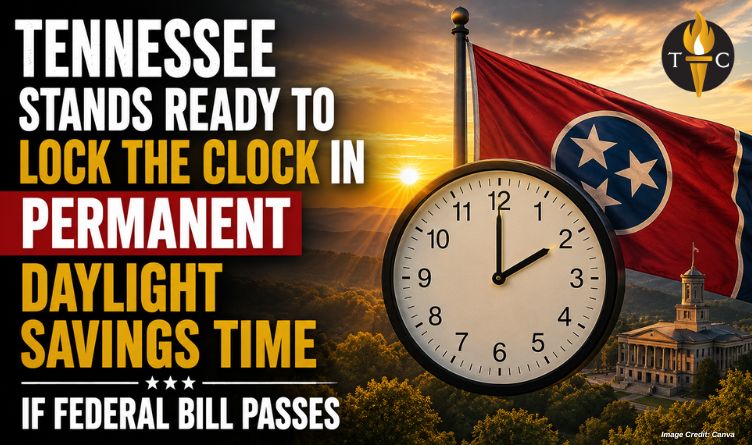
Image Credit: Canva
Tennessee Conservative News [By Olivia Lupia] –
As a bill which includes a provision to move the country to permanent daylight saving time (DST) is gaining traction in Congress, Tennessee and 18 other states stand ready to immediately lock their clocks, already having passed legislation which will trigger year-round DST should Congress approve it.
In 2019, the Tennessee General Assembly passed SB1100 which declares the state will observe daylight saving time year-round, contingent upon three actions. First, Congress must amend or repeal federal statutes mandating the time change. States may currently opt to observe standard time year-round, as Hawaii and most of Arizona do, but cannot do the opposite without congressional approval.
Second, the commissioner of transportation must certify in writing the congressional action to the Tennessee Speakers of the House and Senate, and finally the General Assembly must pass a joint resolution confirming the act of Congress and authorizing the state’s implementation of permanent DST.
The DST observation will begin the first Sunday of November following the actions above, according to the law.
That legislation could come to fruition this year if Congress passes a transportation funding package which contains the language of the Sunshine Protection Act by U.S. Rep. Vern Buchanan of Florida. The package recently received a 48-1 roll call vote in the House Energy and Commerce Committee to proceed to the full House floor.

President Trump has been vocally supportive of the Sunshine Protection Act, saying, “It’s time the people can stop worrying about the ‘Clock’, not to mention all of the work and money that is spend on this ridiculous, twice yearly production. It will also be a very nice WIN for the Republican Party. Take it! We are going with the far more popular alternative, Saving Daylight, which gives you a longer, brighter Day- And who can be against that- This is an easy one!”
And along with Tennessee, 18 other states apparently agree with the federal push as all have passed some form of legislation which will trigger year-round DST upon action by Congress.
Florida was the first state to enact such legislation in 2018 with Delaware, Colorado, Wyoming, Utah, Montana, Idaho, Washington, Oregon, Alabama, Georgia, Louisiana, Minnesota, Mississippi, Oklahoma, South Carolina, and Tennessee following in the next couple of years. Maine and Texas became the latest to join the DST group last year.
Bills in Georgia, Nebraska, and New Mexico to lock the clock failed this year, as did more time change-related legislation in other states, including Tennessee. Rep. Chris Todd (R-Madison County-District 73) carried HB1300 this year, which would have moved in the opposite direction and eliminated DST, putting Tennessee on year-round standard time.
Todd and numerous other experts pointed to data suggesting the observation of DST negatively impacts the health of Americans, with the likelihood of heart attacks and strokes increasing once clocks are changed and upticks in traffic accidents and workplace injuries. Permanent standard time is also supported by sleep specialists and endorsed by every major sleep society, including the American Academy of Sleep Medicine.
HB1300 was progressing in the House but ultimately died in a Senate committee when only the bill’s sponsor voted in its favor, with several Senators concurring in their belief that permanent DST was the preference.
The United States has observed permanent daylight saving time several times previously, most recently in 1973 under President Nixon, but it has not been not well-received.
Enthusiasm waned as Americans realized winter sunrises didn’t happen until at least 8 a.m., closer to 9 or 9:30 a.m. in some parts of the country.
Parents sending children off to school in the dark raised safety concerns, and multiple nationwide incidents were reported of children being struck by vehicles while on their way to school, including eight fatalities in Florida. Support for the new law decreased so rapidly that Congress retracted their actions by October of 1974 and reverted to the four months of standard time.
But for now, Tennessee and the 18 other states must wait on Congress to determine what the next round of clock changes could look like in the fall.


About the Author: Olivia Lupia is a political refugee from Colorado who now calls Tennessee home. A proud follower of Christ, she views all political happenings through a Biblical lens and aims to utilize her knowledge and experience to educate and equip others. Olivia is an outspoken conservative who has run for local office, managed campaigns, and been highly involved with state & local GOPs, state legislatures, and other grassroots organizations and movements. Olivia can be reached at olivia@tennesseeconservativenews.com.

One Response
Good, thanx. Daylight sensitive entities can have winter and summer hours.