
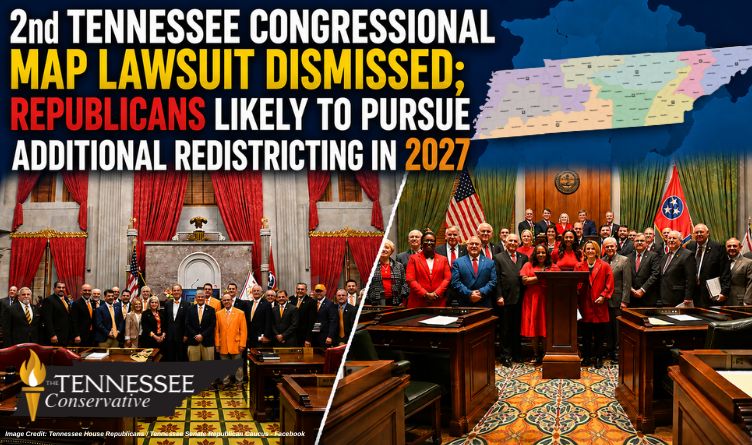
A Federal Lawsuit Filed By The Tennessee Democrat Party And Several Other Plaintiffs Against The Recently Redrawn State Congressional Maps Has Voluntarily Been Dismissed As Tennessee Senate And House Republicans Consider Legislation Related To Redrawing The State’s House And Senate Districts Next Year.
Image Credit: Tennessee House Republicans / Tennessee Senate Republican Caucus – Facebook
Tennessee Conservative News [By Olivia Lupia] –
After the first of four federal suits against the recently redrawn Tennessee congressional maps was dismissed by a judge for lack of standing, a second suit has followed after the Tennessee Democrat Party (TNDP) and several other plaintiffs voluntarily dismissed their challenge as their legal machinations continue to be struck down by federal judges.
Upon the redistricting being finalized by Gov. Lee in early May, four separate complaints were filed in federal court seeking to either bar the new map entirely or prevent its implementation for at least the August 2026 elections.
One suit by the NAACP was ruled out of hand and dismissed by a three-judge panel appointed by the Tennessee Supreme Court as the panel found only one of the plaintiffs met the criteria for standing and the rest of the petitioners’ arguments were based on a narrow interpretation of Gov. Lee’s proclamation for the special session.
On the same day, a federal judge denied a request to temporarily halt Tennessee’s new redistricting lines in a lawsuit brought by the ACLU, three Memphis voters, the Black Clergy Collaborative of Memphis, the Memphis A. Philip Randolph Institute, and the Equity Alliance. Their complaint claimed the new districts discriminated against Blacks and aimed to stop the redistricting before the August 6 primary.
After the ruling denying the temporary injunction, this case became consolidated with the other cases, a second by the NAACP in conjunction with the League of Women Voters and the one by the Tennessee Democrat Party and candidates.
Now, according to court documents filed Monday, the TNDP, U.S. Rep. Steve Cohen, state Rep. Justin Pearson who is also running for Congress, and several Tennessee voters filed a notice of voluntary dismissal in the U.S. District Court for the Middle District of Tennessee.
Their challenge argued the maps unlawfully dismantled a majority-Black district, diluted Black voting power and created confusion ahead of the 2026 elections, but as the court has denied expedited relief ahead of the 2026 election cycle the parties have decided to “move on” from the suit.

TNDP Chair Rachel Campbell said in a statement, “Our case focused on expedited relief for the 2026 cycle, and when that did not happen, we moved onto our next battlefield: the ballot box.” She added that the party stands in support of the other ongoing legal challenges by the ACLU and NAACP which have now been unconsolidated from this suit.
Congressman Cohen, who ended his reelection campaign following the redistricting, said of the dismissal, “I have decided not to continue pursuing a lawsuit against the gerrymandered Republican redistricting maps but vigorously support the efforts of the ACLU and the NAACP to contest them, which are based on different arguments and have different requests for relief. I firmly believe this was an illegal redistricting effort that was harmful to Memphis and the Black community by diluting their political representation. It is my hope that they will prevail and that the previous district maps will be restored.”
And Rep. Pearson stated, “While we believed our Tennessee Democratic Party federal redistricting challenge was just, all plaintiffs were aligned and advised by attorneys that dismissing our case to restore District 9 to the previous map was the best course of action given the U.S. Supreme Court’s stance on Louisiana v. Callais. We are open to exploring recourse in the future if the legal landscape changes.”
Chief U.S. District Judge William L. Campbell Jr. signed an order Tuesday dismissing the case upon request of the plaintiffs, though as it was dismissed without prejudice the claims could potentially be refiled in the future.
But Democrats may not have seen the last of redistricting efforts yet as Tennessee Senate Republican Caucus press secretary Molly Crawford said in an emailed statement that Republicans are likely to consider legislation related to redrawing the state’s House and Senate districts next year.
“Given the Supreme Court’s decision in Louisiana v. Callais, I would expect the next General Assembly to consider legislation related to continued redistricting efforts for Tennessee’s State Senate and House district maps,” Crawford wrote.
While Crawford reiterated that any legislation “would have to go through the committee process, so it’s too soon to know what the outcome would be,” there is at least one district that could find itself on the chopping block if Republicans do move forward on this track.
House District 80 in West Tennessee is a majority-minority district created in response to a lawsuit brought under Section 2 of the Voting Rights Act. That statute was ruled unconstitutional by the U.S. Supreme Court and sparked a wave of redistricting efforts in many southern states as several had districts created using race-based metrics under Section 2.
Tennessee lawmakers may actually be obligated to rework the district boundaries to come into compliance with the new ruling, and other majority-minority districts could be impacted as a result, like Senate District 19 currently held by Democrat Sen. Charlane Oliver who was suspended from her committee assignments for acts of protest on the Senate floor during the special redistricting session.
While not created as the result of a lawsuit, districts like Oliver’s could be next to be cracked, especially considering the recent legal victories for the state which could indicate how additional redrawing would fare.


About the Author: Olivia Lupia is a political refugee from Colorado who now calls Tennessee home. A proud follower of Christ, she views all political happenings through a Biblical lens and aims to utilize her knowledge and experience to educate and equip others. Olivia is an outspoken conservative who has run for local office, managed campaigns, and been highly involved with state & local GOPs, state legislatures, and other grassroots organizations and movements. Olivia can be reached at olivia@tennesseeconservativenews.com.

One Response
Good.