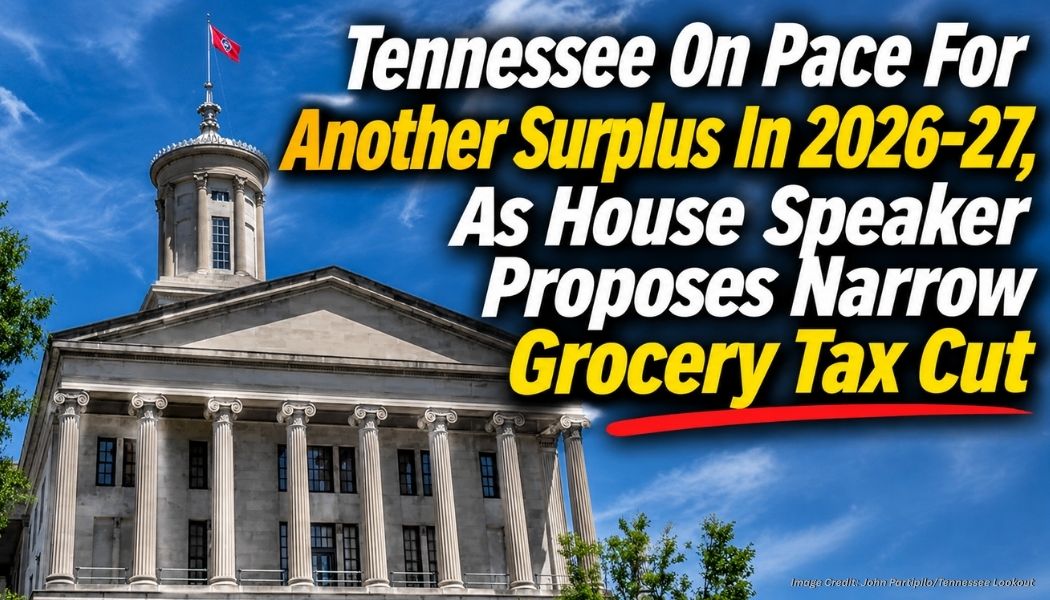
Image Credit: John Partipilo/Tennessee Lookout & Canva.
***Note from The Tennessee Conservative – this article posted here for informational purposes only. Per The Tennessee Lookout’s republishing guidelines, this article has been edited for writing style & length.
By Adam Friedman [Tennessee Lookout -CC BY-NC-ND 4.0] –
Tennessee’s revenue officials predict the state is on pace for another billion-dollar surplus, giving state lawmakers and Gov.-elect Marsha Blackburn more room to navigate budget negotiations.
The estimates were given as part of the department’s presentation to the State Funding Board, which will make an official recommendation on the bottom-line financial numbers lawmakers and the governor can use to shape next year’s budget.
Economists and state officials told the state funding board Monday that they expect state revenues to increase by 3.5% to 4.5%, essentially keeping pace with inflation. This growth follows last year’s $1.2 billion surplus, which lawmakers can spend later this year.
For years, officials have conservatively estimated revenues, allowing the state to experience a “surplus” used for things like road funding, tax cuts and a reworking of the education funding formula.
Don Bruce, a professor at the University of Tennessee’s Boyd Center for Business and Economic Research, said the state continues to struggle to project its franchise and excise taxes on business.
This year the state is projecting a $700 million surplus in franchise and excise taxes. Three years ago, volatility in franchise and excise taxes on business led the state to miss its revenue projections, leaving it to find a way to plug a nearly $600 million budget hole.
“It could go anywhere from up to down double-digit percentage points,” said Bruce, referring to future business tax revenues.
Tennessee does face at least some increasing costs. After the federal One Big Beautiful Bill legislation, the state is expected to have to cover around $170 million in its shared costs of the Supplemental Nutrition Assistance Program, SNAP.
Tennessee House Speaker Cameron Sexton kicked off the legislative season Monday by introducing a bill to cut the sales tax on milk, eggs and bread. Lawmakers won’t convene until January, but can file legislation through the end of the year and into 2027.
Sexton’s narrowly tailored tax cut comes after Democrats have pushed for years to eliminate the food sales tax on all groceries. A bill introduced by two Democrats in 2025 would have eliminated the grocery sales tax.
Eliminating all sales tax on groceries would cost about $1.2 billion in state and local tax revenue, according to legislative fiscal revenue officials at the time.
Tennessee is one of the lowest-taxed states in the nation, but a 2024 ThinkTennessee report found that lawmakers have steadily shifted more of the tax burden from corporations to people through a reliance on sales taxes, leaving low-income families with a “higher tax burden than wealthier families and businesses.” Tennessee also made multibillion-dollar corporate tax cuts in 2023 and 2024.
No estimates yet show how much Sexton’s proposed tax cut would cost. Sexton’s bill is also a caption bill and will likely undergo significant changes before passage.
The proposed legislation also follows Democrats flipping six state House seats in the 2026 election. Republicans now hold a 69-30 supermajority in the state House.
The state funding board will issue its final prediction of state budget growth at a meeting on Nov. 23.
State Treasurer David Lillard said he would caution the board in its revenue projections because so much of the predicted business tax revenue increase is based on estimated payments, and not actual collections.
“We don’t want to be caught off guard,” Lillard said.