***Note from The Tennessee Conservative – this article posted here for informational purposes only.
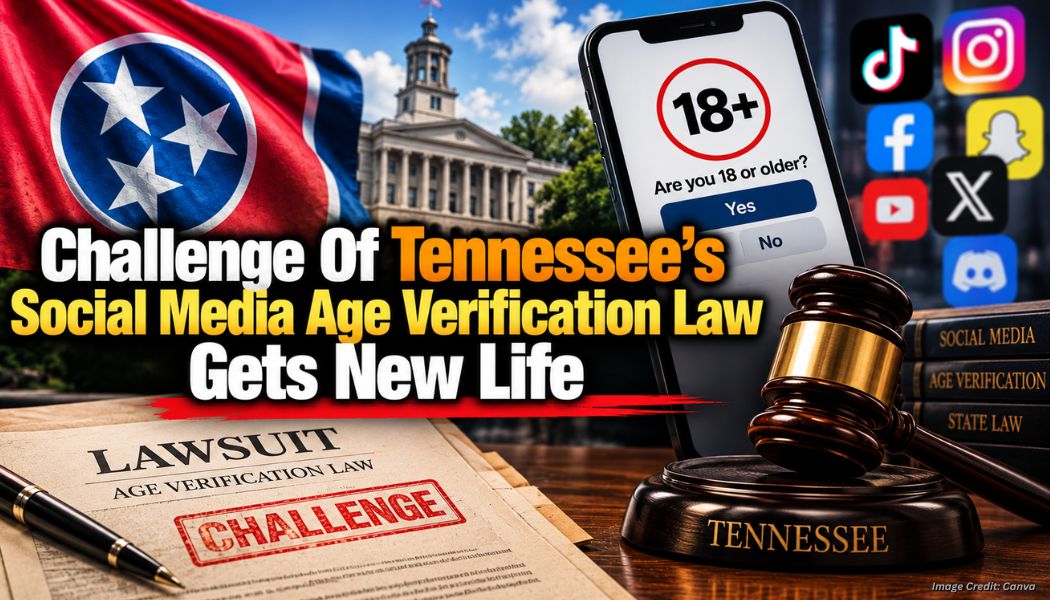
Image Credit: Canva.
By Kim Jarrett, The Center Square –
A social media trade organization will get another chance to challenge Tennessee’s Protecting Children from Social Media Act in the U.S. District Court after an appeals court ruled in its favor.
NetChoice, which represents social media companies, including Facebook and YouTube, is challenging the law, citing First Amendment and privacy concerns. The U.S. Court of Appeals for the Sixth Circuit vacated the district court’s denial of a preliminary injunction to halt the law, which could penalize social media companies that do not verify users’ ages before granting access.
“Assuming NetChoice’s First Amendment claims are correct on the merits (on which we express no opinion and which we leave to the district court for consideration), we hold that its members have demonstrated irreparable harm on that basis, at least sufficient to overcome our threshold irreparable-harm hurdle,” the court said in its ruling. “We reach this conclusion based on NetChoice’s members’ alleged loss of free-speech rights, as well as the unrecoverable compliance costs asserted by some of its members.”
Companies would face fees and penalties if an investigation by the Attorney General determines they broke the law. It took effect on Jan. 1, 2025, after passing the General Assembly and receiving Gov. Bill Lee’s signature in 2024.

The ruling is not a decision on constitutional issues, but it orders the lower court to consider NetChoice’s chances of succeeding based on constitutional claims.
“Tennessee is trying to burden the ability of minors and adults to access speech, requiring them to submit to age verification before they can even log into a Facebook account or a YouTube account, said Paul Taske, an attorney representing NetChoice, in an interview with The Center Square. “This is irreconcilable with basic First Amendment law that says the government does not get to place barriers between the people and lawful speech.
A spokesman for Tennessee Attorney General Jonathan Skrmetti told The Center Square that the office cannot comment on pending litigation.
In a brief filed with the 6th U.S. Circuit Court of Appeals, Skrmetti said the District Court made the right decision in denying NetChoice’s injunction seeking to stop the law.
“Tennessee’s law requires social media companies to implement common-sense features that let parents protect their kids,” Skrmetti said. “The law does not control what anyone can say or not say online. The harms social media causes kids are well-documented.”
The law would also expose parents and children to “bad actors” who could steal their identities, according to Taske.
“The law requires people to hand over their identification and other forms of documentation not only to prove their age, but in the case of parental consent, to prove their relationship with their minor child and those create severe privacy risks,” Taske said. “By essentially creating and mandating a new repository of sensitive information to be collected and stored and preserved so that the government can go in and check and make sure that this sort of verification that it’s demanding has been done, it really opens a can of worms for bad actors to exploit this information as well.”
Skrmetti said in his brief that children’s constant access to social media has fueled a crisis.
“Social media has devastated kids’ mental health, stunted their development, and exposed them to pornography and sexual predators, with little to no parental oversight,” Skrmetti said in the brief. “All the while, social-media platforms profit from minors’ use of their platforms through contracts granting them rights over account holders’ personal information.”
Taske said alternatives exist besides government involvement. One of them is education.
“There are so many parental tools available at all layers, whether it is the individual applications themselves, the phones, the computers, the web browsers, the network routers, you can find ways to decide what is the right fit for your family with the technology that already exists,” Taske said.
Lawmakers could also provide more funding to investigate incidents involving bad actors, according to Taske.
“The tech companies are doing their part to try and identify bad actors and send them over to the (National Center for Missing and Exploited Children) then try to support these investigations to the extent they can,” Taske said. “But the problem often is there is not sufficient funding for the local law enforcement to investigate al of the tips, and then, let alone, prosecute and convict the actual criminal that are making children less safe.”
NetChoice is challenging social media age verification laws in other states, including Nebraska, Arkansas, Utah and California.
“We are making our way through the appellate process and we do have a case that we anticipate will go up to the Supreme Court in due courese and that is the case out of Ohio, NetChoice vs. Yost where the 6th Circuit ruled agains us actually a few weeks ago and has since agreed not to issue its decision while we seek review with the Supreme Court,” Taske said.


One Response
Sadly, government can’t do parent’s job.