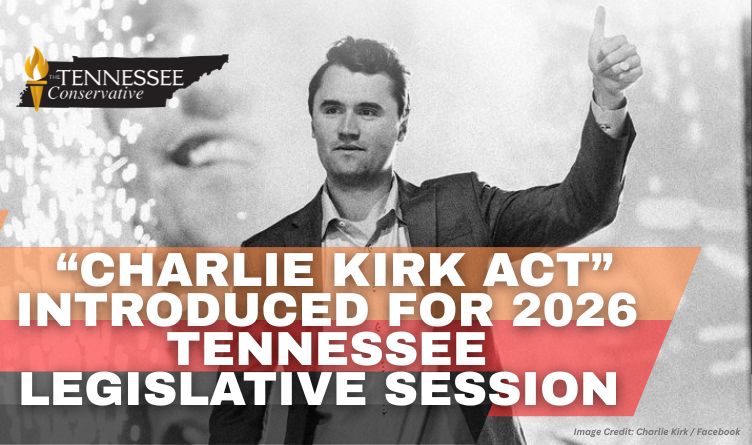
Image Credit: Charlie Kirk / Facebook
The Tennessee Conservative [By Olivia Lupia] –
Two GOP lawmakers have introduced an extensive bill titled the “Charlie Kirk Act” aimed at preserving freedom of expression at higher education institutions by creating accountability and legal deterrents for discrimination against those exercising their First Amendment rights.
Sponsored by Sen. Paul Rose (R-Lauderdale-District 32) and Rep. Gino Bulso (R-Brentwood-District 61), SB1741/HB1476 would firstly require public institutions of higher learning to adopt two separate policies on freedom of expression and the role of such institutes in political and social action.

The first policy must be identical to or be substantially similar to the University of Chicago’s Freedom of Expression Policy, must include certain passages of the Chicago policy verbatim, and must be incorporated into the institution’s bylaws and posted on the school’s website.
In part, the policy states that, “it is not the proper role of the University to attempt to shield individuals from ideas and opinions they find unwelcome, disagreeable, or even deeply offensive. Although the University greatly values civility, and although all members of the University community share in the responsibility for maintaining a climate of mutual respect, concerns about civility and mutual respect can never be used as a justification for closing off discussion of ideas, however offensive or disagreeable those ideas may be to some members of our community.”
It clarifies that a university may restrict expression that violates the law, falsely defames a specific individual, constitutes genuine threats or harassment, invades substantial privacy or confidentiality interests, or is “otherwise directly incompatible with the functioning of the University,” but that ultimately, “the University’s fundamental commitment is to the principle that debate or deliberation may not be suppressed because the ideas put forth are thought by some or even by most members of the University community to be offensive, unwise, immoral, or wrong-headed. It is for the individual members of the University community, not for the University as an institution, to make those judgments for themselves, and to act on those judgments not by seeking to suppress speech, but by openly and vigorously contesting the ideas that they oppose.”

The second policy that public universities would be required to adopt and incorporate into their bylaws must include several passages of the Report on the University’s Role in Political and Social Action (Kalven Report) issued by the University of Chicago in 1967 which says a university is “the home and sponsor of critics; it is not itself the critic.”
“To perform its mission in the society, a university must sustain an extraordinary environment of freedom of inquiry and maintain an independence from political fashions, passions, and pressures. A university, if it is to be true to its faith in intellectual inquiry, must embrace, be hospitable to, and encourage the widest diversity of views within its own community. It is a community but only for the limited, albeit great, purposes of teaching and research. It is not a club, it is not a trade association, it is not a lobby,” it reads.
Any public institutions that do not comply with adopting the policies would be subject to a writ of mandamus (a court order forcing compliance) or injunction.
Next, the Charlie Kirk Act states a public university or faculty member could not refuse to invite a speaker or cancel a speaker at the school because of the speaker’s viewpoints or in response to threatened protests or opposition from students or faculty. The school or a faculty member could also not prohibit a student organization from inviting a speaker of its choice to campus. Should the school violate this provision, it would be subject to a writ of mandamus or injunction, and a faculty member could face civil liability.

The Act would also protect academic freedom by subjecting to legal action any institution or faculty member who retaliates or discriminates “in any manner against a faculty member on account of the viewpoints expressed in the faculty member’s scholarly work, or on account of any speech or writing protected by the First Amendments of the United States Constitution.”
Whether these protections would apply to scenarios like faculty and staff fired for disparaging or degrading remarks about the assassination of Charlie Kirk is unclear as several of these educators have filed federal suits alleging their terminations were violations of their First Amendment rights.
Another section of the bill titled “Freedom of religion and conscience protected” says a public university shall not discriminate or retaliate against a person or deny recognition to any student group based on their sincere religious beliefs or “opposition to abortion, homosexuality, or transgender behavior, regardless of whether that opposition is motivated by religious or non-religious beliefs.”
The bill would allow any resident, citizen, or taxpayer of the Tennessee to file for a writ of mandamus or injunction against a public institution that does not comply with the provisions contained in the bill. It also creates a pathway for civil action by an invited speaker or audience member against a person who violates the campus free speech policy at an event the speaker or audience member attended.
Finally, SB1741/HB1476 would add to current state statutes regarding campus free speech protections a definition of the phrase “substantially obstruct or otherwise substantially interfere” to include intentionally drowning out a speaker or hindering the audience from hearing them, blocking the audience’s view of a speaker either physically or with signs or other objects, staging walk-outs that are overly disruptive or cause the event to be temporarily paused, and physically obstructing an invited speaker or audience member from entering or attending an event.
Those in violation of the new definition of obstruction could be subject to disciplinary measures including probation, suspension, or expulsion for students and suspension without pay or termination for faculty members.
The Charlie Kirk Act has been assigned to the House Higher Education Subcommittee but is still awaiting a date on the calendar while the Senate version has not yet been assigned a committee.

About the Author: Olivia Lupia is a political refugee from Colorado who now calls Tennessee home. A proud follower of Christ, she views all political happenings through a Biblical lens and aims to utilize her knowledge and experience to educate and equip others. Olivia is an outspoken conservative who has run for local office, managed campaigns, and been highly involved with state & local GOPs, state legislatures, and other grassroots organizations and movements. Olivia can be reached at olivia@tennesseeconservativenews.com.

2 Responses
The Charlie Kirk event in Utah was a psyop. All the Evidence proves this, it will all be revealed. I think we should hold off on any legislation until this is sorted out. When the truth comes out, it will make those sponsoring this legislation look foolish.
Considering the so called Crime Scene was bulldozed and concreted over the next day (totally illegal,) the sim cards from the camera’s were confiscated by TPUSA, there was not one drop of blood on anyone who were carrying Charlie and not one drop of blood on the concrete while they were carrying him to the truck, a 30.06 bullet would have destroyed his neck and main arteries, which would have produced massive amounts of blood, research air squibs, that creates realistic bullet effects. There is mountains of evidence to prove that this was a planned event, not carried out by the patsy Tyler Robinson and that TPUSA is suspect, many lies told by those who were working in Charlie’s organization.
GOOD!!