Image Credit: Canva
Submitted by Nicole Ne’Sher, RN & Pediatric Researcher –
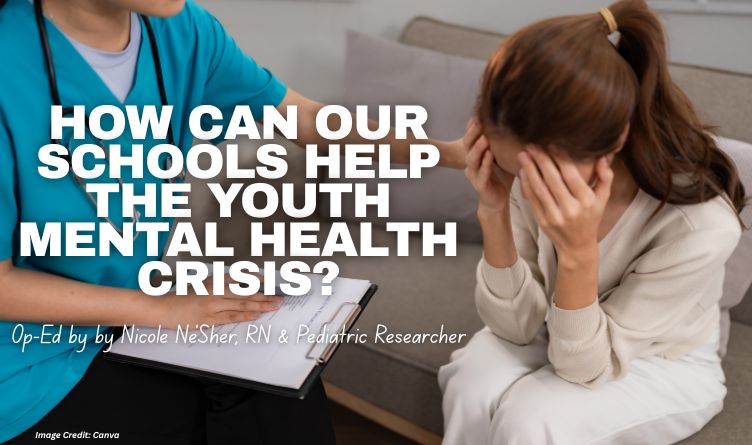
According to the American Academy of Pediatrics, suicide and mental illness are at an all time high with our youth.
One startling statistic states that the suicide rate for 10 to 19 year-olds increased by 85.3% between 2007-2017. Incidentally, the iPhone was invented in 2007, making the world accessible to our youth and our youth accessible to the world!
Schools hire mental health counselors, I was trained as a mental health counselor, and while they can help, they are trained to keep certain information from parents which can be dangerous.
Texas has brought chaplains into the schools, with good results. Chaplains work with the teachers, the counselors, the parents.
13 other states are considering having chaplains in the schools. These chaplains are trained to deal with crisis situations. They are in our congress, our military, our hospitals, our prisons and places of business. Why not in schools? Why not in Tennessee schools?

Many studies show how faith is not only a protective factor against mental illness, but also a resilience factor when dealing with trauma and crisis.
Dr Lisa Miller, professor at Columbia University did a study of the efficacy of chaplains in the military. She authored the book: “The Awakened Brain: Why Spirituality Matters.”
Her research found that the suicide rate dramatically dropped by having chaplains available for military personnel. They also made better command decisions. She performed brain scans and found that those who have faith did better in combat situations than those without faith. Youth who have faith make healthier choices in life.
The National School Chaplain Association (NSCA) is ready and willing to help our youth.
If you would like more information, or want training, contact: Campuschaplains.org. The founder wrote a book: “School Chaplains: 10 Steps to a Fulfilling Career as a Certified School Chaplain. Rocky Malloy.
You can let your legislators know about this program and you would like to see it implemented here in Tennessee.
Also, another important factor in our youth’s mental health is their home life.
If you need parenting tools and resources or marriage resources contact:
Focus on the Family
1-800-A-family, focusonthefamily.com or Dr. James Dobson Family Institute 877-732-6825. drjamesdobson.org.


3 Responses
STOP PUSHING AGENDAS TO SCREW THEM UP TO START WITH!
I think that is a great idea. Of course it will never happen because most of the educational gurus are not Christians and want no part of the Lord in our schools.
That is the reason they are in the mess they are now.
Oh since we discussing the topic of the down fall in our schools, the bright idea of not having an uneducated teacher in the class room sounds about right. The reason our schools are in such a mess is also because of the leadership in the system.
The teachers that are very well educated leave the system because they can’t teach subjects they have to keep testing and testing and testing to show they don’t know anything. Plenty of teachers would love to teach these students but aren’t allowed to because of the political driven agenda in the administration.
Anytime you are challenged about the constitutionality or legality of school chaplains, the following points and cases should be part of your standard response. Chaplaincy has been upheld repeatedly in district and federal courts. It traces its legal foundation to the Articles of Confederation, established before the U.S. Constitution and affirmed by General George Washington. Chaplains have served continuously in all three federal branches since the nation’s founding.
Below are the cornerstone cases and facts that demonstrate the constitutional legitimacy of school chaplaincy:
Key Supreme Court and Federal Precedents Supporting Chaplaincy and Religious Expression
• Kennedy v. Bremerton School District (2022)
U.S. Supreme Court
Religious expression—including prayer by school employees—was upheld. The Court rejected the “Lemon Test” and affirmed that religious expression cannot be censored simply because it occurs on school grounds. This ruling gives broad protection to religious accommodations in schools.
• Carson v. Makin (2022)
U.S. Supreme Court
Public funds may not exclude religious options. The Court ruled that states cannot discriminate against religious institutions or programs if they make public funds available for comparable secular services.
• Carter v. Broadlawns Medical Center (1971)
U.S. Court of Appeals (8th Circuit)
Use of public funds to pay chaplains serving public institutions was upheld as constitutional. This is one of the clearest federal rulings affirming the employment of paid chaplains in publicly funded environments.
• Sherbert v. Verner (1963)
U.S. Supreme Court
The Court established that the government must have a “compelling interest” to refuse religious accommodation. This standard strongly supports chaplaincy programs as a legitimate religious accommodation within public systems, including schools.
Additional Foundational Context
• Chaplaincy predates the U.S. Constitution.
It was established under the Articles of Confederation and affirmed by George Washington. The First Congress—composed of the same men who drafted the First Amendment—created paid chaplaincies for the House, Senate, and military immediately after adopting the Bill of Rights. Their actions confirm that chaplaincy is fully compatible with the Establishment Clause.
• Chaplains serve in every branch of government.
Congress, the Armed Forces, hospitals, prisons, police/fire departments, and federal agencies all employ chaplains under long-established constitutional precedent.
• 48 states permit the Bible to be taught in public schools (as history, literature, and foundational American culture), provided it is presented objectively. This reinforces the legitimacy of structured religious literacy and spiritual support programs.
Summary Statement
“School chaplaincy is constitutional, historically grounded, and strongly supported by Supreme Court precedent. Federal courts have upheld paid chaplains in public institutions for more than 250 years. Recent cases—Kennedy v. Bremerton and Carson v. Makin—further affirm that neither prayer nor religious participation nor public funding for religious providers can be excluded simply because they are religious. Chaplaincy existed before the Constitution, was established by the Founders, and remains fully constitutional today.”