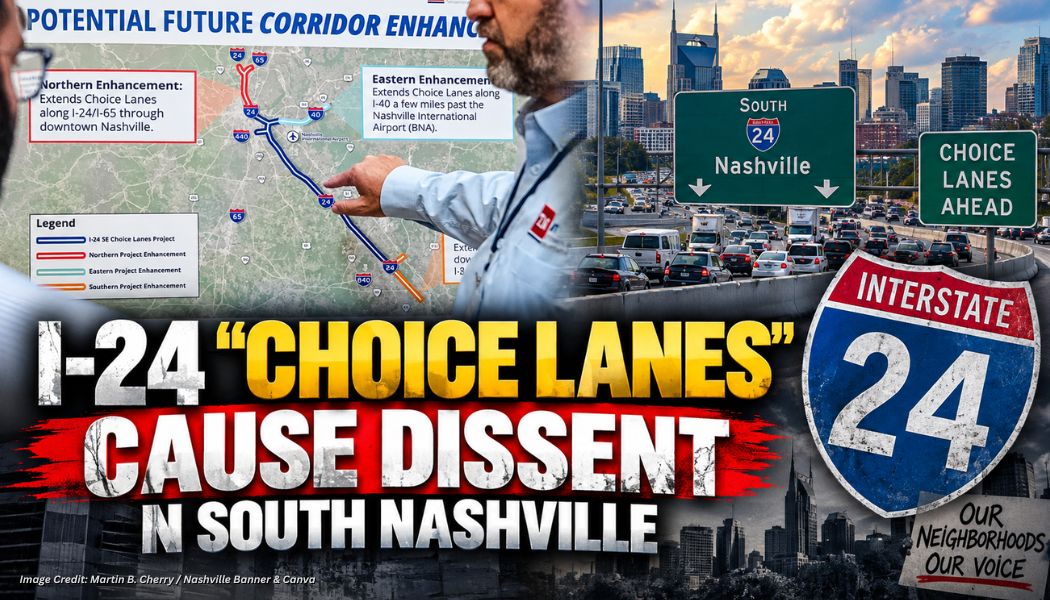
Image Credit: Martin B. Cherry / Nashville Banner & Canva.
***Note from The Tennessee Conservative – this article posted here for informational purposes only.
This story was originally published by the Nashville Banner. Sign up for their newsletter.
by Mikeie Honda Reiland [The Nashville Banner, Creative Commons] –
When Alex* and his family closed on a house in South Nashville during the pandemic, they wanted to live there forever.
“We bought the house not as a starter house or an investment,” he told the Banner. “We bought it to live here and stay here.”
The house has a small, fenced-in yard where Alex’s dogs can roam — and where traffic on Interstate 24 drones in the background. During the winters, they rearrange their sectional around their Christmas tree, and the living room becomes what Alex calls their “holiday hibernation zone.” They all watch TV, and the dogs essentially live on the couch. Prior to moving to South Nashville, Alex said he and his family had never known their neighbors the way they do now, thanks to regular cookouts and campfires.
In late 2024, some of his neighbors returned from a community meeting. The subject had been the construction of new optional toll lanes on I-24 — commonly referred to as “choice lanes” — which will run between Murfreesboro and Nashville. According to those neighbors, a map of the project showed the new lanes running through Alex’s house.
Alex said he has sent the Tennessee Department of Transportation numerous emails filled with questions, and they “respond to about half.” He’s gone to all the community meetings around the project that he can, seeking answers to two questions: are you going to take our house? And when can you tell us if you’re going to take our house?
Alex said that TDOT hasn’t yet been able to answer either question. “That’s been our biggest complaint,” he said. “Just the lack of communication from TDOT.” When asked for comment, TDOT pointed to public meetings they’ve held throughout the affected area since 2024.
Alex said that several of his neighbors have already received letters letting them know that their property is definitely within the scope of the project’s final design. Alex heard from District 16 Council Member Ginny Welsch that TDOT had contacted a limited number of people whose properties they know they will have to take, no matter the final design, as confirmed by the Tennessean. The total number of affected properties is unclear, although in January TDOT estimated that 18 commercial and 33 residential properties would be torn down. Alex knows one neighbor who has already received a visit from an official, who walked through her home and took photos, launching the right-of-way acquisition process. During that process, according to TDOT, homeowners can negotiate for the amount they receive. In some cases, displaced people receive relocation assistance.
As of Sept. 4, Alex still didn’t know whether his home was in the clear. He hasn’t yet received a letter. He said that the limbo they exist in has made planning difficult for his family. The house’s HVAC died last month, and he had to decide whether to opt for a short-term fix or a long-term solution. Not knowing if they would still be living in the house in a year made the decision complicated.
“Most of us have accepted that the choice lanes are happening,” he said. “I haven’t heard from anyone who thinks that they’re a good idea, but we’ve mostly accepted that it’s happening and are trying to get answers about who’s affected, and what compensation will be for that.
“We’ve always said the one thing worse than them taking our house is them not taking our house and building a highway in our backyard and not compensating us for the loss of property value. And so even if they do take our house, it’s just as bad for our neighbors who have to deal with who knows how many years of construction?
“Now there’s a highway going beside or over their house, so they have lost property value.”
People throughout Woodbine and Glencliff have largely echoed Alex’s frustrations. In community meetings held by TDOT, they feel that the department is largely checking boxes rather than answering questions. There are others who say that the arrangement behind the $9.2 billion choice lanes project — a public/private partnership, or “P3,” entirely funded by the private consortium DriveTN but overseen and administered by TDOT — represents a huge win for the state and a model for how to use public assets going forward, with $24.8 billion in concession value that the state can eventually use to improve its roads.
Those in the path of the choice lanes, however, feel bulldozed by politics and government.
“Unfortunately, that’s the way a lot of things happen when it comes to these big government projects,” Julie James, president of the neighborhood group 16th United, said. “We don’t know about it or we don’t realize the impact until it’s almost too late.”

The project
The I-24 Southeast Choice Lanes Project will add two optional toll lanes in each direction along the 26 miles between Nashville and Murfreesboro, one of the most-traveled commutes in the state. The project’s goal is to reduce traffic and shorten commute times. Construction is slated to begin in 2027 and will take at least eight years.
TDOT wouldn’t have been able to fund the project on its own and has partnered with DriveTN, a six-company consortium that will build and maintain the toll lanes for 50 years. DriveTN will receive funds from the toll lanes to recoup its initial $9.2 billion investment. The consortium’s proposal includes $24.8 billion in concessions over the 50-year period, and how that money gets spent has to receive approval from the Governor’s Strategic Transportation Accountability Council. Project opponents have noted that a former TDOT staffer now works for one of the companies in the DriveTN consortium.
JP Villamizar, head of advisory for GISI Consulting, a project management and engineering firm with a global reach, told the Banner that the industry is paying close attention to these choice lanes and to Georgia SR-400, a similar public-private partnership in Atlanta. Central California also just finalized a P3 arrangement for a high-speed rail.
“In the past, it was like, ‘Hey, go design a building, construct this project,’ and you’re done, right?” Villamizar said. “Now it’s looking at a particular asset and identifying added value that can really benefit the public interest. They tested the market from a procurement perspective, and there was a lot of demand on the private side to invest in this.
“I think everybody was surprised at the magnitude of the potential return. A lot of eyes are on this because of the size and complexity.”
Traffic between Murfreesboro and Nashville has been a long-standing challenge for TDOT. Previously, the department launched the I-24 Smart Corridor, a three-phase program to try to improve traffic. Gov. Bill Lee opened the door to choice lanes in 2023, signing a bill that legally authorized toll lanes and public-private partnerships.
“By and large, [I believe] the people at TDOT want to do good things and right by communities,” one South Nashville neighbor who asked not to be named said. “But there’s often just a lot of pressure to move these projects forward.”
Per the project’s FAQ page, the community benefit agreement includes, among other elements, the following:
- Avoiding impacts to the Noble Place Townhomes and the new Pan-Asia Supermarket, which were included in some initial plans.
- Commitments for park-and-ride facilities.
- Commitments for future transit setups — which, according to TDOT, include a commitment that WeGo buses will be able to use the choice lanes for free.
At meetings, some commuters near the Smyrna and Murfreesboro end of the corridor expressed optimism about the project, that maybe these lanes could legitimately make their lives easier. Others who attended a community meeting at the Pruitt Branch of the Nashville Public Library on Sept. 8 said they appreciated the transit integration and the fact that TDOT seemed to listen to community input to avoid Pan-Asia and the townhomes.
That gathering, relatively sparsely attended, was not a Q-and-A, town hall-style meeting. There was no presentation. Instead, between noon and 6 p.m. on a weekday, TDOT employees answered questions in an open house format at various posterboards around the room. People in the neighborhood who spoke with the Banner expressed frustration with past community meetings and this format. Like Alex, they feel that it’s difficult to get a straight answer to any of their questions.
When asked why they chose the Pruitt Library, a small branch with limited parking in the middle of the Napier Homes — as opposed to somewhere closer to Glencliff or Woodbine — for a meeting held during working hours, a TDOT spokesperson told the Banner, “We always try to offer multiple days and times. The Pruitt Branch was available and is a great library that serves the South Nashville community. It’s an area of the project footprint that we hadn’t yet hosted a meeting in, and its accessibility allowed any member of the public to attend.”
‘Choice lanes is about making a buck’
Across several interviews with the Banner, people in Glencliff and Woodbine pointed to a few concerns with the project. First, they don’t believe the choice lanes will solve the traffic problem. Second, as the toll lanes will use dynamic pricing — meaning prices will go up as traffic gets heavier or if traffic speeds in the choice lanes drop below 45 miles per hour — they believe the people who really need to use these lanes won’t be able to afford them. Third, they believe that TDOT never considered long-term solutions like a high-speed rail.
In the neighborhood, some people refer to the project, with some derision, as “Lexus Lanes.” Others cite the economic concept of induced demand, arguing that increasing the capacity on I-24 will lead to increased usage, which will in turn lead to another rise in cars on the freeway. In response to the argument that the lanes are optional, several South Nashville residents who spoke with the Banner said they will still create more inequity, they will serve as a stopgap solution, and eventually, they will encourage more demand and lose their effectiveness, leaving the whole situation the same as where it began.
One neighbor felt that the community benefits agreement was being packaged as altruistic when each bullet point was something TDOT probably would’ve had to do anyway.
The conversation is likely to linger for a while. TDOT has said the choice lanes could eventually expand through downtown, east along I-40 near the airport, and further south of Murfreesboro.
Ultimately, though, the conversation often returns to communication.
“I would say the initial interaction [with TDOT] was non-existent,” James said. “And it had already gotten to a point before we were interacting that there really wasn’t a lot of room for negotiation.”
James added that because the project is state-driven, the group didn’t have any contacts. Members would have known whom to reach out to at the Metro level. Tony Zavitson, another member of 16th United, said that at an early meeting, a TDOT executive offered to meet with the group but delayed until the day before the public comment period ended.
When asked about communication, TDOT told the Banner, “As laid out on our website, TDOT has been hosting public, community meetings about this project since 2024, which include various formats, locations and timing.”
James and Zavitson said that 16th United is currently consulting with other neighborhood groups to put together a shared request to TDOT within the next month. They are working on the particulars but know for sure that they want to request a crosswalk at Southlake Drive and Thompson Lane, which will allow pedestrians easier access to the Kroger on East Thompson Lane, the one major grocery store in the neighborhood. They also just received traffic data and are looking at requests to address safety around the neighborhood’s most dangerous intersections, especially for pedestrians.
“Once that first shovel hits the ground, no one’s going to want to travel on the interstate anymore. They’re going to go on Nolensville Road, Murfreesboro Pike, Thompson Lane to try to get to the same places, and it’s going to really impact the traffic,” James said. “Some of it may be good. We may end up having more businesses getting more business. Great, but we also have danger zones where accidents happen. We don’t have enough crosswalks. We don’t have enough sidewalks. So there’s a fear for pedestrians.”
Brandon Wright, who is also active in neighborhood groups, told the Banner he was tired of it all.
“It’s pretty exhausting to attend public meeting after public meeting, hearing overwhelming dissent about this project, and yet the state is pushing forward,” he said. He echoed the opinion of the handful of neighbors who spoke to the Banner, that based on typical income and economics, a toll lane wouldn’t benefit the typical commuter from Antioch, South Nashville or Smyrna.
“Maybe if Nashville hadn’t downsized and restricted housing types all these years,” Wright added, “more of the workforce could actually live here instead of the surrounding counties.”
“More lanes is not the solution. Choice lanes is about making a buck.”