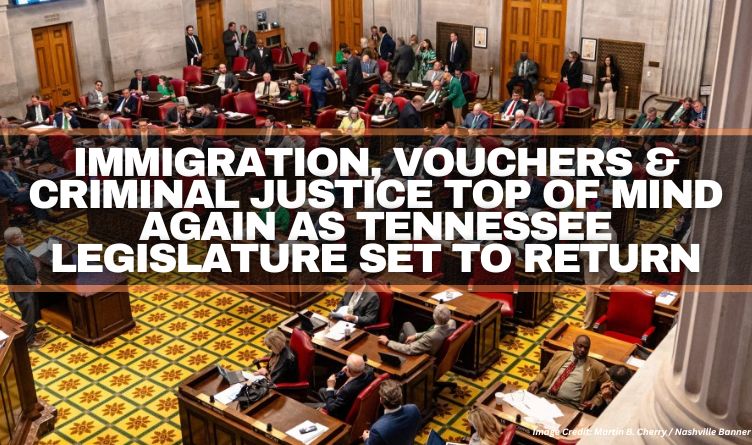
Many holdover bills and some newly filed ones seek to crack down on illegal immigration and crime, while expanding the new school voucher program.
Image Credit: Martin B. Cherry / Nashville Banner
**Note from The Tennessee Conservative – This article posted here for informational purposes only.
This story was originally published by the Nashville Banner. Sign up for their newsletter.
by Sarah Grace Taylor, [The Nashville Banner, Creative Commons] –
Vouchers, immigration and déjà vu are on the agenda for the Tennessee General Assembly this year, as state lawmakers prepare to close out the biannual session.
The legislature will be back in full swing on Jan. 13, closing out the two-year legislative cycle this spring.
In some residual bills spilling over from last year and a handful of new policies introduced since the House and Senate gaveled out in April, Tennessee’s Republican supermajority will focus on immigration, vouchers and criminal justice again this spring, mirroring priorities from last year’s regular and special sessions.
While Gov. Bill Lee finally won his years-long fight to establish a universal school voucher program during the 2025 special legislative session, lawmakers will likely revisit the program this year as Lee seeks to expand the program.

The existing voucher bill allows for expansion of up to 5,000 additional “Education Freedom Scholarships” in each of the first five years of the program. Even in the program’s infancy, Lee has called for even greater expansion — contingent on the state’s revenue forecast — after more than 42,000 students applied for the 20,000 available vouchers in the first year.
The program, which has been criticized for diverting resources from already underfunded public K-12 schools and challenged legally over potential discriminatory enrollment policies, cost the state $144 million in its first year and is projected to exceed $1 billion over its first five years even without additional expansion.
While there are no specific bills set to address expansion, Lee’s final budget proposal as governor will likely be released next month and will influence whether the legislature addresses vouchers, again, this year.
The other major topic leftover from last year is a controversial attempt by House Majority Leader Rep. William Lamberth (R-Portland) and Sen. Bo Watson (R-Hixson) to allow school boards to either charge tuition to or disenroll students who are not U.S. citizens.
The bill stirred protests and party division throughout the spring and would go against the 1982 Plyler v. Doe ruling, where the U.S. Supreme Court determined undocumented children are entitled to public education. Though it cleared the State Senate and is poised to pass the House Finance Committee and floor vote, Lamberth stalled his own bill as financial concerns cropped up.
By violating current federal policy, the bill could jeopardize the $1.1 billion in federal funding Tennessee receives for its public schools each year, according to the state’s own fiscal analysis.
Since slowing its progress, Lamberth has been seeking clarification from the U.S. Department of Education on whether the bill would risk federal funding. In December, Lamberth told the Banner these discussions were still inconclusive.
“We have gotten some response from the federal government on that, but we are still going back and forth with them,” Lamberth said. “I would like to get a definitive answer from the federal government that passing this bill would not in any way endanger the $1.1 billion we get in federal funds for public education in this state before we move it forward.”
According to Lamberth, the feds have been fairly responsive, but haven’t provided sufficient assurance that the funds are safe if the current version of the bill were to pass.
Regardless of the outcome of the education bill, Lamberth promises further changes in immigration enforcement again this year.
“I anticipate that we will have several other new bills this year that will combat illegal immigration in the state of Tennessee,” Lamberth said Monday.

Immigration
Among the few new bills introduced during the break, of course, are new immigration policies.
After a dragnet immigration operation in Nashville in May, which many city officials opposed and which was conducted with almost no city involvement, Republicans criticized Mayor Freddie O’Connell for allegedly “doxing” ICE agents by publishing a blotter of interactions with federal immigration authorities, providing details typically made public during law enforcement operations.
In response, Senate Majority Leader Jack Johnson (R-Franklin) introduced a bill that would further exempt immigration enforcement details from public records and threaten public officials with a felony charge for sharing them. The Class E Felony charge could result in up to six years in prison and a fine of up to $3,000.
While Johnson’s bill has not yet been heard in the legislature, he told the Banner in June that it was necessary to deter officials from “doxing” those involved in controversial immigration enforcement.
A similar provision of a sweeping immigration bill passed in the 2025 special session, which threatened elected officials with recall and a felony charge for supporting so-called “sanctuary city” policies, hit a snag this summer when Attorney General Jonathan Skrmetti — who is usually in lockstep with Republican lawmakers — said he would not defend that policy against constitutional challenges.
In a different response to recent actions, Rep. Justin Jones (D-Nashville) has introduced the “Stop American Gestapo Act,” which would prohibit law enforcement from covering their faces, names or badges while interacting with the public. Although there are exemptions for certain police activities, and masks are permitted for protective reasons like preventing disease exposure or smoke inhalation, the bill would otherwise make it a Class C misdemeanor for law enforcement agents to conceal their identities.
In December, Sen. Brent Taylor (R-Memphis) filed a bill that would require local law enforcement agencies entering memoranda of understanding with federal immigration enforcement officials to “accept and honor any immigration detainer received from federal immigration authorities,” to keep those wanted for federal immigration reasons in temporary custody.
Public Safety
Taylor also filed a series of new criminal justice bills, including increasing the penalty of certain animal cruelty charges and establishing a statewide police recruitment fund for law enforcement agencies with 10 percent or higher vacancy.
Another of Taylor’s bills redefines the act of drag racing as “street drag racing,” broadening the charge to include racing on commercial property, and establishes the charge of “reckless endangerment by street drag racing” as a Class E Felony. In an unlikely pairing, House Democratic Caucus Chair Rep. John Ray Clemmons (D-Nashville) has introduced a similar bill allowing law enforcement to impound vehicles used in drag racing within a county or municipality where local government has passed a policy approving of such impounds.
Food Access
In another callback to previous sessions, Clemmons also introduced a bill on Monday that would exempt groceries purchased through EBT or SNAP from state sales tax, a more narrow version of a repeated effort by House Democrats to exempt grocery purchases from sales tax.
The bill is also part of an ongoing effort by Clemmons to expand food access for those in need, including another new bill which would require school districts to create free breakfast and lunch programs and require the state to reimburse schools for those programs.
Clemmons has been at odds with Lee over food access since the governor rejected federal funds for a summer lunch program. This fall, the historically long federal government shutdown threatened SNAP, and Democrats, like Clemmons, called on Lee to use state money to cover the cost.
Technology
Lawmakers have also introduced a handful of bills aimed at keeping up with technological changes, ranging from electric cars to artificial intelligence.
Sen. Page Walley (R-Savannah) has filed a bill proposing an excise tax on charging electric and hybrid vehicles. The 3-cent-per-kilowatt-hour tax would apply to full-electric and plug-in hybrid vehicles, which, on average, require 40-100 kilowatt-hours to reach a full charge.
Walley is also attempting to mitigate the impacts of social media on minors with a bill updating child labor laws to prohibit anyone under 14 years of age from posting monetized video content online, and requiring parents who profit off of content containing a minor to save a portion of the video’s profits for the benefit of the minor, similar to existing policies for child entertainers. The bill allows adults who were featured in content as minors to request the deletion of that content.
Another tech-oriented bill introduced by Sen. Becky Massey (R-Knoxville) and Rep. Mary Littleton (R-Dickson) would establish a Class A felony, punishable by up to 60 years in prison and as much as a $50,000 fine, for training AI to encourage suicide or homicide, or to mimic a personal relationship with or impersonate a human.