Image Credit: Arctyx creative / CC
Tennessee Conservative News [By Olivia Lupia] –
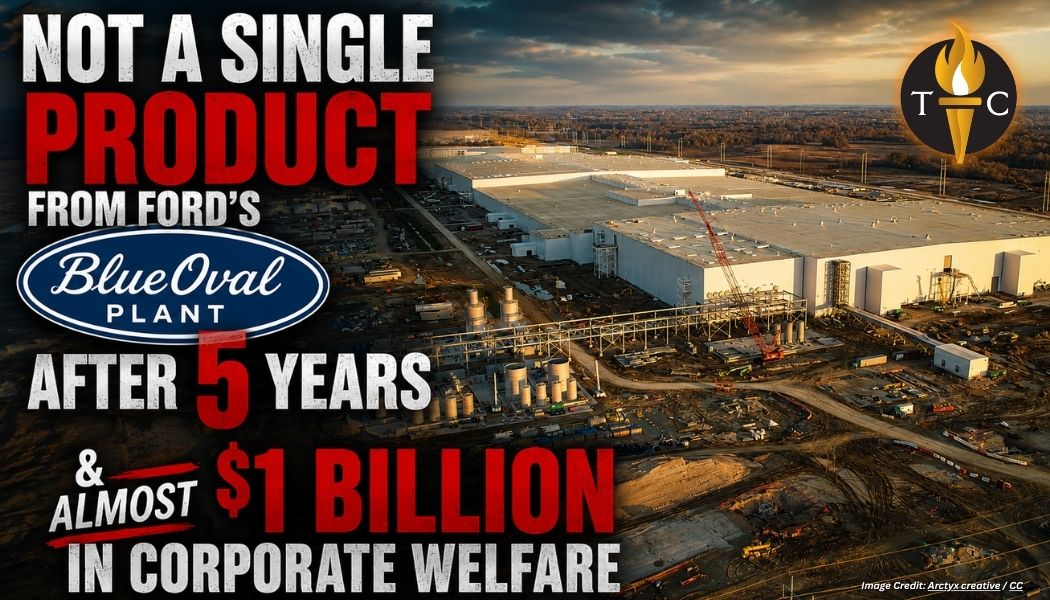
Nearly five years after announcing a massive electric vehicle and battery manufacturing plant, Ford Motor Company’s BlueOval City hub has yet to start production, failing thus far to create any of the nearly 6,000 promised jobs and sitting on $900 million in taxpayer-funded incentives.
In 2021, the Republican-controlled legislature and Governor Lee approved the $900 million incentive package for the site in West Tennessee, a 6-square mile manufacturing campus set to be a $5.6 billion investment.
But while original campus plans included a manufacturing facility for Ford’s electric pickup truck and a battery plant owned and operated by BlueOval SK, a joint venture between Ford and South Korean battery manufacturer SK On, a series of delays, including the dissolution of the partnership with SK On, has significantly pushed back hiring and production timelines for the BlueOval hub.

Shortly after the SK On partnership was ended in December of 2025 and SK On took full ownership of the battery plant, Ford announced they were scrapping plans to manufacture electric vehicles at BlueOval and would instead turn to gas-powered truck models with more stable paths to profit.
The Tennessee Department of Economic and Community Development, responsible for doling out funds connected to corporate incentives, was aware of the change to production plans, but said it did not “diminish” Ford’s commitments to West Tennessee or their promise of jobs and investment in the region.
Gov. Lee said at the time the state would be in “continuous communication” with Ford but was not concerned with the updates as the state regularly deals with “companies that change plans.” Now, more than six months later, there is still no product movement at the plant, with production of the gas-powered models not slated to begin until 2029, nearly eight years into the state’s 10-year agreement with Ford.
Through the agreement, Ford and the former BlueOval SK joint venture are required to create at least 90% of the total 5,800 jobs within 10 years, at which point Ford secures a $500 million reimbursement from the state for construction costs.
If 80% of the promised jobs are not created by 2032, a “clawback” would be triggered, forcing the company to repay that $500 million and an additional $175 million based on the value of the land the plant sits on, which was donated by the state. However, Tennessee’s clawback record has fallen under scrutiny as the state has been unable to recoup millions of dollars as corporations have failed to fulfill their end of the bargain.
Tennessee has also contributed $200 million to build a road interchange, $138 million for water treatment facilities and a wastewater line, and $5 million for local government consulting. The state also agreed to pay for a new $60 million extension campus for the Tennessee College of Applied Technology in nearby Stanton, which opened in summer 2024 under the premise it would help train future employees of the industrial complex.
Additionally, state legislators earmarked $725,000 to create an 11-member Megasite Authority of West Tennessee to oversee the development of the BlueOval City site and “promote economic development, generate high-quality jobs at the Megasite and in the surrounding areas, and encourage and promote the development of manufacturing, warehouse, distribution, office, restaurant, retail, hotel, motel, communications systems, recycling, utilities, educational institutions, workforce housing, financial and recreational activities, and other similar uses,” for an additional 300 acres under state control.
Megasite Authority CEO Clay Bright told state lawmakers in February that the state has met all its commitments to Ford, including road work for the first phase of the project, the water supply, and the wastewater treatment plant, and reiterated the dissolution of BlueOval SK does not change the “details or accountability” of the state’s agreement with the companies.
Currently, Ford employs about 80 people at its facility, and SK On Tennessee has a core team of 100. Both companies have said they will ramp up hiring closer to the start of production for their respective facilities, 2028 for SK On and 2029 for Ford. Before the dissolution of BlueOval SK, around 300 people were employed under the partnership, yet 150 were laid off in May as the partnership again became separate entities, so job growth has hardly matched promises made under the agreement.
Early projections indicated Ford would ultimately employ about 2,300 people at the truck plant with another 3,500 working at the adjoining SK On battery plant, but neither company is anywhere close to that estimation. Yet both are still reaping the benefits of nearly $1 billion in taxpayer funds with almost nothing to show in return thus far.


About the Author: Olivia Lupia is a political refugee from Colorado who now calls Tennessee home. A proud follower of Christ, she views all political happenings through a Biblical lens and aims to utilize her knowledge and experience to educate and equip others. Olivia is an outspoken conservative who has run for local office, managed campaigns, and been highly involved with state & local GOPs, state legislatures, and other grassroots organizations and movements. Olivia can be reached at olivia@tennesseeconservativenews.com.

2 Responses
All with good sense knew it wouldn’t fly.
This was a BAD decision from the start. Anyone with any sense could see electric cars and batteries were NOT going to be sustainable. How is it that no one considers it takes a LOT MORE OIL to generate electricity than gasoline? What a huge waste of taxpayers dollars.