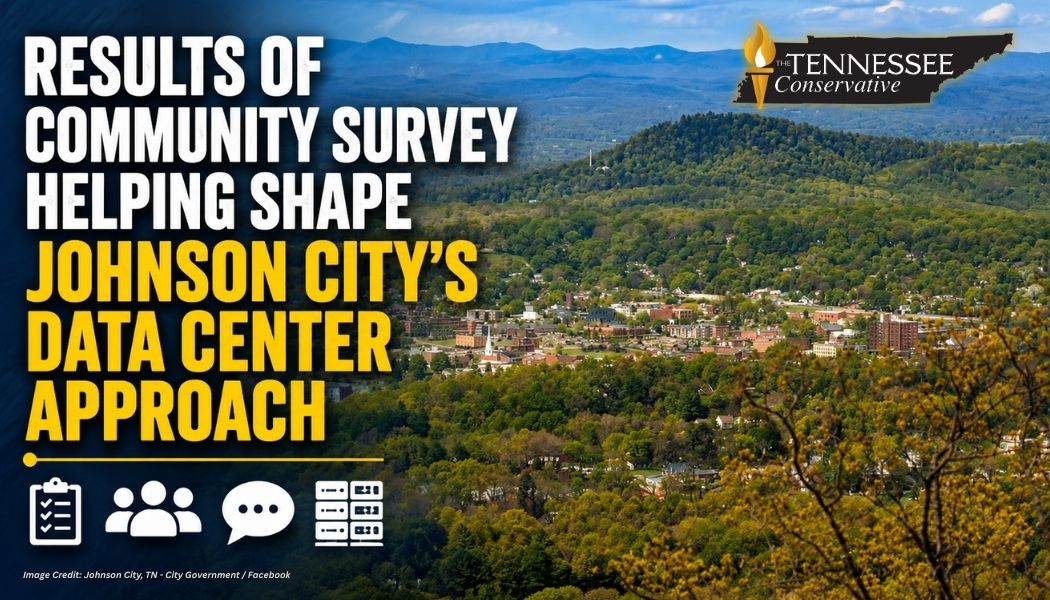
Image Credit: Johnson City, TN – City Government / Facebook
Tennessee Conservative News [By Olivia Lupia] –
In May, the City of Johnson City asked community members to give their input about data centers, and that feedback is now helping the municipality develop the regulations impacting these facilities, putting resident concerns front and center in the ongoing discussion about the continued influx of data centers into the Volunteer State.
Residents were asked to participate in a survey from the city, which said it was evaluating data center operations and their potential impacts such as “noise, location, and compatibility with surrounding uses.” The survey asked people about their concerns regarding data centers and how they felt about their development in Johnson City.
Respondents could choose up to three major areas of concern from a list that included environmental impacts, noise, and traffic. Participants were also asked what kind of approach they’d like to see the city take with the data centers, like location restrictions, noise regulations, or specified generator testing hours.
Now, that feedback is being used by local officials looking to create or adjust ordinances for data center construction, with over six pages of amendments and an independent noise and vibration study being considered by the city commission, zoning board, and regional planning commission.

In June, the planning commission approved an amendment to the city’s data center regulations seeking to close some gaps in the original ordinance, including the implementation of a provision requiring a 200-foot minimum radius a data center must be from a residential property.
More than a dozen members of the public took to the podium during the meeting, with most saying that while the amendment was a step in the right direction, it still needed improvement, especially increasing the mandatory radius.
“I can shout loud enough to be heard from 200 feet away with my human voice,” one commenter said. “I can’t imagine what that’s going to sound like with hundreds and hundreds of servers.”
“The proposed 200-foot setback from residences is not far away enough to protect residents from the well-documented light and sound uses produced by the centers,” another said.
Others suggested continued sound vibration monitoring while one commissioner voted against the amendment because she felt it was not stringent enough.
“I would like a little bit more clarification on that 200-foot setback in residential areas and just would like to explore why we are hesitant to expand that to a greater distance,” she said. “That just requires future and additional collaboration with the city’s legal department and city staff so that I can learn more.”
She also reiterated that the passage of the amendment would be good overall and that there is still time for the city to have additional discussions on the matter with continued community input as officials work to craft the final legislation.

Beyond the required radius, the amendments would further require any future data center to complete a public process through the Board of Zoning Appeals (BZA), comply with a city noise and light ordinance, and vibration regulations.
If codified, the amendments would require approval from the BZA before a developer could even apply for a building permit. Developers would also have to meet an extensive list of prerequisites, including completion of several impact studies, before submitting any plans for approval.
Only after BZA approval could the developer then request a building permit through the planning commission, which supporters say adds an extra layer of public deliberation before construction could begin on any facility.
“This creates an entire process that is open and transparent where the public can also intervene and provide comments, just like the comments at the city commission or the planning commission meetings,” said one community advocate. “And that means that the community has an opportunity to know and be involved if there is such a project that comes in.”
Still in the works are the noise ordinance components to the regulations, without which several of the zoning amendments might not apply as intended. City staff has been receiving updates from the city’s contracted study through JPM Acoustics which is evaluating the potential impacts associated with data centers to help determine whether updates to city noise regulations are warranted.
The study is seeking to “ensure that noise standards adequately protect nearby residents while providing clear expectations for future development” with a target completion date of June/July 2026. These results will likely be used to help craft any ordinance amendments or new language as the city works to set their own boundaries with the booming tech industry.


About the Author: Olivia Lupia is a political refugee from Colorado who now calls Tennessee home. A proud follower of Christ, she views all political happenings through a Biblical lens and aims to utilize her knowledge and experience to educate and equip others. Olivia is an outspoken conservative who has run for local office, managed campaigns, and been highly involved with state & local GOPs, state legislatures, and other grassroots organizations and movements. Olivia can be reached at olivia@tennesseeconservativenews.com.

One Response
Here are my thoughts about data centers. It seems as though most of the restrictions are based upon sound and vibration disruption. The problem with data centers is not sound and vibration. Computers operate with almost no noise what-so-ever. They most probably have little to no vibration.
However, the HUGE problems, which effect communities most, are enormous usage of cooling water and electricity. It should be mandated that before a data center building permit is approved by the BZA, it provides its own electrical power and cooling water source, independent of the city or country’s utilities!