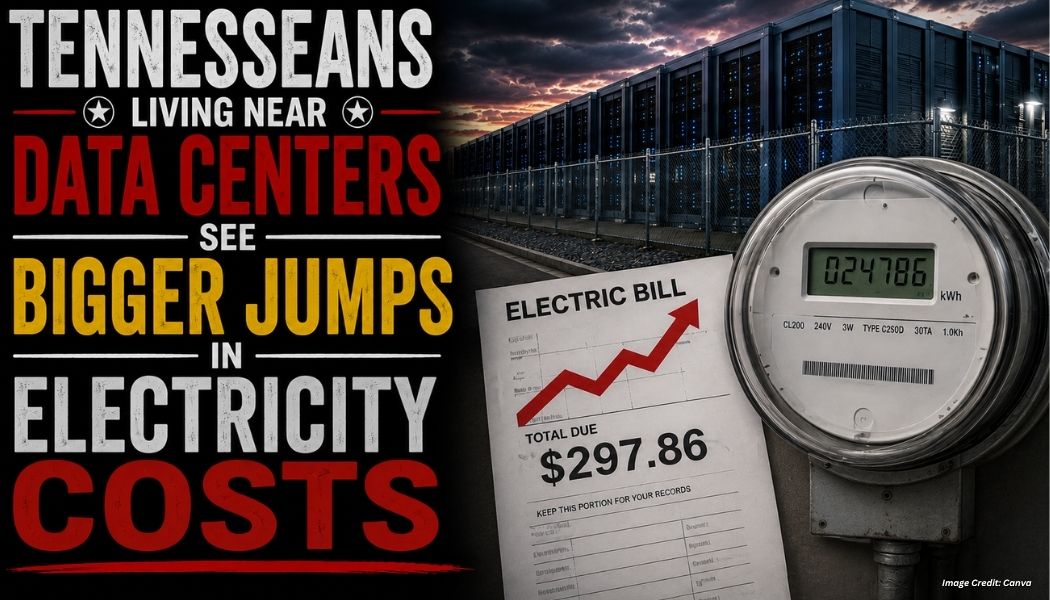
Think Tennessee’s analysis focuses on data centers’ rapidly increasing demand on local power grids.
Image Credit: Canva
***Note from The Tennessee Conservative – this article posted here for informational purposes only.
This story was originally published by the Nashville Banner. Sign up for their newsletter.
by Anna Blubaugh [The Nashville Banner, Creative Commons] –
Residents in areas with data centers foot more of the bill for increased electricity costs, according to a new report by nonpartisan think tank Think Tennessee.
The report released Tuesday is the first of a two-part series analyzing the impact of data centers on Tennessee communities.
According to the report, Tennessee residents living near data centers saw on average a 3.2-percent increase on their electricity bills between 2023 and 2024, whereas commercial consumers, such as data centers, saw their electricity bills decrease by 0.2 percent. Increases in Tennessee regions home to data centers outstripped increases in other parts of the state. Areas home to data centers saw a 1.6-percent increase between 2023 and 2024, while the statewide average was 1.3 percent.

Additionally, Think Tennessee found that, although commercial consumers are projected to consume energy at twice the rate of residents, regional households will face the quickest price increases — an expected 5.1 percent between 2022 and 2027.
According to the analysis, Tennessee’s land availability, energy sources and fast-growing technology industry attract data center developers at a disproportionate rate. Currently, more than 60 data centers exist in Tennessee, and 13 either already exist or are under construction in Nashville.
Think Tennessee found that data centers have also contributed to the growth of Tennessee’s average electricity consumption. Data centers consumed more than 9.2 million megawatts in the Tennessee Valley region in 2025, a sevenfold increase over five years. The amount of megawattage required for operational, under-construction and planned Tennessee data centers to operate at any given time equal to the amount of electricity required to power 1.3 million Tennessee homes per year, according to the report.
The potential impact of data centers on residential areas has sparked widespread debate locally. Proposed data centers near the Nashville Zoo and at Fisk University have heightened the visibility of the issue, and 150 people spoke at a Metro Planning Commission public hearing about new data center zoning regulations in June.
“A data center does not belong near our homes, let alone the Nashville Zoo,” said Santiago, a resident of District 20, at the meeting. “These facilities put an incredible strain on our local power grid, and hey, if we remember the ice storm, our power grid is not entirely that well suited.”
The issue will be up for public debate again Tuesday, as the zoning regulations and a proposed data center moratorium are up for public hearings at the Metro Council.

Mayor Freddie O’Connell is backing the bills, and filed one of his own last month. The legislation would commence the process of condemning the property next to the zoo, allowing Metro to purchase the property for fair market value without the owner’s consent.
“We can support economic development while also making smart choices about the highest and best use of our land,” O’Connell said in a video statement.
Think Tennessee’s report highlighted similar concerns, citing risks associated with data centers that include grid strain and outages.
The report also examined existing concerns surrounding Tennessee grid reliability. More than 230,000 Nashville Electric Service customers were without power during the peak of January’s ice storm, and it took two weeks for some households to regain power. NES’ system saw between $100 million and $140 million worth of damage following the storm.
The report warned of the importance of creating policy and legislation to manage data center growth, acknowledging both the potential economic benefit of data centers and risks of increased electrical consumption.
“Data centers are very quickly changing the energy needs of our state,” said Erin Hafkenschiel, president of Think Tennessee. “And the decisions made now about planning, pricing and infrastructure will determine who bears the costs of this growth. If we don’t get it right, the potential risks to household energy costs might outweigh the positive economic growth impacts.”


3 Responses
This really needs to be checked. My electricity went up and we do not have a data center. Are you all also on TVA? They have raised rates. The TN legislator who got a bill passed requiring data centers to provide their own electricity says there are 60 data centers in TN and ALL provide their own electricity, and even pass on extra to the nearest city. While I agree great caution is needed, we must not lay blame anywhere except the true source. The data centers are coming, we need to be aware of their true nature and potential drawbacks.
Data centers are detriments to all near them.
If residents are in fact seeing an increase in their bills, I strongly suggest they look to the power company for explanation and do not accept an excuse of “it is the data centers (hereinafter ‘DC’).” The DC produce their own electricity so the local power companies are probably padding bills and using the DC as an excuse. Since most power for homes is produced by an arm of TVA (a very corrupt entity) they should look to TVA for answers.