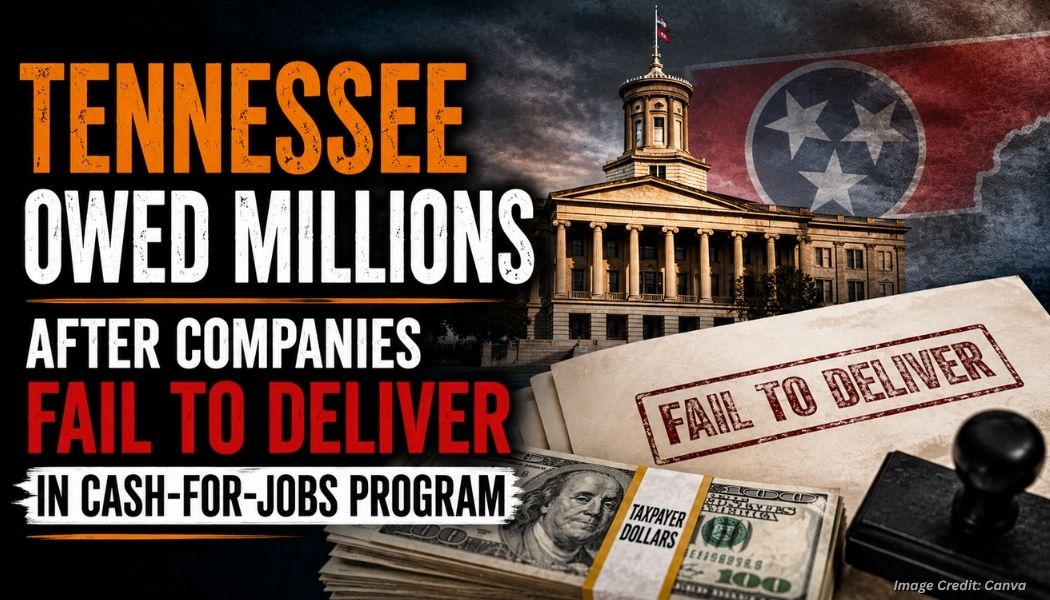
State has clawed back $92M from companies for not meeting job goals, with $20 million still owed.
Image Credit: Canva
***Note from The Tennessee Conservative – this article posted here for informational purposes only.***
The Center Square [By Johnny Edwards & Kim Jarrett] –
Millions of taxpayer dollars have slipped through Tennessee’s fingers in an economic development program that pays huge cash grants to private companies promising new jobs, an investigation by The Center Square found.
The state has recourse when those promises fall flat and has clawed back $92 million from companies that failed to deliver on pledged job numbers, but more than $20 million remains uncollected, state data shows. Recouping funds takes years and can be futile if companies dissolve, file for bankruptcy, or wage battle through protracted litigation.
In an interview last month, Economic and Community Development Commissioner and Deputy Governor Stuart McWhorter characterized clawbacks as “rare” within the state’s FastTrack grants program.
But the state’s own tracking spreadsheet, obtained by The Center Square through a public records request, shows Tennessee’s economic arm has spent years chasing money back from dozens of companies that fell short of their job pledges. McWhorter’s department has pursued 71 companies since 2016. In total, the 71 had been handed $169 million in grants through Tennessee’s FastTrack program, aiming to create more than 24,000 jobs combined.
Actual jobs created by the companies: About 7,400.

Under FastTrack, employers who create at least half of the jobs they promised can keep part of their grant money, so not all the money doled out to underperforming companies can berecovered. The spreadsheet shows the state has managed to recoup $92.4 million from 55 companies and is still fighting for more.
Just last month McWhorter’s department sent a demand letter to Novonix, a Chattanooga battery materials company that received a $3 million FastTrack grant in 2021 by promising 290 jobs, but only created 85 jobs, the state contends.
The department gave Novonix 45 days to return the money. Novonix did not respond to a request for comment for this story.
“The real question that I think most people are interested in is, do you enforce the clawback provision?” McWhorter told The Center Square. “And the answer is yes, we do. It’s not something that anyone enjoys doing. It’s not a conversation that people enjoy having.”
Justin Owen, president and CEO of the Beacon Center of Tennessee and a fierce critic of FastTrack, said government shouldn’t be using tax money to pick business winners and losers in the first place.
“This is part of the problem with corporate welfare,” said Owen, whose Nashville-based nonprofit advocates for market-based policies and helped push a 2013 law mandating clawback agreements for all companies receiving economic development grants.
“Markets are notoriously messy, obviously, and companies fluctuate,” he said. “They hire people, they lay people off. That’s just part of the way it works, and today’s winner may be tomorrow’s loser.”
Failures and disappointments
Including Novonix, 18 companies accused of failing to live up to jobs promises owe the state $20.1 million, including $8.8 million still owed in judgements obtained against eight companies that fought back in court, according to state’s data.
The sum also includes $6.1 million that’s tied up in litigation and owed by five companies, the state says. One of those companies is SmileDirectClub, a Nashville-headquartered teledentistry company that sold teeth aligners and faced class-action lawsuits alleging false advertising and damage to teeth. The company filed for bankruptcy in 2023, but not before receiving almost half of a total $10.05 million awarded FastTrack grant.
Economic and Community Development can only pursue $3.5 million through bankruptcy court, because it didn’t have a signed performance agreement attached to the other $1.4 million, department spokeswoman Lindsey Tipton wrote to The Center Square in an email.
The SmileDirectClub bankruptcy is just one in a long list of disappointments contained in the state’s internal spreadsheet, obtained earlier this month through a request filed under the Tennessee Open Records Act. The Center Square has been examining corporate accountability under FastTrack, in light of a controversial $30 million grant awarded to Starbucks this year for its new southeast corporate office in Nashville, and sought specific information about which companies have been asked to return funds and how much has been paid back.
Among the failures:
The state has a judgment against Textile Corporation of America, which obtained a $3 million grant in 2017 to build a manufacturing plant in Pikeville, promising to create 1,000 jobs. The company created zero jobs, with the owners, twin brothers Karim and Rahim Sadruddin, pleading guilty to federal charges of wire fraud and conspiracy to commit money laundering. Prosecutors said the scheme involved fake invoices, falsified records, and misspent funds.
The brothers were sentenced to 50 months in prison and ordered to pay restitution. So far the company has paid back around $1 million of that FastTrack money, the state data shows.
The state awarded $4 million to MIA (Made in America) Seating in 2013, but Economic and Community Development says it created only 82 of 510 promised jobs at an ergonomic office chairs and seating plant in Clinton. The project was later moved to Union City.
The company fought the state in court, lost, and has yet to make any payments on a $3.4 million judgment obtained in 2024, the state’s spreadsheet reports. Daily interest is accumulating. The Center Square reached out to a company representative about this story but did not receive a response.
Other funds handed over to private enterprise may be gone for good. A 2024 audit by the Tennessee Comptroller of the Treasury examined clawbacks and found $7.9 million in taxpayer money declared uncollectible from seven companies that went bankrupt or dissolved. The audit did not identify the companies, so it’s not clear if the figure overlaps with companies included on the state’s spreadsheet.
$92 million collected
FastTrack launched in 2012 and is the state’s main apparatus for sweetening development deals—and edging out competing states—by making cash payments directly to companies. The program draws from general funds, meaning every Tennessean helps pay for the grants through sales taxes.
Data posted on Economic and Community Development’s website, tracking grants from 2018 to present, shows nearly $767 million awarded to about 585 companies in that timeframe. That would be $100 per Tennessee resident. But it’s unclear how much of that money was actually paid out, and how much may have been returned without a clawback process.
Of the $92.4 million collected from 55 companies, 35 of them created less than half of the jobs they promised. Thirteen of those created no jobs at all, and out of those, four finished their contracts with fewer jobs than they started, giving them negative jobs numbers, according to the state data.
Owen, of the Beacon Center, said FastTrack needlessly entangles taxpayer money into companies’ hiring decisions.
“Companies aren’t coming here and expanding here because we’re giving them handouts,” Owen said. “They’re coming here and expanding here because of our policies, because of our tax structure and those types of things. That’s what we should be doubling down on.”
State Rep. Ryan Williams, R-Cookeville, said Tennessee needs FastTrack grants, though. They’re one of the few tools for growing the tax base in a state with no income tax, he said.
“Whenever we add a job, we’re adding a sales taxpayer,” Williams said. “So when you look at it from an incentives basis, yes, we’re distributing well-fought-for dollars from our citizens into these businesses. But the goal here is to look at … what do we think our return on that investment is going to be through those utilization taxes that we have, because we have no income tax?”

Sliding scale for clawbacks
Under the accountability agreements that companies sign with the state, clawbacks are calculated on a sliding scale according to how much a company comes up short. According to a template contract provided by McWhorter’s staff, a company that creates less than 90% of its pledged new jobs must repay a proportional amount of the grant award while a company that creates less than 50% must repay the entire grant.
McWhorter told The Center Square the accountability agreements give companies years to meet their jobs goals, so clawbacks take as long or longer, “five, six, seven, eight years in some cases.”
He said the risk of a deal going bad factors into how the state vets companies before awarding grants.
“Things don’t go as planned most of the time, but you want to align with companies that can figure that out,” McWhorter said. “They have the deep pockets to pivot, they can weather storms. Because what we don’t want is a company that doesn’t have the ability to do that, and then they’re saying, ‘Hey, we’re out of resources. We can’t do anything about it. And guess what, we’re out of money.”


One Response
Deputy Governor Stuart McWhorter and his Department of Economic and Community Development are abysmally poor at their job. They’re WAAY too eager to pass out our money with little/no recourse.
WHY aren’t the companies required to post performance bonds?