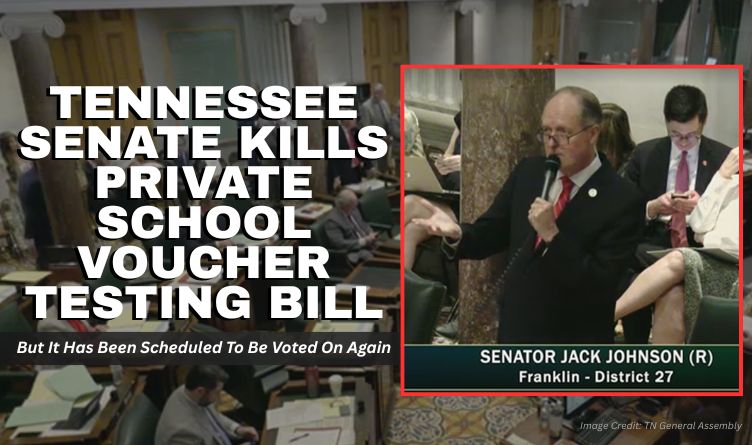
House version would have expanded Education Savings Account program.
Image Credit: TN General Assembly
***Note from The Tennessee Conservative – this article posted here for informational purposes only.***
By Sam Stockard [Tennessee Lookout -CC BY-NC-ND 4.0] –
Legislation that would have led to massive expansion of a Tennessee private-school voucher program died in the Senate Wednesday.
***Note from The Tennessee Conservative: Even though the bill failed in the Senate, it has been reset to be heard again today 4.23.26.
The Senate voted 16-14 in favor of Senate Bill 1585, one short of the constitutionally required number for passage, ending its hopes of moving through the House.
The Senate version would have allowed private schools participating in the Education Savings Account program to give a nationally-recognized achievement test as well as the same standardized test the state requires.
The House version of the bill, which was amended in a finance committee, would have expanded the voucher program dramatically, removing the cap on the number of students who can participate.
Lawmakers narrowly adopted the program in 2019 for Metro Nashville and Memphis Shelby County school districts, then expanded to Chattanooga for low-income students. About 4,800 students participate in the program, some 10,000 less than allowed.

Critics of the bill say it would devastate the local governments financially whose school districts would be affected. Knox County was to be added to the ESA program.
The amendment also would have raised the qualifications to 400% of the federal free and reduced-price lunch program, roughly $240,000 for a family of four. Students receive about $9,700 to go toward private-school expenses.
In addition, the House bill would have allowed students unable to receive an “Education Freedom Scholarship,” a separate private-school voucher program, to receive funds through the Education Savings Account program to go toward private-school costs.
Before Wednesday’s vote, Democrat Sen. Heidi Campbell of Nashville raised questions about the House version of the bill, calling it “extreme” and a “black hole” for education funding.
“It will be a kill order,” she said, for the school districts involved.
Besides lifting the cap on the number of students who could receive the funds, the House bill removed a provision in state law requiring the state to pay school districts when they lose students to the voucher program.
The bill’s sponsor, Senate Majority Leader Jack Johnson of Franklin, tried to divert debate from the House version and contended his bill was nothing but a testing measure that would bring “greater accountability.”
But Democrat Sen. Jeff Yarbro of Nashville called it a “bait and switch” and said it does the opposite of bringing more accountability because it eliminates several measurements, including the requirement that students take the same test as those in traditional public schools.
“We’re not being honest,” Yarbro said.
Irritated by Yarbro’s claims, Johnson said it was “troubling” that another senator would accuse members of being “dishonest” and argued that tests should be given based on what is being taught. Yet he acknowledged that the legislature made a “mistake” in 2019 when it passed the Education Savings Account by requiring students to take the state’s test.
The idea seven years ago, one that still has traction, was to be able to compare test scores of public school and private-school voucher students to see how well they’re performing.
Republican Rep. William Slater of Gallatin, a former headmaster at Hendersonville Christian School, pushed the amended version of the bill through the House finance committee but delayed consideration in the House to see what would happen with the Senate version.
Slater said he was “surprised” at the outcome and “disappointed.”
Yet he wasn’t concerned about the potential impact on state or local budgets or that the amendment was attached to his bill with only days left in the session. He felt the House had enough votes for passage.
“In other states where these programs have taken place, public schools don’t end up hemorrhaging students,” he said. “There’s a certain number, it’s always a finite number, a finite percentage of parents that decide to send their children to a private school.”
Slater said public schools should be concerned about the possibility that students using vouchers or “scholarships” could return, forcing them to hire more teachers and increase classrooms.
Voting for the bill were Sens. Todd Gardenhire, Ferrell Haile, Jack Johnson, Adam Lowe, Becky Massey, Mark Pody, Bill Powers, Shane Reeves, Paul Rose, John Stevens, Brent Taylor, Bo Watson, Dawn White, Ken Yager and Lt. Gov. Randy McNally, all Republicans.
Opposing the bill were Democrat Sens. Raumesh Akbari, Sara Kyle, London Lamar, Charlane Oliver and Jeff Yarbro and Republican Sens. Bobby Harshbarger, Tom Hatcher, Joey Hensley, Ed Jackson, Steve Southerland and Page Walley.
Not voting were Sen. Heidi Campbell and Republican Sens. Janice Bowling and Kerry Roberts.


One Response
Well what do you know….Ol’ Kerry “PRESENT AND NOT VOTING” Roberts strikes again! How many times is it he’s been present and not taken a stand in this session now? What are the odds he is not done with his AWOL voting record now? And, when will the folks in the 23rd Senatorial District send this AWOL politician home?