Image Credit: TVA / CC
Tennessee Conservative News [By Olivia Lupia] –
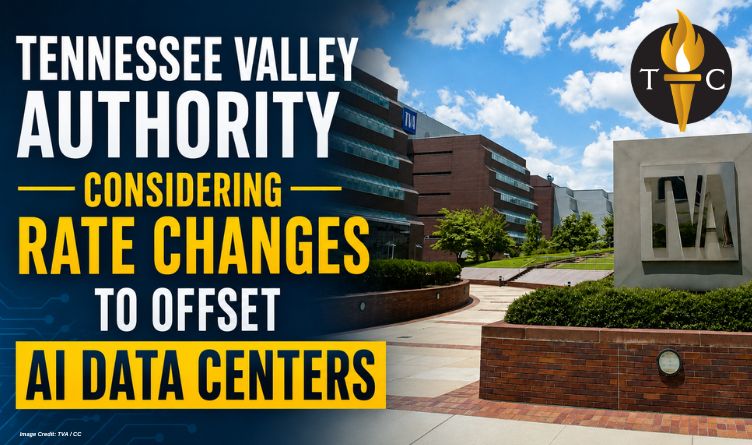
As power demand grows from large data centers across the region, the Tennessee Valley Authority (TVA) announced it will consider electric rate changes to offset the costs, potentially eventually including residential customers shouldering increases for infrastructure demands, though that proposal may find itself in conflict with legislation passed earlier this year.
TVA members are reportedly discussing whether data centers should ultimately fall under a separate rate structure due to their massive amounts of energy consumption. The agency is supposedly working to ensure any new structures will not add cost burdens to residential customers, but no official rate changes have been announced yet.
In February, TVA sent a letter to local power companies to begin the rate-changing process and has continued “frequent discussions” with them and other customers about the proposed changes. Actions for implementation will be recommended to the TVA board of directors in August at the earliest.

Scott Brooks, TVA spokesman, said that in the last year, data centers comprised around 18% of the TVA’s overall industrial load, nearly one fifth, and that number is expected to double by 2030. And 99% of the data centers for which the agency provides power are connected to local power companies. Should all the data centers interested in coming to East Tennessee be approved there would be an increased power demand of 11,000 megawatts.
“As a public power provider, TVA is not saying no, but we’re saying ‘yes, but,’” Brooks said. “The ‘but’ is you need to work with local power providers if that’s where you’re going to connect and make sure that they can handle the load without putting a strain or an additional burden on their customers.”
“That letter kind of kicked off a process where we want to sit down with those local power providers, 153 of them in the valley, and talk to them about what they’re seeing, what they think would be the best option, again, to manage the additional load without putting a strain and a financial burden on the rest of the system and on the other 10 million people who pay their power bills,” Brooks elaborated.
Some East Tennesseans are already seeing skyrocketing rate hikes and believe a bitcoin mining data center may be the culprit. Residents of Jellico saw bills more than $600, $800, and even $1,000, with the amount owed increasing each month and seemingly no viable explanation other than the bitcoin mine.
After local media reached out to the Jellico Utilities Authority for some answers in March, President Joe Carroll and CleanSpark Chief Business Officer Harry Sudock said the presence of the facility is helping to stabilize rates rather than increase them and attributed the sharp increases to recent extreme cold weather.
Congressman Chuck Fleischmann (R-District 3) says TVA customers should not face surprise eclectic rate hikes and that he has been “closely involved” in conversations surrounding the energy demand growth and TVA’s role.
“I probably have the closest working relationship with TVA than any other member of Congress,” Fleischmann said. “I can assure you that there will be no rate increases without going to the people.”
He also referenced President Trump’s “Ratepayer Protection Pledge”, wherein several Big Tech companies committed to fully covering the cost in increased electricity production for their data centers and assure prices for American communities will not increase.
Whatever new rate system the TVA ultimately decides to implement, there should be at least a modicum of protection for residential rate payers due to HB1847 passed by the General Assembly during the 2026 session. The legislation, which has already been signed into law by Gov. Lee and took effect immediately, prohibits the costs associated with building a new data center or upgrading electrical infrastructure of a center from being absorbed or subsidized by a municipal or electric utility except in limited circumstances. Should upgrades also benefit ratepayers, utilities may then share the cost with a data center.
However this was the sole piece of data center regulation that made it across the finish line in this year’s legislature, and many municipalities are now taking matters into their own hands, looking to enact proactive regulatory frameworks or gather community input given the rapidly growing number of data centers across the state.
One mayor is calling for a full two-year moratorium on all new data centers while Johnson City officials are seeking public input through a survey designed to get resident feedback on any potential data centers in the city, including concerns about noise, location, generator testing limitations, and “compatibility with surrounding uses.”
And in Nashville, which reportedly has 27 operational or under construction facilities as of late 2025, Metro Councilmember Rollin Horton has filed legislation aimed at restricting and regulating large data centers in the area. Horton’s bill proposes restricting data centers larger than 500,000 square feet in Nashville and requiring other large data centers to complete a public approval process and follow rules on water usage, emissions, power generation and noise.
Horton said his goal is not to stop technology growth in the city, but to be proactive in making sure large data centers are regulated before they arrive and potentially cause problems down the line. The bill already has 14 co-sponsors and is scheduled to be discussed at the June 2 Metro Council meeting.


About the Author: Olivia Lupia is a political refugee from Colorado who now calls Tennessee home. A proud follower of Christ, she views all political happenings through a Biblical lens and aims to utilize her knowledge and experience to educate and equip others. Olivia is an outspoken conservative who has run for local office, managed campaigns, and been highly involved with state & local GOPs, state legislatures, and other grassroots organizations and movements. Olivia can be reached at olivia@tennesseeconservativenews.com.

5 Responses
Technology is killing us.
So are cars, sugar, processed food, air planes, COVID, diabetes, violent riots, heart attacks………………………….
So the Billionaires that are putting in these atrocities get tax breaks, while the astronomical power usage cost are being put on the backs of the citizens who are already struggling to afford food, housing, medical care and gas! NO WAY!
The AI centers can pay for their own energy…including any upgrades that the grid(s) may need. Keeping an eye on the money and which politicians are benefiting from AI centers.
I e-mailed my TN Senator (Stevens) yesterday and this was his response. ” We passed a law this year that requires them to be self-sufficient for their energy needs. That may or may not be a good thing because that may mean they simply build large “green energy” solar power mirrors. We would prefer TVA to build small modular nuclear reactors.”