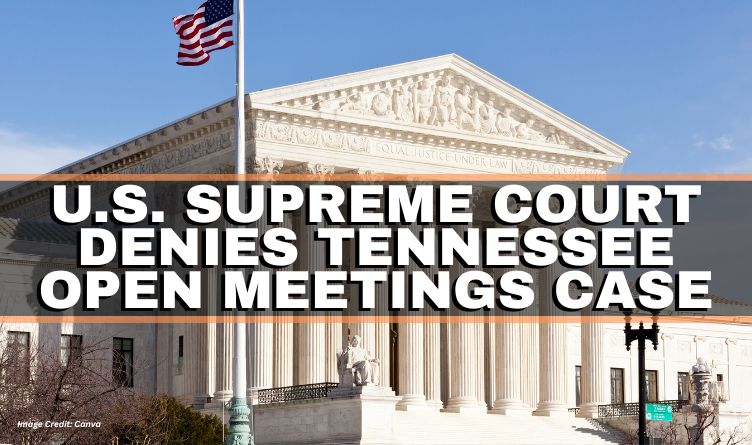
U.S. Supreme Court Denies Tennessee Open Meetings Case

U.S. Supreme Court Denies Tennessee Open Meetings Case

U.S. Supreme Court Denies Tennessee Open Meetings Case

Image Credit: Canva

***Note from The Tennessee Conservative – this article posted here for informational purposes only.***

The Center Square [By Andrew Rice] –

The U.S. Supreme Court declined to hear a case brought by The Center Square challenging rules that prevent the public from accessing certain government proceedings.

The case, McCaleb v. Long, challenged the Tennessee Judicial Advisory Commission’s decision in 2018 to close its meetings to the public after a specific disruption. The meetings were open to the public for 35 years before its closure, according to court documents. 

The Liberty Justice Center, a nonprofit law firm, filed the case on behalf of Dan McCaleb, executive editor of The Center Square. The Tennessee Judicial Advisory Commission meets quarterly, and makes recommendations to the Tennessee Supreme Court on court rules of practice and procedure.

“When government officials choose to block members of the press and public from accessing court rule-making meetings – where decisions affecting citizens are made in secret – they undermine government transparency and the public trust,” the Liberty Justice Center wrote.
The Center Square filed a lawsuit in June 2022, asserting a First Amendment right to access the proceedings of the commission.

“Allowing the public and press to observe members at federal Judicial Conference meetings considering rules and making recommendations to Congress has played a significant and positive role in the rulemaking process regarding federal court policy,” the Federal Judicial Center wrote in a brief to the Tennessee district court.

A court ruled in favor of The Center Square in March 2023. However, in November 2024, the district court reversed and said the right to public access only applies to trials and hearings where final decisions are made.

“There is generally no First Amendment right to access information that the government has decided not to make public,” the district judge wrote.

In September 2025, the Sixth Circuit Court of Appeals agreed with the district court’s decision. The Center Square later appealed to the U.S. Supreme Court.

“The impact of this case can be summarized in a famous quote, made over a century ago by United States Supreme Court Justice Louis Brandeis – ‘Sunlight is said to be the best of disinfectants,’” said former Liberty Justice Center Senior Counsel Buck Dougherty.

Share this:

2 Responses

  1. They went about litigating it all the wrong way……that’s why they lost. How it should have been litigated to SCOTUS. Frame the issue narrowly and strongly. It should not have been pushed as a broad “public has a right to attend all government meetings” argument. That loses 9-0 every time. Instead, it should have been framed it was this way: “Whether the First Amendment right of public access to government proceedings — long recognized for criminal trials (Richmond Newspapers), preliminary hearings, and certain administrative proceedings — extends to a state’s official judicial rulemaking advisory body that wields significant de facto power over court rules that govern the public.”
    This ties it directly to existing Supreme Court precedent on the “right of access” (Richmond Newspapers v. Virginia, Press-Enterprise cases, etc.). And…… Core Legal Arguments Should Emphasize Historical Tradition Test: Show that judicial rulemaking bodies and advisory commissions have historically been open in many states, including Tennessee for 35 years before 2018. Use the experience and logic prongs from Richmond Newspapers.
    Functional Importance: These meetings aren’t purely advisory in practice. The Tennessee Supreme Court almost always adopts the commission’s recommendations. The public has a strong interest in seeing how court rules that affect their lives are shaped.
    Distinguish from Purely Internal Deliberations: Argue this is different from a judge’s private chambers or a legislature’s internal caucus. Once a body is created to solicit input and make formal recommendations that carry heavy weight, it crosses into the realm where public access serves as a checking function.
    To Avoid Overreach: Explicitly say we are not asking for a right to attend every closed-door staff meeting or purely deliberative session. We are asking for access to this specific type of hybrid advisory/rulemaking body.
    Rely heavily on state open meetings laws is risky as they vary wildly and many exempt judicial bodies.
    It should not make a broad “sunshine” or policy argument about transparency. SCOTUS hates turning the First Amendment into a general open-government statute. We’ve seen that before.
    Keep the emotional “the public has a right to know” rhetoric to a minimum in the briefs.
    Strategic weaknesses in the case is always an uphill fight. Many justices (especially the conservatives) are protective of judicial independence and reluctant to impose constitutional access requirements on internal judicial processes. The “advisory” label gave the lower courts an easy out. A stronger case might have been one involving a more powerful commission or one with a longer, clearer historical tradition of openness.
    Bottom Line: Even with the best possible briefing, this was a tough case for SCOTUS to take. The Court has been quite restrained on expanding the First Amendment right of access beyond criminal judicial proceedings. It may not be a winning strategy either….but it might have made SCOTUS review it and/or defend the Richmond Newspapers v. Virginia, Press-Enterprise rulings……………………

Leave a Reply

Stay Informed. Stay Ahead.

Before you go, don’t miss the headlines that matter—plus sharp opinions and a touch of humor, delivered to your inbox.

Subscribe now and never miss a beat.

Please prove you are human by selecting the truck: