Image Credit: Martin B. Cherry / Nashville Banner
***Note from The Tennessee Conservative – this article posted here for informational purposes only.
This story was originally published by the Nashville Banner. Sign up for their newsletter.
by Sarah Grace Taylor and Anna Blubaugh, [The Nashville Banner, Creative Commons] –
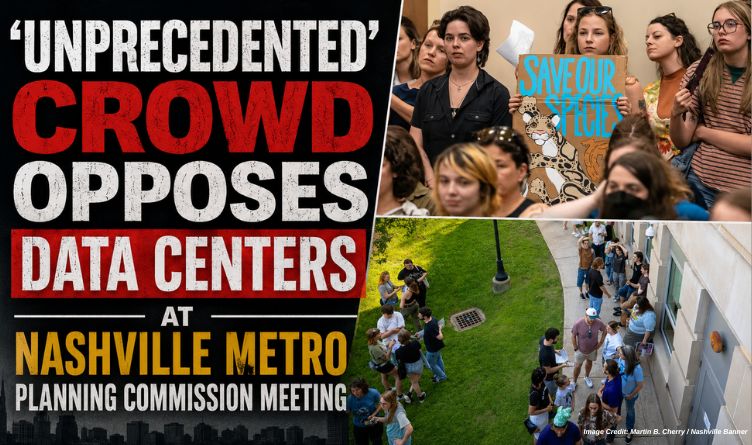
A marathon public comment period at Thursday’s Metropolitan Planning Commission meeting became a decisive referendum on data centers in Nashville, with more than 150 members of the public denouncing a pair of planned data center projects and endorsing proposed zoning restrictions.
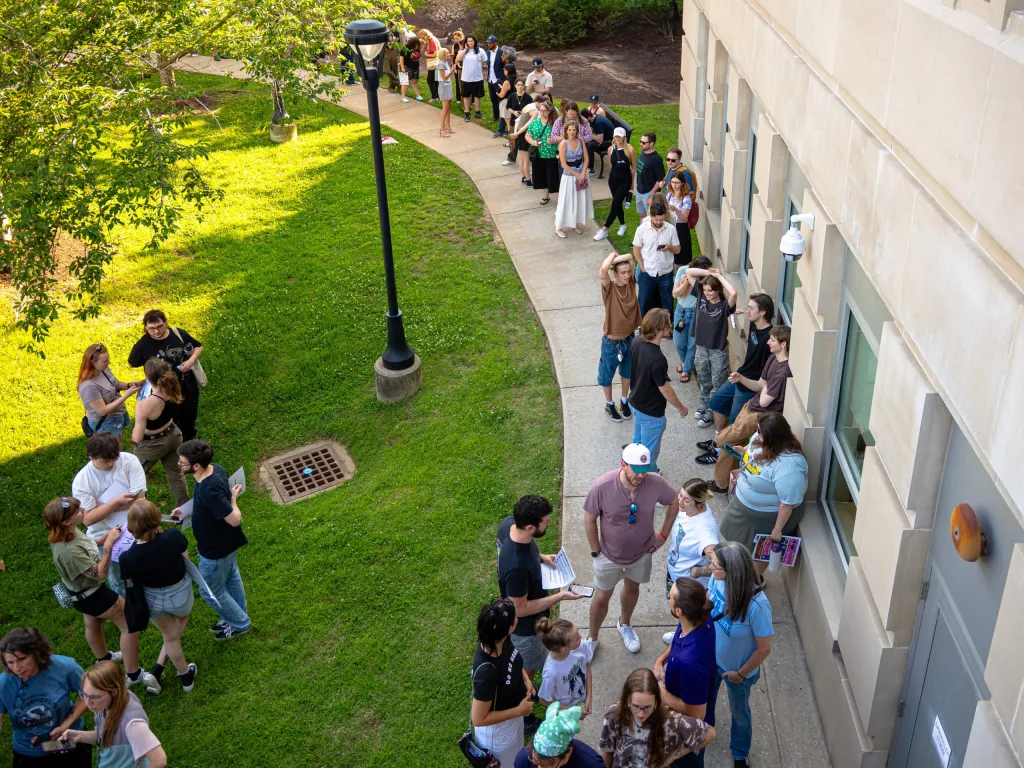
Despite temperatures in the 90s, Nashvillians lined the Howard Office Building for hours on Thursday, awaiting their turn to oppose data center development before the Metropolitan Planning Commission. Though the hearing room had so exceeded capacity that a fire marshal came to oversee the meeting, scores of people waited as much as five hours for their chance to address the commission, which allowed everyone who chose to stick it out two minutes to speak.

Alexandra Crawford, a local social worker, waited directly outside the meeting doors. Although she arrived before the meeting began, the room was already at capacity. As a resident of South Nashville, Crawford felt the need to advocate for her neighborhood, where the DC Blox project is planned. She prepared with signs, one reading “Keep Local Land Out of Corporate Hands.”
“Our neighborhood is for our neighbors, it’s not for corporations,” Crawford said, gesturing to her sign. “We live in one of the fastest growing neighborhoods in Nashville, and if they want to do anything with the land, they should build more low-income housing.”
Vice Chair Jessica Farr said it was an “unprecedented” crowd before the speakers addressed the commission, almost unanimously in favor of data center regulations, citing some combination of noise, heat generation, water consumption, water contamination, air pollution, electricity consumption or public health concerns.
Though the bill in question, which was ultimately deferred to a June 25 planning commission meeting, would broadly categorize and establish restrictions for data centers in the city’s zoning policy, a majority of speakers focused on either the DC Blox proposed data center next door to the Nashville Zoo, or a proposed data center on Fisk University’s campus.
Comments started ardently, with the very first speaker threatening the removal of every elected official in the country who supports data centers. Though there were occasional tears or outbursts, a mostly mild-mannered crowd repeated environmental and public health concerns about data centers at large, supporting the proposed zoning bill, but frequently calling for an outright moratorium on data center construction.
Many speakers noted it was their first time coming to a public meeting to discuss any policy, but said that the rise in data center projects was indicative of businesses exploiting “loopholes” in the city and state’s policies, which they hoped to address before it got out of hand.
“We should not gamble away our community’s future on the promise of private companies,” said Ben Hendrick, a North Nashville resident, calling the construction of data centers “economic speculation,” and noting that petitions opposing the two proposed data centers each had thousands of signatures.
‘Disgusting and ungodly dichotomy’
Speakers ranged from zoo employees and volunteers to data center employees to corporate developers and lawyers. Primarily, they echoed each other’s concerns about noise, pollution and utility impacts, but also mentioned hyperlocal ecological impacts on species like the Nashville crawfish and protected red-tailed hawk, both of which inhabit the property near the zoo.
Wilder, a 10-year-old currently attending camp at the zoo, spoke against the DC Blox proposal, noting his concern that animals with more sensitive hearing than humans may be especially impacted by the sound. Raphaela, a woman who described herself as “old enough to remember when doctors told you it was OK to smoke a cigarette,” warned that the health risks of data centers may be similarly under-researched.
Another man noted that it’s just not the community’s “vibe.”
“I’m just going to be honest, on a vibes level, I’m pretty sick of Nashville getting pushed around by some of the worst interests in the country,” a resident named Nathan told the commission, criticizing Tennessee’s lax business regulations. “This just feels like the Tesla tunnel, I think, on a purely vibe level.”
People overwhelmingly support the bill, but many said it doesn’t go far enough, calling for stricter policies like further location buffers and an outright moratorium, often repeating “no new data centers.”
Others called data center development “bogus,” “evil,” “inhumane and anti-Tennessee,” noting that construction near zoos or other nature conservation sites was a “disgusting and ungodly dichotomy.”
At the meeting, many people noted that both of the proposed data centers in question were in diverse neighborhoods — South Nashville, the city’s most immigrant-rich area, which encompasses the zoo, and North Nashville, a historically Black community that houses multiple HBCUs, including Fisk.
This week, state Rep. Justin Jones (D-Nashville), an alumnus and former instructor at Fisk, also hosted a press conference at the university, opposing the project and denouncing the university’s lack of communication with the community, including students and alumni.
“We want to send a clear message that this project has been mired in secrecy, lack of transparency,” Jones said Wednesday.
“Fisk University has been a beacon light of civil rights and social justice, and one of the lessons of that is not all money is good money,” Jones said of the development, later noting that if data centers were such a positive addition to a university’s campus and community, they would be built at Vanderbilt University and other schools with whiter, more affluent communities.
Metro Councilmember Sandra Sepulveda also addressed the planning commission before the public comment, noting the disproportionate impact on minority neighborhoods, and voicing support for the proposed zoning bill by Councilmember Rollin Horton.
Defending big data
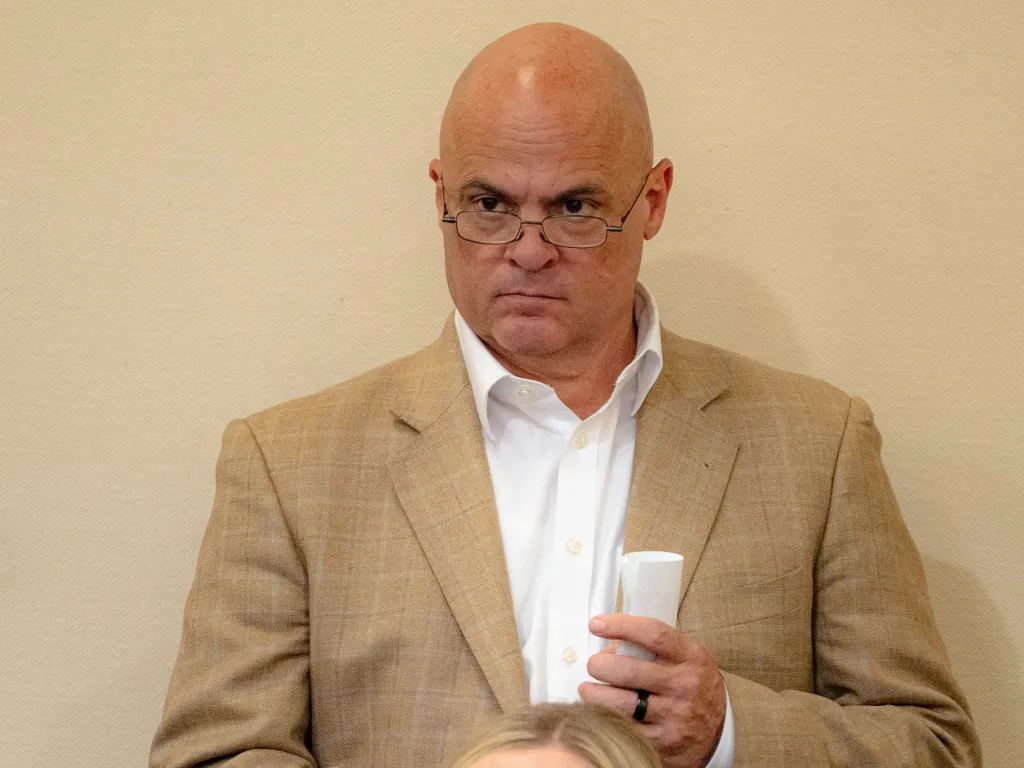
When Doug Sloan, an attorney and former Metro Planning director representing the DC Blox proposal next to the zoo, spoke to the commission, he said the company generally supports data center regulation, but rebuffed “assumptions” from members of the public, who he said conflated all data centers with massive AI data centers.
“Not all data centers are the same. There are legacy data centers built years ago, modern cloud data centers and new AI and high-performing computing facilities,” Sloan said. “They have different operational characteristics, water demands, cooling technology, power requirements and community impacts.”
When Sloan went slightly over his allotted time, the crowd aggressively booed him, in the single loudest outburst throughout the nearly six-hour meeting.
After he spoke, Sloan told the Banner that he resented the company only being given two minutes to speak. Each speaker had the same amount of time, but Sloan was the only person there in favor of the zoo development.
Still, Sloan said employees of DC Blox have received death threats online as the project has become more controversial, and blamed the zoo for stoking the fire.
“It’s unfortunate that the folks at the zoo have continued to press these false statements about DC Blox and what’s being built next to the zoo, and they have misled the community,” Sloan said.
While he was defensive of the project, claiming new technology would allow the facility to operate at a low noise output and solve other community concerns, Sloan also said the city and zoo have refused to communicate effectively with the company over questions about noise mitigation for the animals and other cited concerns about the project.
Ultimately, Sloan said he’s confident the project is far enough along to be built, but he came to the meeting to set the record straight.
“People are reacting based on fear, not facts,” Sloan said.
Timothy Hughes, President of the Nashville branch of the NAACP and chair of community engagement for the Nashville Fisk University Alumni Association, was the only other speaker who was not abjectly opposed to the developments in question.
Instead, Hughes recognized the potential harms to the community and similarly endorsed regulations, yet insisted that Fisk would plan the facility responsibly.
“Fisk is committed to accountability, transparency, and doing no harm. The university fully supports Metro’s efforts to establish appropriate safeguards and oversight for projects of this scale,” Hughes said. “Fisk University is actively evaluating how this project, when developed responsibly, can address concerns related to energy use, water consumption, environmental impact, and public health.”
At the end of the marathon meeting, each member of the planning commission expressed some support for the policy in question, but also posed logistical questions to staff about enforcement, renewable energy incentives and how to close loopholes in the fast-moving policy before its final passage, while also preventing pre-emption from the Republican state legislature, which voted down half a dozen data center regulation bills this legislative session.
There will be no further public hearing at the June 25 meeting. The next opportunity for public input will be at the Metro Council meeting on July 7.


One Response
They’re simply not what what folks need or want. The cons far outweigh the pros.