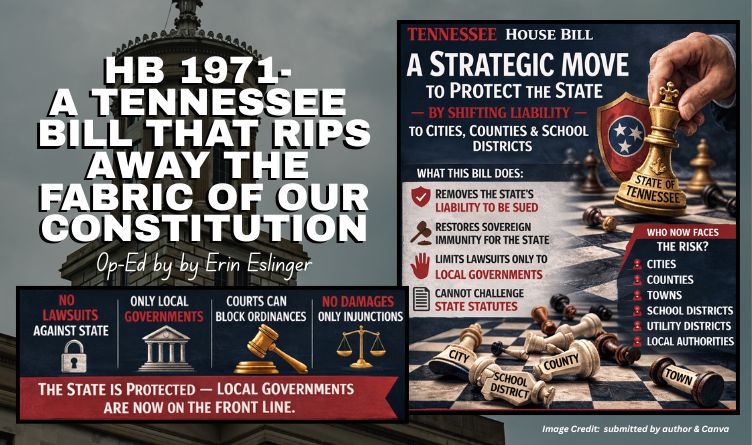
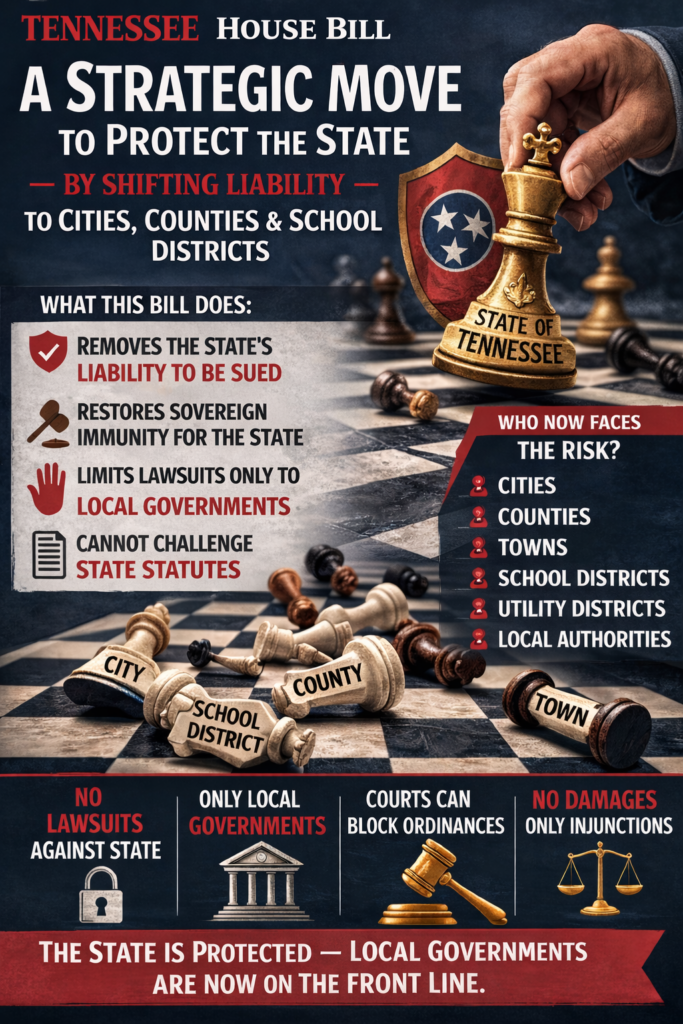
Image Credit: submitted by author & Canva
Note from The Tennessee Conservative: Editorial statements in this column are the sole opinion of the author; they do not necessarily reflect the opinions of the staff of this publication.
Submitted by Erin Eslinger –
Where is the accountability for the actions taken by those we elect?
How can a bill even be considered that places our local governments at risk? HB1971 does exactly that. This bill makes it nearly impossible to challenge a Tennessee law passed by the legislature on constitutional grounds. In doing so, it shifts the burden onto local governments.
That means small towns could be forced into the position of defending state policies in court. This is deeply concerning. Small municipalities often operate with very limited legal budgets, and they simply do not have the resources to fight complex constitutional battles.
If liability exists, it should rest with the lawmakers who created the policy, not with local communities that had no role in writing the law. Passing that responsibility down the chain is not accountability — it is avoidance.

Our legislators should be focused on passing laws that protect their constituents, not ones that expose local governments to costly legal fights.
Have we truly considered how this could affect small-town America?
Imagine a situation where a local court finds a state law unconstitutional and blocks enforcement. What happens then to the morale of the citizens who believed that law was meant to protect them? Instead of clarity and accountability, this bill creates confusion and conflict.
HB1971 shields the state government while leaving local governments exposed.
That is not responsible governance.
In the game of chess, we call this defensive interposition. It is when a king places other pieces—rooks and bishops—in front of him to make himself harder to reach. In this case, those pieces are towns, counties, and local authorities.
The problem is that the king is the one making the rules that those pieces must enforce, yet the smaller pieces are expected to absorb the legal attacks that follow. Local governments become the shield while the state remains protected behind them.
What kind of leader creates the rules but takes no accountability for the consequences of those rules?
I watched the bill move through subcommittee on February 11, 2026, to better understand how it was presented. During that hearing, another member raised concerns about the removal of the cause of action and questioned how the bill would work in practice. Representative Farmer responded with an example about someone suing the state without having suffered harm.
But that explanation seemed completely off point. It suggested a misunderstanding of the real issue. The real concern is not frivolous lawsuits—it is what happens when people are actually harmed by the enforcement of a law.
There are many ways a person can be harmed. Property rights are a perfect example. If a state law creates harm through its enforcement, citizens should be able to challenge the law itself—not just the local governments forced to carry it out.
Another concern of mine is how this affects other bills that are being considered such as HB1837, a bill protecting property rights. More specifically, could HB1971 weaken—or even effectively nullify—the protections HB1837 intend to provide?
Several important questions follow from this.

What happens when the state itself deprives property owners of their constitutional rights? If individuals are prevented from challenging state actions in state court, their only remaining option may be to file suit in U.S. District Court. Those cases can become extremely complex and expensive, especially when federal litigation is involved and attorney’s fees may ultimately be awarded.
Is it wise public policy to push Tennessee citizens into federal court simply to challenge the constitutionality of actions taken by their own state government?
I ask these questions as a constituent, not as a legal professional. This is my first year spending time at the Cordell Hull Building, trying to understand how these policies affect ordinary Tennesseans. As I work through these issues, I sometimes feel like I’m looking at holes in a piece of Swiss cheese—gaps that deserve careful attention before legislation moves forward.
Thank you for taking the time to consider these concerns. Now contact members of the House Judiciary Committee and ask them to reject HB1971.
House Judiciary Committee– HB1971 to be heard March 18
HB1971 makes it nearly impossible to challenge a Tennessee law passed by the legislature on constitutional grounds.
Rep.andrew.farmer@capitol.tn.gov; rep.elaine.davis@capitol.tn.gov; rep.rebecca.alexander@capitol.tn.gov; rep.fred.atchley@capitol.tn.gov; rep.gino.bulso@capitol.tn.gov; rep.clay.doggett@capitol.tn.gov; rep.rick.eldridge@capitol.tn.gov; rep.johnny.garrett@capitol.tn.gov; Rep.ga.hardaway@capitol.tn.gov; rep.torrey.harris@capitol.tn.gov; rep.gloria.johnson@capitol.tn.gov; rep.kelly.keisling@capitol.tn.gov; rep.william.lamberth@capitol.tn.gov; rep.mary.littleton@capitol.tn.gov; rep.jason.powell@capitol.tn.gov; rep.lowell.russell@capitol.tn.gov; rep.gabby.salinas@capitol.tn.gov; rep.rick.scarbrough@capitol.tn.gov; rep.tom.stinnett@capitol.tn.gov; rep.chris.todd@capitol.tn.gov; rep.joe.towns@capitol.tn.gov; rep.ron.travis@capitol.tn.gov

About the Author: Erin Eslinger is a property rights activist and citizen lobbyist from Alcoa, Tennessee.

2 Responses
HEY !!!!! Laws are FOR the people NOT against them……………. SMH
Thanx, emailed committee, “This bill is TRASH!! The sponsors/cosponsors are no good either, some of TN and freedoms worst enemies.”