
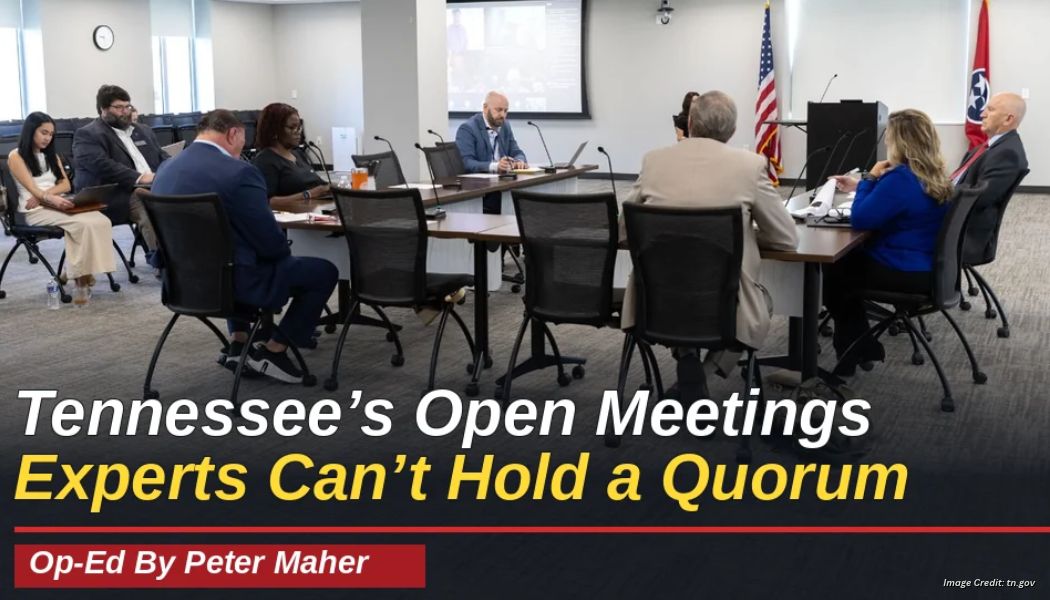
Image Credit: tn.gov.
Note from The Tennessee Conservative: Editorial statements in this column are the sole opinion of the author; they do not necessarily reflect the opinions of the staff of this publication.
Submitted by Peter Maher –
I have reported before about problems inside Tennessee’s Advisory Committee on Open Government. What happened at its October 27, 2026 meeting makes those concerns much harder to dismiss. I also used a vacation day from work on August 25, 2025, to participate in ACOG’s first meeting after their almost five-year absence and presented public comment because I genuinely wanted to help improve civic participation in our state. This is the committee Tennessee created to advise on open records and open meetings. It is supposed to help advance government transparency and accountability. Yet when ACOG met on October 27, nine members were absent. Six were present. Nine were needed for a quorum.
“We have six present. We need nine to have a quorum. So, we don’t have a quorum,” co-chair Brian Lapps said. He then explained what that meant. The committee could listen, receive information and have some discussion, “but we cannot conduct any business.”
And there was serious business on the agenda to conduct. The published agenda included approval of minutes from previous meetings, approval of bylaws, revisions to its own public-comment policy, potential election of co-chairs and scheduling the next meeting. Without a quorum, none of that happened.
This would be concerning for any Tennessee governmental committee. For a committee specifically devoted to fundamental civic rights, it’s unbelievable.
It is even more troubling because this did not occur in a vacuum.

Five Years Without Meetings, Followed by Quorum Problems
ACOG’s own 2026 sunset-review response acknowledges that the committee “did not meet for approximately five years prior to 2025.”
That history matters because Tennessee law does not treat ACOG meetings as optional. Tenn. Code Ann. § 8-4-603 provides that the committee “shall meet at least once during each calendar year.” I have previously written about that extraordinary history. A committee whose mission is government accountability went approximately five years without meeting, by its own acknowledgment.
Now ACOG is trying to meet again, but it has struggled to assemble appointed members to conduct business. ACOG member Karen Jackson raised that problem herself during the October 27 meeting. “Do you have or anyone have any idea why we aren’t getting a quorum for these meetings?” she asked. “I think the last two we didn’t have them.”
Then came a sentence Tennessee lawmakers should remember:
“We will not be of any use if we can never have a quorum.”
Duh.

The People Accepting Guaranteed Seats Need to Show Up
ACOG’s membership structure makes this particularly frustrating.
Tennessee law does not simply open these seats to any qualified Tennessean willing to serve. Tenn. Code Ann. § 8-4-602 reserves positions for representatives associated with specifically designated organizations, along with ex officio government members.
That makes participation especially important.
The Tennessee Coalition for Open Government has a designated position on ACOG. Its representative, Victor Ashe, did not respond when his name was called during the October 27 roll call. Neither did the committee’s two legislative ex officio members, including Sen. Richard Briggs. I do not know why any individual member missed the meeting, and one absence alone tells us very little about someone’s commitment or intentions. But the institutional problem is undeniable: nine members were absent, the committee lacked a quorum, and official business could not be conducted.
Sunset Review Used To Mean Something
The timing makes all of this especially important.
ACOG recently underwent Tennessee’s “sunset-review” process, and its continued existence has been recommended for another four years. That should not be treated as an automatic renewal. Sunset review used to exist for a reason. If a governmental entity has acknowledged an approximately five-year period without meetings and subsequently experiences repeated difficulty obtaining a quorum, those facts should matter when lawmakers decide whether and under what structure it should continue.
The question is not whether Tennessee needs attention to civic rights. Of course it does. The question is whether the structure Tennessee created is legitimate.
Before granting another four years, members of the General Assembly should examine ACOG’s complete meeting and attendance history, how many meetings failed to produce a quorum, whether its statutory appointment procedures have consistently been followed, and whether organizations given designated seats are actually supplying active representatives.
The Appointment Structure Deserves Scrutiny Too
There is another problem I believe sunset reviewers should examine. Under Tenn. Code Ann. § 8-4-602, fourteen organizational representatives are selected through a process under which designated groups submit three nominees and the Comptroller appoints a representative from those nominees. That should create a straightforward chain of accountability: an organization submits its candidates, the Comptroller makes an appointment, and the appointee serves.
But public records I obtained concerning the Common Cause seat have long raised questions, in my view, about whether that statutory process actually operated as contemplated.
Like the other groups, Common Cause is given a designated position in the statute. Yet my examination has not identified an active Tennessee Common Cause organization performing the state-level nominating function one would expect from an organization holding a statutory seat. In fact, Common Cause itself admits this. More importantly, the Comptroller records I obtained concerning the position raise questions about whether the required three-nominee process occurred for the relevant appointments. In my reading of those public records, the process effectively allowed the person ultimately occupying the Common Cause position to put himself forward. Those records deserve scrutiny, and the state should provide a clear answer about whether every ACOG appointment complied with § 8-4-602.
The October attempt at a failed notified public meeting produced another example of why the statutory nomination process needs clarification. If organizations are supposed to provide three nominees, what happens when they don’t?
Does the incumbent simply remain indefinitely? Can an organization lose its designated position? Can the Comptroller appoint someone without the prescribed nominees? What happens when a designated organization no longer operates meaningfully in Tennessee?
Those aren’t attacks on individual appointees. They are basic questions about whether Tennessee’s statutory appointment system works.
Maybe the Structure Is the Problem
Perhaps it is time for Tennessee to reconsider whether permanent organization-specific seats are the best way to constitute an open-government advisory committee.
A statutory seat should not become the institutional property of a private organization regardless of whether that organization submits nominees, maintains an active Tennessee presence or participates consistently in committee business. And most other states have long ago figured this out.
Tennessee could instead establish clearer qualifications for membership, require meaningful attendance, create procedures for replacing chronically absent members, require compliance with nomination deadlines, and provide opportunities for ordinary Tennesseans with demonstrated experience using the state’s open-government laws to serve.
That last point deserves special attention.
Citizens are alone the people actually using and enforcing our Tennessee’s Public Records and Open Meetings Act. They are requesting records, attending public meetings, encountering government resistance and spending their own money to enforce these laws in court. Yet ordinary unaffiliated citizens do not have one of the organization-specific seats Tennessee law reserves on ACOG.
The history of this committee and its meetings put that contradiction into unusually sharp focus.
But nine appointed members of Tennessee’s Advisory Committee on Open Government did not participate, and the committee could not conduct its official business. The situation was serious enough that members discussed scheduling a backup meeting date in case the next meeting again failed to obtain a quorum. That should tell lawmakers something. ACOG does not need another ceremonial renewal. It needs basic, common sense reform.
Before giving the committee another four years, the General Assembly should determine whether the organizations and officials occupying its limited seats are actually participating, whether its appointments have complied with the law, whether group organization-specific appointments remain sensible, and what should happen when members do not show up.
Tennessee lawmakers should take that warning seriously.
But don’t take my word for it. Watch the taxpayer-funded meeting and draw your own conclusions. Then send it to your lawmakers in the Tennessee General Assembly and ask them to watch it before deciding whether ACOG deserves another four years.
Advisory Committee on Open Government – 10/27/26