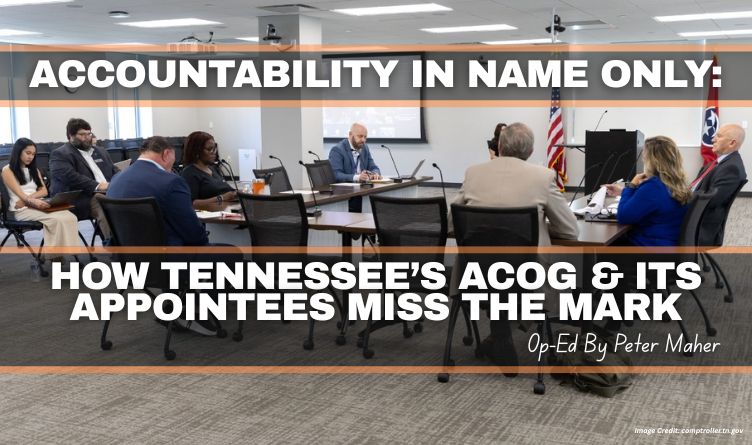
Image Credit: comptroller.tn.gov
Submitted by Peter Maher –
Under Tennessee law (TCA § 8-4-602), our state’s group appointed Advisory Committee on Open Government (ACOG) exists to provide guidance and advice to our state’s Office of Open Records Counsel on issues related to public records and open meetings. Its purpose is to help “ensure transparency and accountability in government by advising on best practices and statutory interpretation.”
Yet ACOG long violated state statute by failing to hold the minimum one public meeting required each calendar year between December 2020 and August 2025. This failure undermines the very principle ACOG was created to uphold—open government. Worse, since its founding in 2008, the committee offered no opportunity for public comment prior to its August 2025 meeting. And during a period of crisis when Tennessee’s public middle schoolers were learning how to attend classes virtually, ACOG’s appointed leaders disappeared and did not hold a single virtual meeting to fulfill its statutory duty or engage the public, until 2025.
ACOG also has no statutory requirement to ensure statewide geographic representation among its appointed members. Recent research shows that only one of seventeen ACOG members represents Tennessee’s entire Western Division, leaving large regions of the state without meaningful input in discussions about government transparency and accountability.
Last checked, several of the groups represented on ACOG have no organization or registration with the Tennessee Secretary of State. Moreover, ACOG declines to post its own pre-2025 agendas and minutes, including those of its subcommittees, forcing Tennesseans to file formal—and often costly—public records requests just to access ACOG information.
Below is a quick review of taxpayer-subsidized special interest groups and affiliated members of ACOG. These groups and members claim to champion transparency, yet their own practices reflect the motto: Accountability for thee, but not for me.

ACOG Groups
Common Cause
Common Cause has no formal Tennessee organization but somehow maintains a single registered lobbyist. Governance documents are not state-specific or publicly posted. Meeting agendas and minutes are not accessible. While national financials are available, Tennessee-specific transparency is nonexistent.
County Officials Association of Tennessee
This taxpayer-subsidized special interest group engages in advocacy and lobbying but does not operate with transparency. No evidence of open governance practices such as posting agendas, minutes, or financial disclosures.
Tennessee Press Association (TPA)
TPA’s own “About TPA” page states the association “monitors legislative activities” and aims to “advocate for the press by proactively shaping public policy and opinion.” Yet its website offers news items, contests, and events—but no governance section with board or committee agendas, or approved minutes. While trade associations are not legally bound by our Open Meetings Act, those that influence public policy should publish basic governance information, so stakeholders understand how positions are formed. TPA does not.
Tennessee Municipal League / Public Entity Partners
This organization claims exemption from Tennessee’s open government laws. Their governance practices are not transparent, despite their influence on public policy and taxpayer-funded risk pools. in correspondence dated April 17, 2025, PEP’s taxpayer funded private legal counsel, Mr. J. Russell Farrar, asserted that PEP’s records are “confidential and not open to public inspection.” The Office of Open Records confirms there is no exception for Public Entity Partners. However, the same state attorneys provide PEP with special taxpayer funded training presentations to “enhance knowledge about the rights and responsibilities set forth in Tennessee’s open government laws.”
Tennessee School Boards Association (TSBA)
TSBA provides no central repository for annual reports, financial statements, or detailed minutes and post-meeting summaries. Courts have ruled TSBA is the functional equivalent of a government entity, yet its transparency practices remain inadequate.
League of Women Voters of Tennessee
LWVTN does not post meeting agendas or minutes, does not disclose state-level lobbying registrations, and offers only limited annual financial reports. Despite its advocacy for open government, its own governance is largely closed.
Tennessee Board of Regents (TBR)
TBR is a government entity so it publishes meeting materials but lacks a centralized annual report or conflict-of-interest filings for board members. Foreign contract disclosures are technically public but buried in Comptroller databases, which are not easily accessible on TBR’s own site.
Tennessee Association of Chiefs of Police (TACP)
TACP does not routinely publish board or committee minutes. A Comptroller investigation revealed an executive director simultaneously worked as a registered lobbyist for another nonprofit, violating TACP’s own bylaws. This raises serious questions about accountability.
Tennessee Hospital Association (THA)
THA posts meeting schedules but not full agendas or minutes. It operates a PAC and engages in lobbying, yet its governance transparency is minimal.
Tennessee Association of Broadcasters (TAB)
TAB is a 501(c)(6) nonprofit with significant public policy interests and lobbying activity. However, it provides no public disclosure of board meeting agendas, minutes, or lobbying registrations. For an organization shaping industry regulation, this lack of transparency undermines public trust.
AARP Tennessee
AARP Tennessee does not post state-specific bylaws, agendas, or governance minutes. TN AARP member requests to access these documents have gone unanswered. Chapter-level minutes are not available on its TN AARP website.
Society of Professional Journalists – East Tennessee
This chapter is not registered with the Tennessee Secretary of State. Its ACOG member nominated a co-chair representing Tennessee Municipal League/Public Entity Partners, raising questions about governance alignment and not understanding the dynamic of ACOG members rules to share Co Chair responsibilities between government entity and non-government entity group representation.
Tennessee Sheriffs’ Association
No Tennessee-specific bylaws were found on TSA’s site. While it lists events and conferences, it does not publish board or committee agendas or minutes. Financial transparency exists only through IRS filings.
Tennessee Coalition for Open Government (TCOG)
Though its tax-exempt board consists of attorneys and members with secretaries, TCOG does not post its own agendas, minutes, bylaws, welcome the public to its governance meetings, or offer interest forms to serve on its nonprofit Board. It does not post its financials or membership numbers. Worse, it professionally lobbies against bipartisan-supported and Governor-signed First Amendment civil rights bills, like SB0086/HB0734. TCOG positions itself as a watchdog, but its own nonprofit governance is uniquely and perhaps intentionally opaque. Its own Board includes other ACOG appointed members representing Common Cause and the Society of Professional of East Tennessee.
ACOG Ex Officio Members
Chair, Senate State and Local Government Committee (Senator Richard Briggs)
Attends 50% of ACOG meetings. Sponsored legislation to eliminate public comment at city and county legislative sessions on development projects deemed “substantially compliant” with zoning—an approach limiting First Amendment rights.
Chair, House State Government Committee (Representative John Crawford)
Has yet to attend an ACOG public meeting. Has no clear record of sponsoring open-records reforms or supporting real-time disclosure of lobbying or PAC contributions.
Designee, Tennessee Attorney General and Reporter (Lauren Lamberth)
ACOG public meeting attendance is irregular. Does not publish meeting agendas or minutes, as the office does not operate public governing bodies. No state-specific annual report is available, though financial oversight occurs through audits and statewide budget processes.
These appointed ACOG organizations, groups, and officials claim to stand for transparency and accountability yet fail to practice it themselves. Missing agendas, absent minutes, undisclosed financials, and opaque governance are common themes. Many of these groups also employ taxpayer-subsidized registered lobbyists to influence General Assembly legislators, while withholding their basic governance information from the very taxpayers that fund them. In our state—where citizens shoulder the nation’s second-highest sales tax and endure some of the worst voter turnout rates—public trust and strong leadership are not optional; they are essential. When those charged with guiding open government fail to lead by example, they erode confidence in the very institutions meant to serve us all.
Accountability for thee, but not for me.


One Response
Thanx!
They’re all worse’n useless.