Image Credit: Canva
Note from The Tennessee Conservative: Editorial statements in this column are the sole opinion of the author; they do not necessarily reflect the opinions of the staff of this publication.
Submitted by Peter Maher –
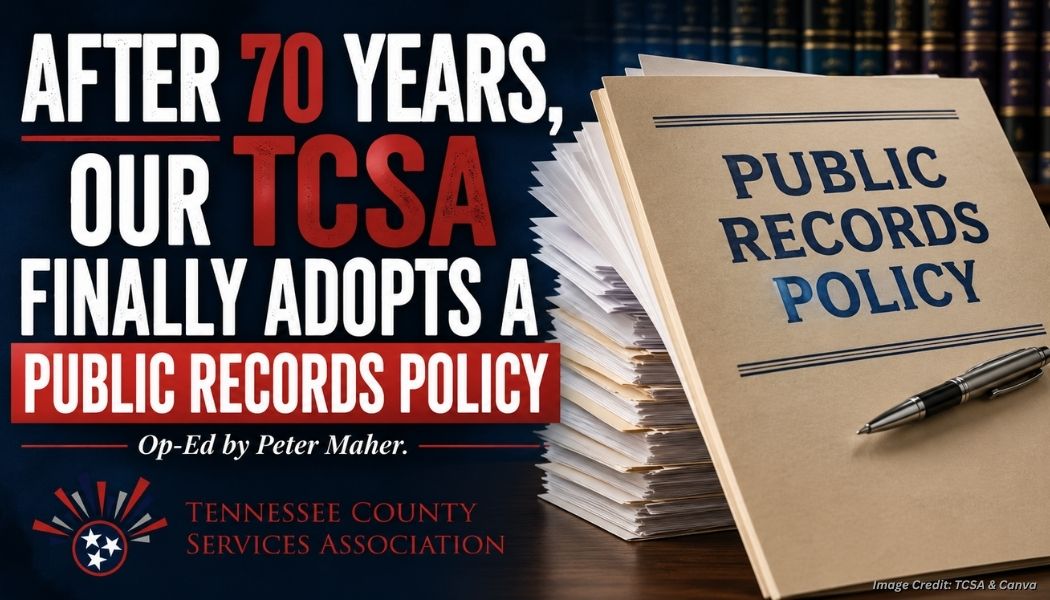
For nearly seven decades, the taxpayer funded Tennessee County Services Association (TCSA) has served as one of the most influential organizations in Tennessee local government.
Founded in 1954, TCSA represents and supports all 95 counties, funded primarily through county taxpayer membership dues, training and conference fees, and program revenues from services it administers for counties. Its reach is broad — and, at times, arguably regrettable.
In 1973, TCSA played a central role in creating the University of Tennessee’s County Technical Assistance Service (CTAS), an entity whose effectiveness and accountability have long been questioned by many Tennesseans and lawmakers of our General Assembly. Today, TCSA serves as the umbrella organization for the Association of County Mayors (ACM), the Tennessee County Commissioners Association (TCCA), and the Tennessee County Highway Officials Association (TCHOA). Each of these taxpayer‑funded groups share offices, coordinate statewide lobbying in our General Assembly, engage in legislative advocacy, and provide training — collectively shaping how county governments operate across our state. Yet for all its influence, TCSA had never adopted a public records policy — not once in its nearly 70‑year history.
That changed only recently, and only after this one West Tennesseean pressed the issue.

A Nonprofit That Is Still Subject to the TPRA
TCSA is not a government agency. It is a nonprofit corporation. But under Tennessee law, it can be still subject to the Tennessee Public Records Act (TPRA). As Executive Director David Connor kindly and surprisingly wrote in response to my records request:
“As a non-profit association serving local government in Tennessee, our records are open to public inspection pursuant to Tennessee Code Annotated Section 10‑7‑503(d).”
Despite this statutory obligation, TCSA acknowledged that it had never adopted a written public records policy. Instead, it relied informally on guidance from the Office of Open Records Counsel (OORC):
“The association (TCSA) has not, to my knowledge, adopted a formal written public records policy of its own. However, we rely upon the guides, forms and schedules of the Office of Open Records Counsel…”
TCSA also confirmed that no Tennessean — including its own Board of elected and appointed officials — had ever raised this issue before. In responding to my inquiry, Executive Director David Connor wrote that he had searched the association’s records and “was unable to find any inquiries, other than yours, relative to this topic.” That acknowledgment is significant: in nearly seventy years of operation, no member of the public, no county official, no TCSA Board member, no media or press, and no affiliated organization had ever asked TCSA about posting public records information on its website or about adopting a formal public records policy, just this one journalist. The absence of prior inquiries underscores how long this gap in transparency went unnoticed — and how unusual it was for TCSA to confront the issue at all.
This meant that for close to seventy years, TCSA ignored or handled public records requests without a written policy, without posted procedures, provideing possible special access, and without the transparency that Tennessee’s Comptroller recommends for all TPRA‑covered entities.
This One Simple Citizen Request Sparks Change
My correspondence shows a months‑long exchange between TCSA seeking clarity on TCSA’s public records obligations, its lack of a written policy, and the absence of any public‑facing records information on TCSA’s public facing website.
I pointed out that the Comptroller’s Best Practices & Guidelines recommend that any entity subject to the TPRA:
“…clearly post its public records policy, or a link to applicable public records request information, on the homepage of its website.”
TCSA had never done so.
In fact, as Mr. Connor acknowledged:
“Based on a review of the TCSA website, that type of public‑facing records information does not appear to be posted.”
I asked whether TCSA intended to adopt a policy or post public records information online. TCSA responded that it would “look into that.”
And then — quietly, but significantly — TCSA acted.
TCSA Adopts Its First Public Records Policy in Nearly 70 Years
In May 2026, TCSA’s Board of Directors formally adopted the organization’s first-ever public records policy. As Mr. Connor wrote:
“The board of directors of TCSA did adopt a formal public records policy at its recent board meeting on May the 19th.”
He further explained:
“I presented the board with the official records policy that the Office of the State Comptroller uses… The board made a few minor modifications to the policy and adopted it as the official records policy for TCSA.”
This is a Tennessee milestone worth noting. For a taxpayer funded organization that represents and lobby’s legislation for every county in Tennessee — and that has shaped county governance for generations — adopting a public records policy is not a small administrative update. It is a long‑overdue step toward transparency, accountability, and compliance with state law.
Why This Matters for Tennessee Counties
TCSA is not just another taxpayer funded nonprofit. It is the statewide hub for county officials, county mayors, commissioners, highway officials, and legislative advocacy. When TCSA adopts a policy and posts it on their website’s homepage, counties notice. When TCSA trains elected and appointed officials, counties follow. When TCSA sets expectations, counties align.
For decades, TCSA operated without a written TPRA policy, even as it advised counties on governance, advocated for legislation, and coordinated statewide county leadership. Now, with a policy in place, TCSA is modeling the transparency it expects from others.
This matters because:
- TCSA influences county practices statewide. Its adoption of a policy signals that TPRA compliance is not optional.
- Citizens deserve clarity. A posted policy reduces confusion, delays, and inconsistent handling of requests.
- Transparency builds trust. Counties and citizens alike benefit when statewide associations follow open‑government norms.
- It sets a precedent. Other county‑related nonprofits may now feel pressure to adopt similar policies.
A Step Forward — And an Opportunity
TCSA’s adoption of a public records policy is a meaningful step forward. But it also highlights an opportunity: ensuring that the policy is publicly accessible, clearly posted, and easy for citizens to find — just as the Comptroller recommends but doesn’t check or enforce.
As Mr. Connor noted:
“As soon as we have the updated policy in its correct form, it will be posted to the TCSA website…”
Posting the policy prominently on the homepage brings TCSA in line with best practices and demonstrate a long missed commitment to transparency consistent with its mission.
TCSA’s decision to adopt its first public records policy in nearly 70 years is a milestone for Tennessee’s open-government and First Amendment landscape. It shows that persistent, respectful Tennessee citizen engagement can lead to meaningful institutional change — even within organizations that have operated the same way for generations.
For an taxpayer funded association in Tennessee, this step is more than administrative housekeeping. It is a recognition that transparency is not merely a legal requirement, but a public responsibility.
And it is a reminder that transparency in Tennessee is strengthened not only by statutes, but by individual citizens who ask the right questions — and by institutions willing to evolve.
This all also highlights an opportunity for Tennesseans: citizens and county residents should feel empowered to ask similar questions of other taxpayer‑funded associations and public‑facing groups to see whether they, too, will follow TCSA’s lead. Seventy years is a long time for taxpayers to wait for access to our public records — and there is no reason to wait that long again.
Check out the brand new TCSA Public Records Policy here and consider passing it on.
TCSA Public Records Request – TCSA


One Response
Many thanks to Peter Maher, the patriot West Tennessean who pressed the issue and made a difference.
It’d be nice to be able to contact and thank him.