
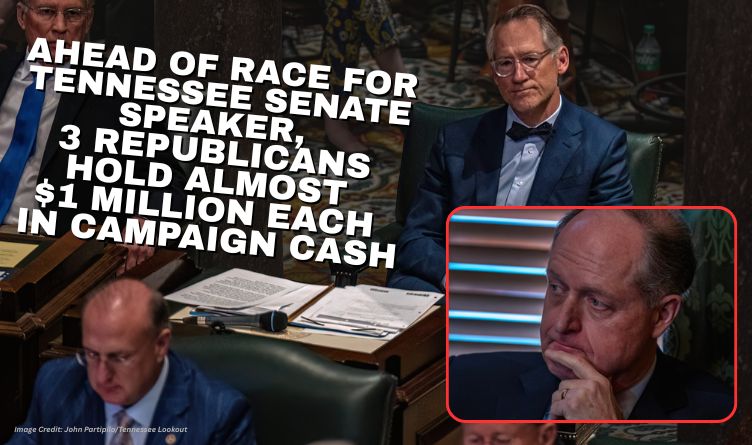
Memphis Sen. Brent Taylor, not thought to be in the race, also has $960,000 in his war chest.
Image Credit: John Partipilo/Tennessee Lookout
***Note from The Tennessee Conservative – this article posted here for informational purposes only.
By: Adam Friedman [Tennessee Lookout -CC BY-NC-ND 4.0] –
After Lt. Gov. Randy McNally announced his retirement Thursday, the race to replace him as Tennessee’s next Senate Speaker and second in line of succession for the state’s top office began to take shape.
No Senate Republican has officially announced his candidacy for the top job, but Majority Leader Jack Johnson of Franklin, finance committee chair Bo Watson of Hixson, and commerce committee chair Paul Bailey of Sparta are among the potential candidates.

Johnson, as the majority leader, is considered the most likely successor to McNally. Johnson upped his fundraising efforts and has almost $1.25 million in both his campaign and political action committee, Jack PAC, campaign finance reports filed at the end of January show. He outraised McNally in 2025.
Watson has around $925,000 in his two accounts, and Bailey has around $600,000 in his two accounts, records show.
But the senator with the second largest sum on hand besides Johnson is Memphis Republican Sen. Brent Taylor, who has around $965,000 in his campaign account. Taylor personally loaned his campaign $600,000 and doesn’t have a political action committee.
Taylor is relatively new to the Senate, having been elected in 2022, and holds no committee chairmanships in the state Senate. He is also up for reelection in 2026.
McNally rose to the top job in the Senate in 2016 after Ron Ramsey announced his retirement. The party didn’t formally choose McNally until after the election season, but he secured unanimous support that March, just days after Ramsey’s retirement, avoiding a bruising caucus battle.
Initially, McNally took the top job at 72 years old and was not expected to hold it very long, but for nearly a decade, no one stepped up to try to replace him.
His strengths for managing the caucus over the years, included the effective use of his campaign account and political action committee, McPAC, to put money into the campaign accounts of fellow GOPers and protect vulnerable incumbents.
Since 2017, he has raised more than $5.7 million and directed nearly $3.2 million of it to other Republicans in the state House and Senate. About $2 million of that spending came in the form of in-kind support to help the likes of state Sens. Ferrell Haile of Gallatin and Jack Johnson of Franklin defeat challengers from the party’s right flank in primary elections. He also used the money to back Sen. Richard Briggs of Knoxville and former Sen. Brian Kelsey in their tougher general-election victories.

McNally wasn’t always successful in keeping allies, spending a combined $750,000 to help the losing campaigns of former Sens. Jon Lundberg and Steve Dickerson.
So far, Senate Republicans haven’t announced McNally’s replacement. The party could do what it did in 2016 and decide a successor before election season or wait to see which incumbents survive the 2026 cycle. The qualifying deadline for the Senate races is March 10.
When the state House speaker position opened in 2018 with the retirement of former Speaker Beth Harwell, a Nashville Republican, former Speaker Glen Casada used his campaign money to back Republicans in primaries that committed to supporting his bid for the top job in the House.