Image Credit: Canva
The Tennessee Conservative [By Olivia Lupia] –
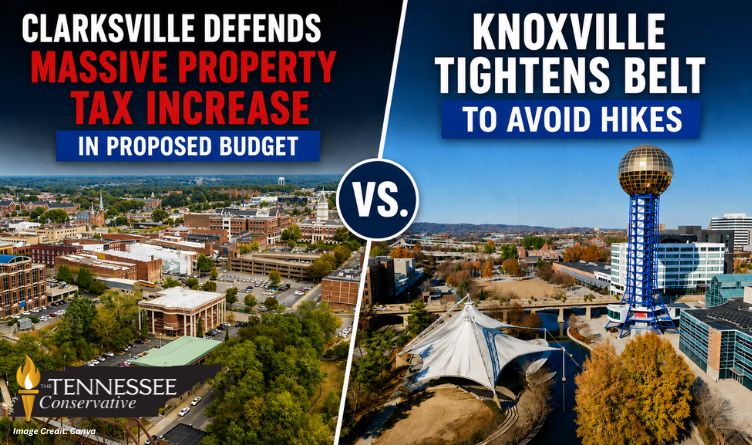
As municipalities across the state are working through their budget proposals for the fiscal year 2026-27, two of the largest are taking vastly different approaches in securing financial stability for their cities with one defending a roughly 34% increase in property taxes while the other will secure competitive pay for first responders and prioritize affordable housing without hiking taxes.
The City of Clarksville, Tennessee’s 5th largest city at around 195,000 people, is considering a proposed budget by Democrat Mayor Joe Pitts which not only includes a 33.7% property tax increase after a 4-cent increase last budget cycle, but also seeks to pull back a portion of the sales tax shared with the local schools.
In his letter to the City Council, Pitts claimed growth, inflation, and the “critical need to support city government operations” as contributing factors to the increase. The proposal contains potential allocations for starting pay raises for firefighters and police officers and an overall 3% wage increase for all city employees.
The mayor has also proposed clawing back some of the extra sales tax revenue that has previously gone to the local school system to offset the cost of some services, including crossing guards, installation of sidewalks, and other infrastructure improvements.
Now, city officials are doubling down on the need for the significant property tax increase, claiming it is needed to produce a “structurally sound budget.”
“As the city is focusing on a maintaining a budget with no property tax (rate) increase, we have lost sight that the budget is structurally sound. For example, in effort to balance the budget for the last two fiscal years, we have not funded the self-insurance fund. This has not presented an issue, as we have not had any significant settlements. … However, this is not sustainable,” Clarksville Deputy CFO Regina Hampton told the City Council during a work session on Tuesday.
She stated that if the tax rate remains at the current $0.92 for the next fiscal year instead of increasing to the proposed $1.23, the city would have to remove $21 million from operating expenditures, including a reduction of $7 million from the budget for all new vehicles requested and asking departments like Fire Rescue and Police to reduce their budgets by $1-1.5 million.
Hampton also said the $42.5 million bond anticipation note the City Council approved earlier this month must be supported by the $1.23 tax rate as it is projected to fund several city projects including a new Building and Codes facility, renovations to public golf courses, several sidewalks and crosswalks, and continued roadwork.
Meanwhile, Knoxville, also led by a Democrat mayor, sits as Tennessee’s 3rd largest city with approximately 202,000 residents. But despite a population of about 7,700 more people, Mayor Indya Kincannon’s $499 million budget, which was approved by the City Council on Tuesday, does not call for any tax increases.
The budget is anticipated to cover key services but will not leave much room for “baubles and frills”. According to the mayor’s office, the budget is “lean” due to slowing revenues coupled with rising operational expenses and inflation.
A top priority in the budget is competitive pay for first responders, and it directs $102.1 million to salaries and benefits for police and firefighters. Five uniformed Police Department positions will be added, with about $1 out of every $5 in the city’s general budget going to cover police and fire salaries and benefits.
Other key budget lines include:
- $8 million for affordable housing & reducing homelessness
- $2.7 for a fire station renovation and other department improvements
- $1.4 million for zoo projects
- $500,000 contribution towards a Habitat for Humanity community
- An additional $200,000 for warming shelters, making the total budget expenditure $500,000 for warming centers
But perhaps most notably, the city’s property tax rate remains unchanged, holding at $2.1556 per $100 of assessed value, the lowest tax rate since 1974.
With cost of living and staggering property tax increases becoming a central issue for many Tennesseans, these two remarkably different budget approaches will likely produce two vastly different citizen responses, especially as Pitts is not running for reelection. Continued budget woes could potentially turn Clarksville voters away from more liberal candidates and toward a contender who emerges as fiscally conscious and works to build a stable budgetary future without consistently reaching into taxpayer pockets.


About the Author: Olivia Lupia is a political refugee from Colorado who now calls Tennessee home. A proud follower of Christ, she views all political happenings through a Biblical lens and aims to utilize her knowledge and experience to educate and equip others. Olivia is an outspoken conservative who has run for local office, managed campaigns, and been highly involved with state & local GOPs, state legislatures, and other grassroots organizations and movements. Olivia can be reached at olivia@tennesseeconservativenews.com.

3 Responses
Yup, different philosophies.
Excellent article. Thank you.
Notice the difference in the Property Tax Rates >
Clarksville = $1.23
Knoxville = $2.1556
Knoxville is 75% higher.
I have to say great job not raising taxes!! Y’all lucky with another 7,700 tax payers that helps.
Let me see if I’m understanding this right,
$8 million for affordable housing & reducing homelessness and
An additional $200,000 for warming shelters, making the total budget expenditure $500,000 for warming centers.
Why would ya need to increase monies for warming centers if y’all are decreasing homelessness?
This doesn’t make a lick of sense to me!
This isn’t the way to reduce homelessness throwing money at the problem, this is how it got started.
Have a great weekend