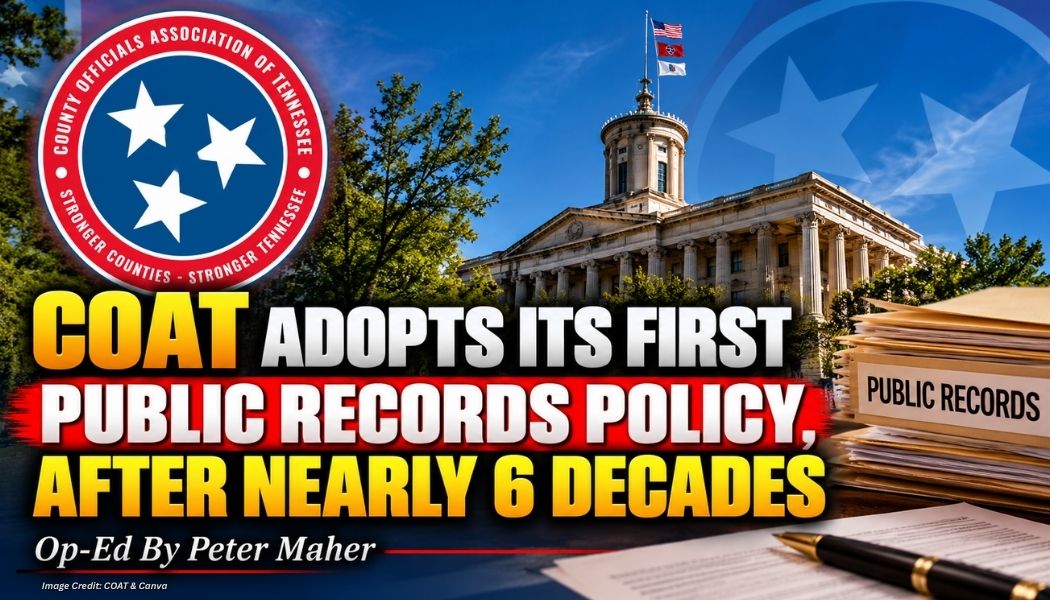
Image Credit: COAT & Canva.
Note from The Tennessee Conservative: Editorial statements in this column are the sole opinion of the author; they do not necessarily reflect the opinions of the staff of this publication.
Submitted by Peter Maher –
For the first time since its founding in 1968, the County Officials Association of Tennessee (COAT) has adopted and publicly posted a Tennessee Public Records Act (TPRA) policy, request form, and public comment procedure.
This milestone comes nearly six decades after COAT first began serving as an advocate and resource for four of the most essential offices in county government: our County Clerks, State Court Clerks, Registers of Deeds, and County Trustees.
And it happened because one Memphian finally asked.

On May 20, I emailed a polite request seeking COAT’s public records policy pursuant to Tenn. Code Ann. § 10‑7‑503. Like many Tennesseans, I assumed that any taxpayer‑funded association representing elected officials who safeguard property deeds, court filings, tax collections, and vital public documents would already maintain a clear and accessible transparency policy. But COAT’s website contained no posted policy, no request form, and no identification of a Public Records Request Coordinator.
Within days, Executive Director Ben Rodgers responded with candor that is increasingly rare in Tennessee’s statewide taxpayer funded association landscape. He acknowledged that COAT had never adopted a public records policy. But instead of using that ambiguity as a shield, COAT chose transparency and accountability.
Rodgers committed to working with the COAT Board to adopt a policy. He identified himself as the future Public Records Request Coordinator and pledged to comply with Tennesseans’ records requests in the interim. This was not a defensive posture. It was leadership.

In June, I emailed a respectful follow‑up request seeking records reflecting COAT’s lobbying activities, including communications with members of the Tennessee General Assembly. Many statewide taxpayer‑funded associations have resisted similar requests—most even now resorting to litigation and, for apparently the first time in Tennessee history, filing reverse‑records lawsuits against a Tennessean who lawfully requested similar public information. COAT did the opposite. Rodgers produced the records.
He provided “talking points” sent to legislators, agendas, reports, registration materials, and additional documents from 2024 through 2026. He explained that COAT does not record in‑person meetings with legislators and that most conversations occur informally in hallways. This level of candor and cooperation is both a start and uncommon among statewide taxpayer‑funded associations, particularly those engaged in legislative advocacy.
And then COAT completed the work.
On September 22, Rodgers informed me that COAT had officially posted its public records policy, request form, and public comment procedure on its public website (link below). For the first time in nearly 60 years, COAT now provides a clear, accessible pathway for all Tennesseans to request records, participate, and understand how the association serves the public.
This is not a small achievement. It is a rare step toward transparency in a statewide environment where many associations—most funded by struggling taxpayers, most governed by elected and appointed officials, many with multiple paid registered lobbyists, many participating in TCRS—continue to operate without public records policies, without request or civic participation policies, and without the basic accountability that all Tennesseans deserve.

COAT’s decision reflects the values of the officials it represents. County Clerks, State Court Clerks, Registers of Deeds, and County Trustees are the custodians of Tennessee’s public records. They maintain the fundamental documents that make local government accountable, accessible, and functional. Their association’s willingness to adopt a public records and public comment policy aligns directly with the principles of openness that is intended to define their daily work.
I want to thank COAT—and the county officials who guide it—for taking this important step. It demonstrates the kind of leadership Tennesseans expect from those entrusted with local governance. It strengthens public trust. It aligns COAT with common‑sense best practices. And it shows that transparency is not merely a statutory obligation, but a public service. Now, let’s hope this leadership shown within their statewide association is carried back home by our County Clerks, State Court Clerks, Registers of Deeds, and County Trustees to every corner of our great state —across all three Grand Divisions and into each of our 95 counties.

References:
County Officials Association of Tennessee Public Records Policy, Request Form, and Public Comment Policy.
Public Records – County Officials Association of Tennessee (COAT)



One Response
Good, thanx. Sadly the likes of Executive Director Ben Rodgers are the minority.