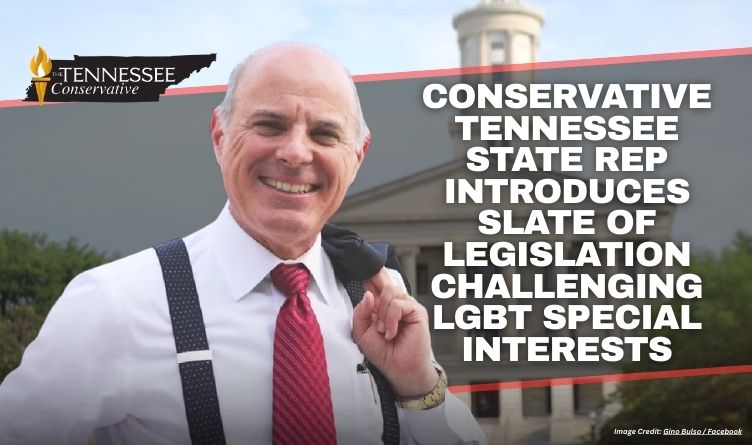
Image Credit: Gino Bulso / Facebook
The Tennessee Conservative [By Olivia Lupia] –
Representative Gino Bulso (R-Brentwood-District 61) has filed a series of bills for the upcoming legislative session all focused on LGBT issues including challenging U.S. Supreme Court rulings regarding sexual orientation as a protected class and same-sex marriages and banning Pride flags on state property.
The first bill, HB1472, seeks to exclude sexual orientation, gender identity, and abortion-related acts from the definition of sex-based discrimination. It further says that sex discrimination laws cannot prohibit the creation or enforcement of sex-segregated spaces such as restrooms, locker rooms, shower facilities, changing areas, dormitories, or sports teams.
Titled the “Banning Bostock Act”, HB1472 would stand as a challenge to the U.S. Supreme Court’s 2020 ruling in Bostock v. Clayton County, Georgia, where the Court decided the above categories were to be included in sex discrimination protections.

Next, HB1473, states that private citizens and organizations would not be bound by the U.S. Supreme Court’s interpretation of the Fourteenth Amendment as dictated in Obergefell v. Hodge and therefore are not “required to recognize a marriage or a purported marriage between individuals of the same sex.”
It would also prohibit the Tennessee Judiciary board from disciplining, sanctioning, or threatening to discipline or sanction any person for “declining to celebrate or officiate at a marriage or commitment ceremony” that falls outside the state’s definition of marriage, which explicitly classifies the institution as between one man and one woman.
Finally, HB1474 is titled the “No Pride Flag or Month Act” and would mandate that “an LGBTQ flag or emblem must not be displayed or maintained on property owned by this state or a political subdivision of this state, or on a building or the grounds of any such building, by any employee, volunteer, or agent of this state or a political subdivision of this state.”
The bill defines an LGBTQ flag or emblem to as one “intended to display support for lesbianism, homosexuality, bisexuality, transgenderism, gender non-conforming behavior, or individuals who engage in such conduct”, the rainbow, transgender, and equality flags, and any other “object, image or representation that uses the word ‘pride’ in a manner intended to convey support for lesbianism, homosexuality, bisexuality, transgenderism, gender non-conforming behavior, or individuals who engage in such conduct.”
Additionally, the state or any political subdivision of the state would be prohibited from taking “any action that recognizes or acknowledges the month of June or another period of time as an LGBTQ pride period”. The mandate would apply to an employee, volunteer or agent of the state or political subdivision of the state who is working in their official capacity.

While Bulso’s HB1474 is far more extensive, this is not the first time the subject of banning Pride flags has been discussed in the General Assembly.
In 2024, Bulso and Sen. Joey Hensley proposed a bill specifically banning public schools from displaying any other flags than the U.S. and Tennessee flags, with extremely limited exceptions. The Pride flag was included in the list of “ideological flags” that would not have been allowed to be displayed, which Democrats argued would be an attack on the LGBT community.
The bill ultimately passed the House, but faced pushback from Democrats and Republicans in the Senate. Three Republican Senators on the Senate Education Committee voted against the bill, causing it to barely squeak out of the committee with a one-vote margin. On the Senate floor, Lt. Governor Randy McNally joined Democrats in voting against the bill, and three Republicans chose not to cast a vote, ultimately causing the bill to fail.
Unsurprisingly, Bulso’s newest slate of proposed legislation has drawn the ire of the LGBT community and its advocates. “There are bad old ideas coming back and new bad ideas we haven’t seen before,” said Tom Lee, legislative counsel to the Tennessee Pride Chamber.
Dahron Johnson, co-chair of the Tennessee Equality Project, expressed concern that even if the bills do not pass, the legislative discussion can be used to “justify hate” against the LGBT community.
“It’s used to justify the policy and then vilify, monstrify, ‘other’, and push whole populations, whole communities, of folks out of the public square. We can’t not be concerned about that,” she said.
While many of the ideas presented in Bulso’s lineup are not new to the Representative as he has tried to pass similar iterations of some of these concepts in previous sessions, they might find more success this year as a slew of the Assembly seats are up for reelection in 2026 and constituents may be more closely monitoring voting records and legislative actions while making decisions on how to cast their ballots.


About the Author: Olivia Lupia is a political refugee from Colorado who now calls Tennessee home. A proud follower of Christ, she views all political happenings through a Biblical lens and aims to utilize her knowledge and experience to educate and equip others. Olivia is an outspoken conservative who has run for local office, managed campaigns, and been highly involved with state & local GOPs, state legislatures, and other grassroots organizations and movements. Olivia can be reached at olivia@tennesseeconservativenews.com.

One Response
We are SICK of the perverted lgbt crap being forced upon us. May God bless and help those standing against it.