
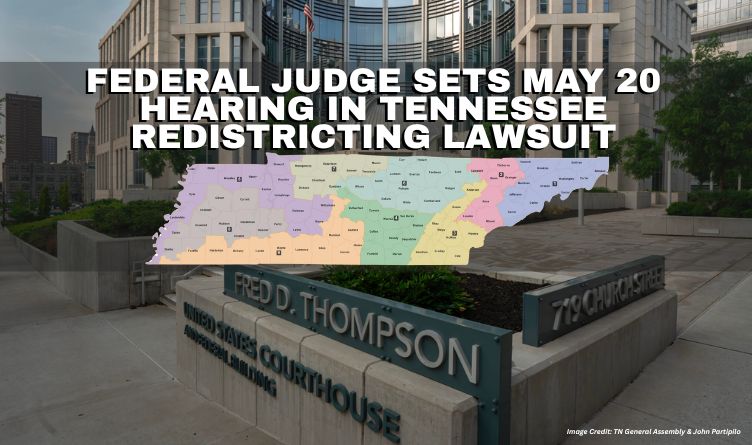
Challengers say decision on temporary restraining order needed by new May 15 election qualifying deadline.
Image Credit: TN General Assembly & John Partipilo
***Note from The Tennessee Conservative – this article posted here for informational purposes only. Per The Tennessee Lookout’s Republishing Guidelines, this article has been edited for writing style & length.***
By Sam Stockard [Tennessee Lookout -CC BY-NC-ND 4.0] –
A federal court hearing is set for May 20 to determine whether a temporary restraining order should be placed on Tennessee’s new congressional district maps, five days later than the new deadline lawmakers scheduled for candidates to qualify for the ballot.
Democrats challenging the new map filed a request late Monday for a ruling by Friday, contending that a longer wait “risks voter confusion, and potentially compromises the integrity of our state’s elections,” the Tennessee Supreme Court warned about in a separate case in 2022.
The filing also says a ruling for the candidate qualifying deadline will enable candidates who are plaintiffs in the case to “avoid being coerced” into campaigning in newly-drawn districts while they are trying to stop the map from taking effect. The plaintiffs requested a hearing be held this Thursday, a day before the new candidate qualifying deadline.
The state countered Tuesday by saying the new map is the “status quo” and that election preparation started before the plaintiffs filed their lawsuit, with the legislature providing more than $3.1 million for county election commissions to make changes in response to the new map and extended qualify deadline.
“Plaintiffs’ request for a temporary injunction would interrupt those preparations at the risk of creating the very sort of confusion and errors that election officials could otherwise avoid if their work was not put on pause. Nor would any such pause be justified,” a filing by the attorney general’s office says.
The Tennessee legislature redrew the maps last week, splitting a majority-Black district in Memphis, in a special session to support President Donald Trump in the midterm election. The move is designed to give Republicans a 9-0 sweep of Tennessee’s congressional seats by diluting Memphis’ vote by separating the city into three districts containing rural red counties and Williamson and Maury counties in Middle Tennessee.

U.S. District Court Judge William Campbell, a Trump appointee, scheduled the May 20 hearing and encouraged attorneys for the state attorney general, including three lawyers with Consovoy McCarthy in Arlington, Virginia, to work out agreements on procedural issues. The state is likely to argue that a three-judge panel is required to hear the case, which must be expedited because preparation for the election has been under way since the March 10 qualifying deadline.
Following a chaotic special session ordered by Gov. Bill Lee at Trump’s request, the Tennessee Democratic Party, four Democratic congressional candidates and four voters filed the federal challenge to Republican efforts to alter congressional maps in the midst of a 10-year apportionment cycle. The legislature changed a state law prohibiting such revisions and redrew the maps, splitting Shelby County into three districts, a move Republicans claim is legal following the U.S. Supreme Court decision that altered a key provision in the 1965 Voting Rights Act.
Lawmakers also extended the candidate qualifying date to May 15, a critical date in the election process when absentee ballots are also to be sent overseas to U.S troops.
The NAACP Tennessee State Conference filed a separate lawsuit in Davidson County Chancery Court to stop the map from taking effect.
Plaintiffs in the federal case filed an amended motion to their initial challenge and additional statements contending that the new act violates constitutional rights and jeopardizes the election process.
“These are extraordinary circumstances,” David Garrison, an attorney for the plaintiffs, said during a Monday phone conference with the judge. He said that a temporary restraining order should be issued by this Friday to maintain the “status quo” or risk violating people’s constitutional rights.
Garrison said the state argued in a 2022 legal challenge that changing district maps late in the election process would cause “irreparable harm” and disenfranchise voters. That took place before the qualifying deadline four years ago in a challenge of the state’s district map, which failed to abide by a constitutional requirement that multiple Senate seats in Davidson County be consecutively numbered.
Taylor Meehan, with Consovoy McCarthy, said the defendants need time to respond in writing to the plaintiffs’ arguments, mainly to explain “how the 2022 circumstances can be conflated with the present circumstances.”


One Response
Lucifer’s accursed dimmercraps, criminals, idiots or both. They haven’t a clue that they haven’t a clue.